Marketing Business Intelligence: Data into Action
Most marketing teams are drowning in data but starving for direction. You have dashboards tracking hundreds of metrics, analytics platforms monitoring every click, and CRM systems bulging with customer records. Yet when it's time to decide which competitor to challenge, which segment to enter, or which message will win, you're still guessing. Marketing business intelligence exists to end that paralysis by transforming scattered signals into structured decisions.
The difference between data and intelligence is action. Data tells you what happened. Intelligence tells you what to do next. That gap is where most marketing efforts fall apart, and where marketing business intelligence becomes the bridge between knowing and doing.
What Marketing Business Intelligence Actually Means
Marketing business intelligence is the systematic collection, analysis, and application of data from your market, customers, and competitors to make strategic decisions. It's not just analytics, which tracks internal performance. It's not just market research, which asks customers what they want. It's the operational discipline of turning external signals into competitive moves.
The term gets muddled with adjacent concepts, so clarity matters here. Business intelligence in marketing focuses on data tools and performance measurement. Marketing intelligence is broader, encompassing competitor behavior, industry dynamics, and customer landscape shifts. The overlap is real, but the distinction is useful: one optimizes what you're already doing, the other decides what you should be doing instead.
The Components That Matter
External data sources:
- Competitor pricing, messaging, and product moves
- Customer behavior patterns across channels
- Market trends and regulatory shifts
- Distribution and partnership changes
Internal performance metrics:
- Campaign effectiveness by segment and channel
- Customer acquisition cost and lifetime value
- Conversion rates at each funnel stage
- Retention and churn signals
Analytical frameworks:
- SWOT for positioning clarity
- PESTEL for macro environment scanning
- Porter's Five Forces for industry structure
- Ansoff Matrix for growth path selection
What separates good marketing business intelligence from expensive busywork is velocity. Marketing doesn’t have a data problem, it has an action problem. The team that spots a competitor's pricing shift and adjusts messaging in 48 hours beats the team that conducts a three-month study to confirm what already happened.

Why Traditional Approaches Fail
The classic marketing intelligence model looks like this: hire analysts, build dashboards, schedule quarterly reviews, debate findings in conference rooms, produce PowerPoint decks, file them in shared drives, repeat. Six months later, the market has moved and the intelligence is historical fiction.
This model fails for three reasons.
Speed mismatch: By the time analysis reaches decision-makers, the opportunity has closed or the threat has landed. Competitors don't wait for your quarterly review cycle.
Insight burial: The most valuable intelligence gets buried in slide 47 of a 60-page deck. Decision-makers see summaries that smooth away the sharp edges, the uncomfortable truths that demand bold moves.
Translation gap: Analysts understand the data. Executives understand strategy. The handoff between them loses fidelity. What should be "Competitor X just undercut us on enterprise deals by 30% and is targeting our top accounts" becomes "competitive pricing pressure observed in Q3."
The companies that win with marketing business intelligence compress that cycle. They automate data collection, apply frameworks consistently, and surface threats and opportunities in real-time. Marketing analytics has evolved from retrospective reporting to predictive modeling, but most organizations still treat it as a backward-looking compliance exercise rather than a forward-looking weapon.
The Intelligence-to-Strategy Problem
Even when intelligence is timely and clear, most teams struggle to convert it into strategic action. You know your competitor launched a new feature. You know customer sentiment is shifting toward sustainability messaging. You know a regulatory change is coming in 2027. Now what?
This is where competitive intelligence frameworks become operational assets rather than academic exercises. A SWOT analysis isn't a box to check in a business plan. It's a decision tool that converts awareness of strengths, weaknesses, opportunities, and threats into specific defensive or offensive moves.
| Intelligence Type | Question It Answers | Strategic Output |
|---|---|---|
| Competitive | Who's moving where? | Attack or defend decisions |
| Customer | What's changing in behavior? | Segment targeting priorities |
| Market | What forces are shifting? | Timing and positioning choices |
| Performance | What's working internally? | Resource allocation adjustments |
Marketing business intelligence becomes strategic when it feeds directly into doctrine selection. If competitor analysis reveals a rival attacking your core segment with price cuts, that's not just data. It's a signal to deploy defensive strategies that protect market position while you prepare a counterattack.
Building an Intelligence System That Delivers
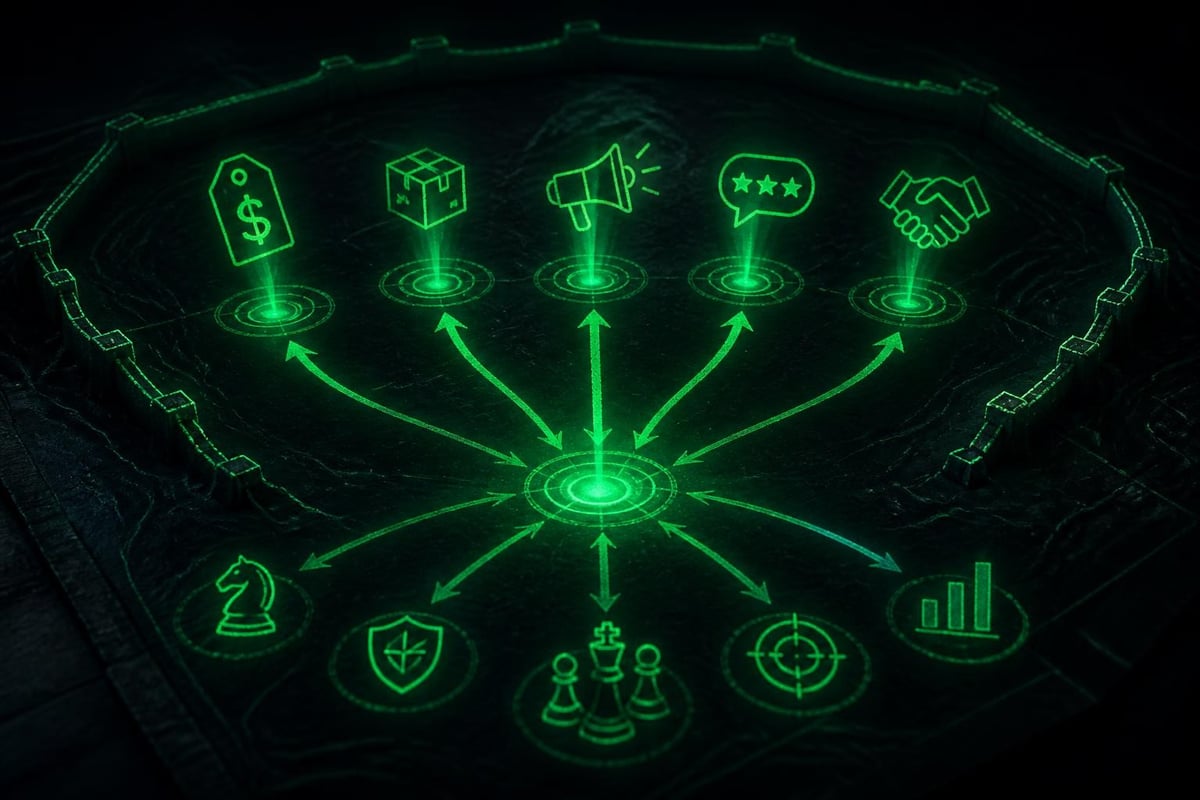
An effective marketing business intelligence system requires three layers: collection, analysis, and application. Most organizations have the first, ignore the second, and never reach the third.
Collection: Structured Signal Gathering
Competitor monitoring:
- Product and feature releases
- Pricing and packaging changes
- Marketing campaigns and messaging shifts
- Leadership moves and funding announcements
- Customer reviews and complaint patterns
Customer intelligence:
- Behavioral data from owned channels
- Third-party research and surveys
- Support ticket themes and feature requests
- Social listening and sentiment tracking
- Win/loss interview insights
Market scanning:
- Industry reports and analyst coverage
- Regulatory and policy developments
- Technology and platform shifts
- Economic indicators affecting buying behavior
- Partnership and M&A activity
The mistake here is casting too wide a net. More data doesn't equal better intelligence. Focus on signals that inform specific decisions. If you're a B2B SaaS company, your competitor's Super Bowl ad doesn't matter. Their enterprise pricing tiers do.
Analysis: Framework Application
Raw signals need structure. This is where proven analytical frameworks separate useful intelligence from noise. Understanding marketing intelligence means knowing which framework to apply to which question.
PESTEL analysis scans Political, Economic, Social, Technological, Environmental, and Legal factors that shape your operating environment. Use it when macro forces are shifting, like regulatory changes or economic downturns. It answers: what external forces are about to reshape our market?
Porter's Five Forces examines industry structure: competitive rivalry, supplier power, buyer power, threat of substitutes, and barriers to entry. Apply it when industry dynamics are unclear or when considering market entry. It answers: where is power concentrated, and how can we accumulate it?
SWOT analysis maps Strengths, Weaknesses, Opportunities, and Threats relative to competitors. Turning SWOT awareness into advantage requires honest assessment of where you actually stand, not where you wish you stood. It answers: given our position and the landscape, what should we defend and what should we attack?
Ansoff Matrix plots growth strategies across existing/new products and markets. Choosing the right growth opportunity prevents the classic mistake of pursuing expansion in all directions simultaneously. It answers: which growth path has the highest probability of success given our capabilities?
None of these frameworks are decoration. Each converts intelligence into strategic clarity by forcing structured thinking about competitive position and market dynamics.
Application: Intelligence to Execution
The final layer is where marketing business intelligence proves its worth. Analysis that doesn't change behavior is waste. The output must be a decision or a plan, not another report.
For teams managing multiple brands or clients, competitive intelligence at scale solves the repetition problem. Running the same discovery and analysis process for each brand manually is how intelligence becomes stale before it's useful. Multi-Brand Competitive Intelligence runs BrandScout's full discovery-to-strategy workflow across multiple separate competitive landscapes from one account, converting scattered market signals into structured intelligence that enables strategic decisions across portfolios.
Decision triggers:
- When competitor analysis reveals a direct attack on your position, activate defensive doctrine
- When customer intelligence shows an underserved segment, evaluate market development opportunities
- When market scanning identifies a regulatory shift, adjust positioning before competitors react
- When performance data shows campaign fatigue, redirect resources to higher-performing channels
Execution formats:
- 90-day action plans with specific tactics, owners, and metrics
- Battlecards for sales teams with competitive talking points and objection handling
- Messaging frameworks based on competitor positioning gaps
- Resource allocation models shifting budget toward validated opportunities
Marketing business intelligence that ends in a deck on someone's desktop failed. Intelligence that ends in a campaign launched, a feature shipped, or a competitor countered succeeded.
The Competitive Intelligence Advantage
The strategic value of marketing business intelligence compounds when integrated with competitive doctrine. Knowing that a competitor is targeting your customers matters. Knowing which of the fourteen doctrines, eight defensive and six offensive, applies to your situation determines your response.
Defensive doctrines protect position:
- Position fortification when core market share is under attack
- Flanking defense to cover weak segments before competitors exploit them
- Preemptive strikes to neutralize threats before they materialize
- Counteroffensives to blunt competitor momentum
- Mobile defense through continuous innovation
- Strategic withdrawal from indefensible positions
- Contraction defense to concentrate strength
- Signaling to deter challenger aggression
Offensive doctrines seize initiative:
- Frontal assault on established competitors in their core
- Flanking maneuvers targeting underserved segments
- Encirclement attacking from multiple vectors
- Bypass moves creating new categories or business models
- Guerrilla tactics for resource-constrained challengers
- Strategic cooperation through partnerships or alliances
These aren't metaphors. They're operational frameworks derived from Jorge A. Vasconcellos e Sá's competitive strategy work. When marketing intelligence identifies competitor weaknesses, doctrine tells you whether to attack directly, flank around, or bypass entirely.
The difference between teams that know their competitors and teams that outmaneuver them is doctrine application. Data tells you the landscape. Frameworks organize the data. Doctrine tells you which move to make.
Common Failures and How to Avoid Them
Marketing business intelligence initiatives fail predictably. Here's what kills them and how to prevent it.
Failure Mode 1: Analysis Paralysis
Symptom: Teams collect endless data, run sophisticated models, and produce beautiful visualizations but never make a decision.
Cause: No connection between intelligence gathering and decision authority. Analysts aren't empowered to recommend action, executives don't trust the analysis, so intelligence becomes academic.
Fix: Define decision rights. For each intelligence stream, specify: who owns the decision, what threshold triggers action, and what the action options are. If competitor pricing drops 15%, the CMO shifts promotional strategy within 72 hours. If customer churn spikes in a segment, the product team investigates within a week.
Failure Mode 2: Tool Obsession
Symptom: Organizations spend six figures on marketing intelligence platforms that end up as expensive data warehouses no one uses.
Cause: Belief that the right tool solves the problem without changing process or culture. Tools enable intelligence but don't create it.
Fix: Start with frameworks and manual processes. Prove you can generate actionable intelligence with spreadsheets and weekly meetings. Understanding business intelligence in marketing means recognizing that technology amplifies good process but can't fix bad strategy.
Failure Mode 3: Inside-Out Thinking
Symptom: Intelligence efforts focus exclusively on internal metrics: our campaign performance, our funnel conversion, our customer satisfaction.
Cause: Confusion between business intelligence (internal optimization) and marketing intelligence (external awareness). Marketing intelligence versus business intelligence require different data sources and analytical approaches.
Fix: Force external perspective. Dedicate specific resources to competitor monitoring, market scanning, and customer landscape shifts. Half your intelligence effort should look outward.
| Failure Mode | Symptom | Root Cause | Solution |
|---|---|---|---|
| Analysis Paralysis | Reports without decisions | No decision authority link | Define decision triggers and owners |
| Tool Obsession | Expensive unused platforms | Process avoidance | Prove manual process first |
| Inside-Out Thinking | Only internal metrics | Missing external perspective | Mandate outward-looking intelligence |
Failure Mode 4: One-Time Events
Symptom: Marketing business intelligence happens once a year in a strategic planning offsite, then disappears until the next annual cycle.
Cause: Treating intelligence as a planning input rather than an operational capability.
Fix: Build intelligence rhythms. Weekly competitor scans, monthly market updates, quarterly framework applications. Intelligence is perishable. Last quarter's competitive analysis is already outdated.

Measuring Intelligence Impact
How do you know if your marketing business intelligence efforts are working? Traditional ROI calculation doesn't apply cleanly to intelligence, which prevents negative outcomes as often as it creates positive ones.
Leading indicators:
- Time from signal detection to decision (decreasing)
- Percentage of strategic decisions informed by intelligence (increasing)
- Competitor moves anticipated versus surprised by (ratio improving)
- Number of intelligence insights that trigger action (increasing)
Lagging indicators:
- Win rate in competitive deals (improving)
- Speed of market response to competitive threats (faster)
- Cost of customer acquisition in targeted segments (decreasing)
- Market share in prioritized categories (growing)
The best measure is counterfactual: what would have happened without the intelligence? That requires honest reflection on decisions that avoided failure rather than created success. The competitor you didn't engage because intelligence showed the battle wasn't winnable. The market you didn't enter because scanning revealed structural disadvantages. The customer segment you doubled down on because intelligence confirmed white space.
Value manifestations:
- Campaigns launched faster because competitive positioning was clear
- Features prioritized based on competitor gap analysis
- Pricing adjusted before competitors forced reactive discounting
- Resources redirected from low-probability markets to high-potential segments
Marketing business intelligence justifies itself not through attribution models but through decision quality. Better decisions, made faster, with higher confidence. That's the value.
Building Intelligence Muscle
Marketing business intelligence isn't a project with an end date. It's an operational capability that strengthens with practice. Teams that excel at it develop specific muscles.
Pattern recognition: The ability to spot competitive moves early, often from weak signals others dismiss. That subtle messaging shift in a competitor's homepage. That unexpected hire with specific domain expertise. That partnership announcement that seems tangential but signals strategic direction.
Framework fluency: Knowing which analytical tool applies to which question without deliberation. PESTEL for macro scanning, Porter's for industry dynamics, SWOT for position assessment, Ansoff for growth path selection. Fluency means applying frameworks quickly, not perfectly.
Doctrine decisiveness: Converting analysis into strategic choice without endless deliberation. When intelligence reveals opportunity or threat, selecting the appropriate offensive or defensive doctrine and committing to execution. Hesitation kills advantage.
Execution discipline: Following through on intelligence-driven decisions even when uncomfortable. Pulling resources from comfortable markets to attack white space. Defending aggressively when competitors test boundaries. Making the hard call intelligence recommends rather than the safe call politics prefer.
These muscles develop through repetition. Start with one competitor tracked consistently. Add one framework applied monthly. Build one decision trigger linked to specific intelligence signals. Expand from there.
The organizations that dominate their markets in 2026 aren't necessarily smarter or better resourced than their rivals. They're faster at converting market signals into strategic action. They've built marketing business intelligence into their operating rhythm rather than treating it as a planning exercise.
Intelligence becomes advantage only when it changes what you do. Data without decisions is noise. Analysis without action is busywork. The teams that win understand this and build systems that compress the cycle from signal to strategy to execution.
Marketing business intelligence separates teams that react to market changes from teams that anticipate and exploit them. The difference isn't access to data – everyone has that now. It's the operational discipline to convert signals into structured decisions, apply proven frameworks consistently, and execute before competitors recognize what's happening. Brandscout transforms scattered market signals into strategic intelligence, running competitive analysis frameworks automatically and generating specific offensive and defensive strategies grounded in your actual competitive landscape. If your team is drowning in competitor data but starving for direction, the platform ends that gap.