Market Decision: Intelligence to Action in 2026
A market decision is the moment when scattered intelligence becomes committed action. It's the inflection point where analysis stops and execution begins. Most businesses struggle not because they lack data, but because they can't translate what they know into what they should do. The gap between awareness and action is where competitive advantage dies. In 2026, closing that gap requires more than dashboards and spreadsheets. It demands structured intelligence, proven frameworks, and the discipline to move from insight to implementation without second-guessing yourself into paralysis.
The Anatomy of a Market Decision
Every market decision carries three layers: the trigger, the analysis, and the commitment. The trigger is external – a competitor launches, pricing shifts, customer behavior changes. The analysis is your attempt to make sense of the signal. The commitment is the bet you place based on incomplete information.
Most companies confuse the trigger for the decision itself. A competitor raises funding, so you panic and discount. A feature ships, so you rush yours out half-baked. That's not decision-making; it's reaction. A true market decision requires separating signal from noise, understanding competitive intent, and choosing a strategic response that aligns with your position in the market.
What Separates Reaction from Strategy
Reaction is reflexive. Strategy is deliberate. When a competitor moves, your instinct might be to match them feature-for-feature or undercut on price. That instinct assumes their move was smart and that imitation is your best defense. Often, it's neither.
Strategic thinkers ask different questions:
- What does this move reveal about their constraints?
- What response would they least expect?
- What can we do that they structurally cannot?
A market decision rooted in strategy evaluates not just what happened, but why it happened and what it means for the battlefield ahead. It's the difference between matching a competitor's pricing because they cut first and holding firm because you understand their move signals desperation, not strength.

The Intelligence Layer: What You Need Before You Decide
You can't make a sound market decision without ground truth. That means knowing who your competitors are, what they're doing, and where the market is heading. Most businesses operate on fragments: a pricing page here, a review there, half-remembered conversations from a conference.
Fragmented intelligence produces fragmented decisions. When your picture of the competitive landscape is incomplete, every decision becomes a guess. You overprioritize visible threats and miss rising ones. You misread intent because you're working from outdated assumptions.
Building a reliable intelligence layer means three things:
- Complete competitor identification – not just the obvious players, but adjacent threats, rising challengers, and overlooked substitutes
- Continuous monitoring – markets move faster than quarterly reviews; your intelligence needs to update in real time
- Structured capture – raw signals need to flow into a system where they're categorized, connected, and ready to inform decisions
| Intelligence Gap | Decision Impact | Strategic Cost |
|---|---|---|
| Missing competitors | Blindsided by new entrants | Market share erosion |
| Stale data | Responding to outdated threats | Wasted resources |
| Scattered sources | Inconsistent picture | Paralysis or false confidence |
Platforms like Brandscout solve the intelligence-gathering problem by automating competitor discovery and tracking, so you're working from a complete, current view rather than guessing. When the Competitive Analysis & Strategy product runs proven frameworks – PESTEL, Porter's Five Forces, SWOT, Ansoff – it's operating on structured data, not anecdotes.
The Role of AI in Shortening the Intelligence Cycle
Generative AI changed the speed at which intelligence can be synthesized. What used to take a team of analysts weeks now happens in minutes. That doesn't mean AI makes the market decision for you. It means you can spend less time gathering and more time thinking.
AI surfaces patterns faster than humans can manually. It connects dots across disparate sources. It flags anomalies that might signal a competitor pivoting or a market shifting. But the final call – the market decision – still belongs to you. Recent research on AI-driven KPIs shows that the value isn't in automation alone; it's in how AI shortens the loop between data and strategic insight.
Frameworks: The Bridge Between Intelligence and Action
Frameworks don't make decisions for you. They clarify trade-offs so you can make decisions faster and with more confidence. A good framework exposes what you're betting on, what you're risking, and what you're giving up.
SWOT: Honest Inventory
SWOT – Strengths, Weaknesses, Opportunities, Threats – forces you to separate what you control from what you don't. Most teams treat it as a brainstorming exercise. That's a waste. SWOT is an inventory, not inspiration.
- Strengths and weaknesses are internal. They're the raw materials you have to work with.
- Opportunities and threats are external. They're the conditions of the market you're operating in.
A market decision grounded in SWOT asks: given our strengths and weaknesses, which opportunities can we realistically capture, and which threats can we actually mitigate? The rest is noise.
Porter's Five Forces: Understanding Competitive Pressure
Michael Porter's Five Forces framework maps the structural pressures on profitability in any market. It tells you where power sits and where margin gets squeezed. When you're making a market decision about pricing, positioning, or expansion, understanding these forces prevents you from betting against structural realities.
The five forces:
- Threat of new entrants
- Bargaining power of suppliers
- Bargaining power of buyers
- Threat of substitutes
- Competitive rivalry
If you're deciding whether to compete on price, Porter's forces tell you whether that's a sustainable move or a race to the bottom. If buyers have high bargaining power and substitutes are plentiful, cutting price just accelerates margin compression. A smarter market decision might be differentiation or vertical integration. Porter’s Five Forces clarifies the rules of competition before you commit resources.
Ansoff Matrix: Choosing the Growth Path
The Ansoff Matrix offers four growth strategies: market penetration, market development, product development, and diversification. Each carries different risk and resource requirements. A market decision about where to grow next should explicitly evaluate which quadrant you're playing in.
- Market penetration (existing product, existing market) is lowest risk but limited upside.
- Diversification (new product, new market) is highest risk but opens new revenue streams.
Most companies pick growth strategies based on instinct or imitation. Ansoff forces you to name the bet you're making and resource it appropriately.
The 14 Doctrines: Strategic Responses to Competitive Threats
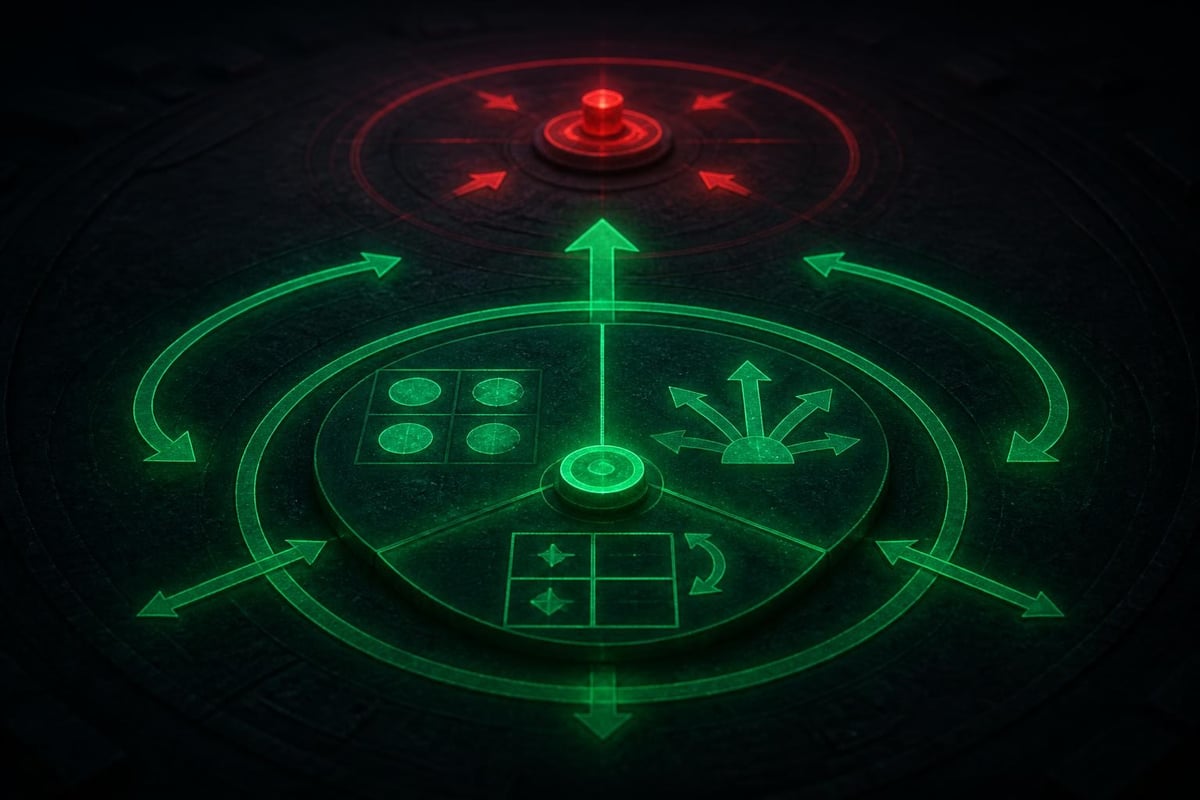
Jorge A. Vasconcellos e Sá's competitive strategy framework offers 14 doctrines – 8 defensive, 6 offensive. These aren't invented tactics or borrowed metaphors. They're a fixed set of strategic responses grounded in competitive positioning. When you're making a market decision in response to a competitive threat, these doctrines clarify your options.
Defensive Doctrines
Defensive strategies protect position. They're appropriate when you're an incumbent under pressure or when a challenger is testing your boundaries.
- Position defense – fortify your core market
- Flanking defense – protect secondary markets
- Preemptive defense – strike before the threat materializes
- Counteroffensive defense – respond with precision to neutralize an attack
- Mobile defense – shift resources to stay ahead of changing conditions
- Contraction defense – consolidate around defensible positions
- Retreat – cede ground strategically to control timing and preserve resources
- Guerrilla defense – small, targeted moves that disrupt without full-scale engagement
Offensive Doctrines
Offensive strategies are for challengers and market entrants. They're appropriate when you're trying to take ground, not hold it.
- Frontal attack – direct, head-to-head competition
- Flanking attack – target underserved segments or geographies
- Encirclement – surround the competitor with multiple offerings
- Bypass attack – create a new category or leapfrog with innovation
- Guerrilla attack – unpredictable, resource-efficient strikes
- Alliance attack – partner to create combined strength
These doctrines don't predict the future. They clarify the logic behind a market decision. If you're choosing to hold the high ground, you're betting on brand equity and customer loyalty. If you're launching a flanking attack, you're betting the incumbent can't or won't follow you into a niche.
The Behavioral Layer: Why Smart People Make Bad Market Decisions
Even with perfect intelligence and clear frameworks, humans make irrational choices. Behavioral economics shows that bounded rationality – our tendency to simplify complex decisions – shapes how we process competitive information. We anchor on the first data point we see. We overweight recent events. We confuse confidence with competence.
A common trap: the availability heuristic. If a competitor just launched a high-profile feature, you overestimate its impact because it's top of mind. You rush a response, burning resources on something that doesn't actually move your position. A disciplined market decision separates signal from recency bias.
The Danger of Data Without Context
Harvard Business Review's coverage on pitfalls in data-driven decision-making highlights a critical risk: companies drown in metrics but starve for meaning. Tracking 47 KPIs doesn't make you smarter; it makes you slower. Every market decision should tie back to a small set of leading indicators that actually predict competitive outcomes.
Ask: what would change this decision? If the answer is "nothing," you're not using data to decide; you're using it to justify a choice you already made. That's confirmation bias dressed up as analysis.
Execution: The Market Decision After the Market Decision
A market decision isn't complete when you choose a strategy. It's complete when you execute it. Most strategies fail not because the analysis was wrong, but because execution was inconsistent, under-resourced, or abandoned halfway through.
Building the 90-Day Plan
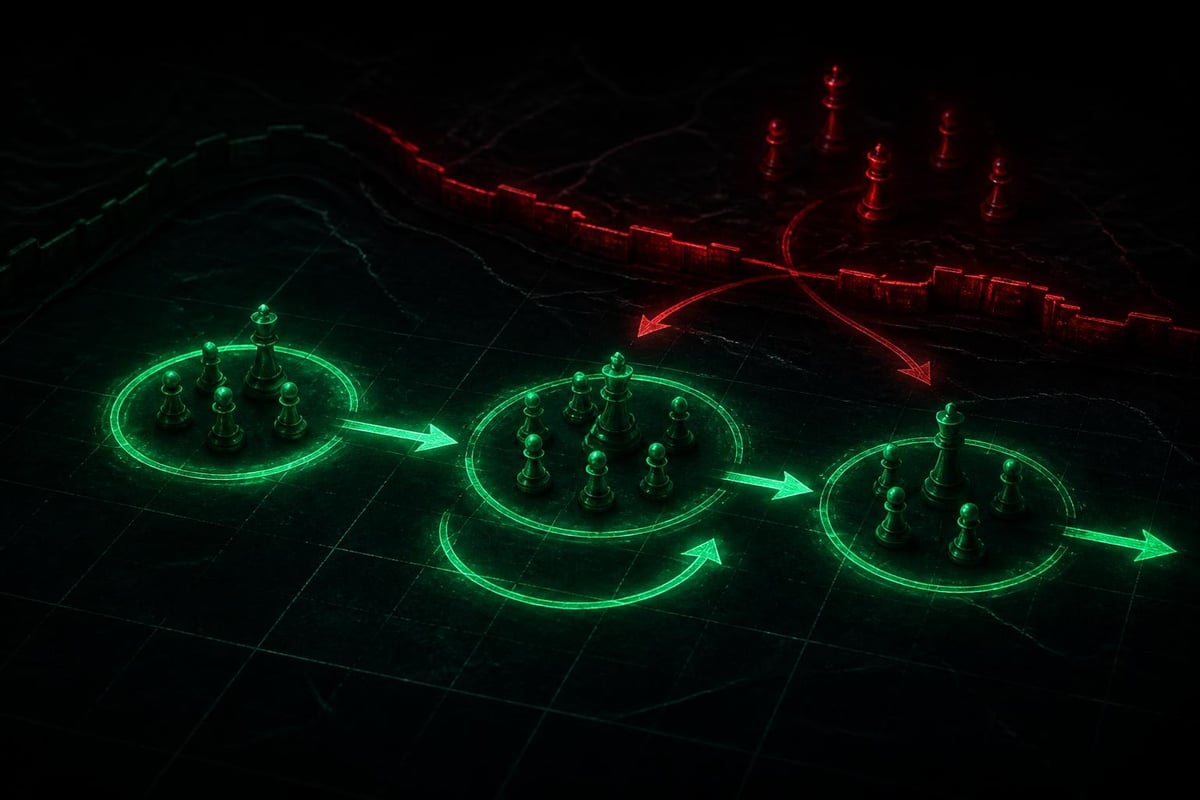
A 90-day execution window is long enough to see results but short enough to maintain focus. Every market decision should decompose into:
- Week 1-4: Set conditions – align teams, allocate budget, establish metrics
- Week 5-8: First contact – launch, test, iterate based on early signals
- Week 9-12: Assess and adjust – measure against objectives, decide to double down or pivot
This cadence prevents two failure modes: moving too fast (launching before you're ready) and moving too slow (overthinking until the window closes).
Measuring What Matters
You need a tight feedback loop between your market decision and market reality. That means tracking metrics that reveal whether your chosen strategy is working.
| Strategy Type | Leading Indicator | Lagging Indicator |
|---|---|---|
| Market penetration | Customer acquisition cost (CAC) trend | Market share growth |
| Differentiation | Win rate vs. named competitor | Price premium sustained |
| Flanking | Segment adoption rate | Revenue from new segment |
| Preemptive | Competitor response time | Retained customer base |
If the leading indicators move in the wrong direction early, you have time to adjust. If you wait for lagging indicators, you've already lost the quarter.
When to Revisit a Market Decision
Markets evolve. Competitors adapt. A decision that was sound six months ago might be obsolete today. The question isn't whether to revisit decisions, but when and under what conditions.
Triggers for revisiting:
- Competitive countermove – they responded in a way you didn't anticipate
- Market shift – customer behavior, regulation, or technology changed the playing field
- Internal constraint – you can't resource the strategy as planned
Revisiting doesn't mean abandoning. It means updating your assumptions and recalculating. Sometimes the right call is to double down. Sometimes it's to pivot. The discipline is in evaluating without ego.
The Cost of Indecision
Indecision is a decision. When you delay a market decision waiting for perfect information, competitors move and conditions shift. The cost isn't just opportunity; it's momentum. Teams lose confidence. Customers sense hesitation. The market fills the vacuum you left.
Speed matters, but recklessness doesn't. The goal is to shorten the time between trigger and commitment without skipping the analysis. Structured intelligence and proven frameworks compress decision cycles because they eliminate the need to reinvent the process every time.
Building a Decision-Making System That Scales
One-off market decisions are tactical. A repeatable decision-making system is strategic. If every competitive move requires starting from scratch – gathering intel, debating frameworks, aligning stakeholders – you'll always be reactive.
A scalable system includes:
- Centralized intelligence – one source of truth for competitive data
- Standard frameworks – SWOT, Porter's, Ansoff applied consistently
- Clear ownership – who decides, who advises, who executes
- Regular cadence – weekly reviews, monthly deep dives, quarterly strategy resets
When intelligence flows into frameworks automatically, and frameworks produce action plans without manual synthesis, you've built a system that turns market signals into market decisions at the speed the market demands. Competitive intelligence platforms that integrate discovery, analysis, and planning solve the repetition problem: instead of rebuilding the process for every decision, you run the same workflow faster and more reliably.
The Role of Cross-Functional Alignment
A market decision made in isolation fails in execution. Sales, product, marketing, and finance need to understand the logic and commit to the plan. That doesn't mean consensus. It means clarity.
Alignment isn't agreement. It's shared understanding of the trade-offs and the bet. If product knows you're prioritizing speed over polish to preempt a competitor, they can resource accordingly. If marketing knows you're flanking into a new segment, they can shift messaging. Misalignment happens when the rationale behind the market decision stays locked in the C-suite.
Intelligence, Frameworks, Execution: The Loop That Compounds
Market decisions improve when you close the loop. Every decision generates data. Every execution reveals whether your assumptions were right. That new intelligence feeds the next decision, making it sharper.
The companies that dominate their markets in 2026 aren't the ones with the most data. They're the ones with the tightest loop between intelligence, analysis, and action. They make market decisions faster, with higher confidence, because they've built systems that learn.
The compounding effect of disciplined decision-making:
- Each decision refines your competitive model
- Each execution tests your understanding of the market
- Each result updates your intelligence and sharpens your frameworks
Over time, you're not just making better market decisions; you're making them faster. Speed and accuracy compound. Your competitors are still gathering intel when you're already three moves ahead.
A market decision is only as good as the intelligence behind it and the discipline to execute it. When you're ready to move from scattered signals to structured strategy, Brandscout gives you the competitive intelligence platform that closes the gap between what you know and what you do. Transform market signals into confident action, every time.