Marketing Intelligence Systems: What They Are & Why They Matter
Marketing intelligence systems separate the companies that react from the companies that anticipate. In 2026, the volume of market signals – customer behavior shifts, competitor moves, pricing changes, regulatory updates – exceeds what any team can process manually. A proper system doesn't just collect this data. It structures it, contextualizes it, and turns it into decisions you can act on today. Without one, you're flying blind in a market where your competitors aren't.
What Marketing Intelligence Systems Actually Do
Marketing intelligence systems aggregate external market data and transform it into actionable insight. They're not analytics platforms that report what already happened inside your business. They're forward-looking engines that process what's happening outside: competitor product launches, shifting customer preferences, regulatory changes, economic indicators, distribution channel dynamics.
The core function is synthesis. Raw data means nothing until it's organized, filtered, and connected to strategic questions. A marketing intelligence system monitors competitors, tracks market trends, identifies opportunities, and flags threats before they become crises.
The Four Core Components
Every effective system contains these elements:
- Data collection infrastructure – automated monitoring of competitor websites, pricing changes, social media activity, review platforms, industry publications, regulatory filings
- Storage and organization layer – structured databases that categorize intelligence by type, relevance, urgency, and strategic impact
- Analysis and interpretation tools – frameworks that turn raw signals into strategic recommendations (SWOT, Porter's Five Forces, PESTEL)
- Distribution and action protocols – clear paths from insight to decision, ensuring intelligence reaches the right people at the right time

Most companies have pieces of this. Few have the full stack working together. The gap between collection and action is where competitive advantage dies.
Why Traditional Market Research Isn't Enough
Market research tells you what customers said last quarter in a controlled setting. Marketing intelligence platforms tell you what competitors are doing right now and what market forces are shifting underneath you.
Research is a snapshot. Intelligence is a live feed.
Traditional methods – surveys, focus groups, annual reports – move too slowly for markets that change weekly. By the time you commission a study, analyze results, and present findings, the competitive landscape has already shifted. Your conclusions are outdated before the deck is finished.
| Traditional Market Research |
Marketing Intelligence Systems |
| Periodic snapshots |
Continuous monitoring |
| Customer-focused only |
Competitors + market forces |
| Retrospective analysis |
Forward-looking signals |
| Manual synthesis |
Automated aggregation |
| Quarterly insights |
Real-time alerts |
Intelligence systems don't replace research. They complement it by filling the gaps between formal studies with continuous market awareness.
What Gets Tracked in a Modern System
Effective marketing intelligence systems monitor multiple signal categories simultaneously. Missing even one creates blind spots that competitors exploit.
Competitor Intelligence
Track product releases, feature updates, pricing changes, marketing campaigns, hiring patterns, funding announcements, partnership deals, customer wins and losses. When a competitor drops prices 15%, you need to know within hours, not weeks.
Monitor their messaging evolution. What problems are they emphasizing? What objections are they addressing? Where are they spending ad dollars? This reveals their strategic priorities and vulnerabilities.
Customer and Market Trends
Watch shifting preferences, emerging needs, complaint patterns, feature requests, adoption behaviors. Social listening tools capture unfiltered customer sentiment that never surfaces in formal feedback channels.
Track search volume changes, content engagement patterns, review site activity. These signals forecast demand shifts before sales data reflects them.
Economic and Regulatory Forces
Monitor industry regulations, compliance requirements, economic indicators, supply chain disruptions, labor market changes. These macro forces reshape competitive advantage faster than product innovation.
A new data privacy law doesn't just create compliance work. It eliminates competitive tactics overnight and opens new positioning opportunities for those who adapt first.
Distribution and Channel Dynamics
Track retail partnerships, distributor relationships, sales channel performance, partnership announcements. Distribution access often matters more than product quality.
When a competitor secures exclusive distribution through a major channel, your product strategy becomes irrelevant if customers can't find you.
How Intelligence Becomes Strategy
Data collection without analysis is hoarding. The value emerges when you apply strategic frameworks to interpret what matters and what's noise.
Strategic position starts with understanding the full competitive landscape. You can't defend market share you don't know you're losing. You can't attack opportunities you haven't identified.
From Signals to Decisions
Modern systems use proven frameworks to structure analysis:
- Environmental scanning – PESTEL analysis identifies political, economic, social, technological, environmental, and legal forces reshaping your market
- Competitive positioning – Porter's Five Forces maps industry structure and power dynamics
- Internal-external analysis – SWOT connects market opportunities to organizational capabilities
- Growth opportunity mapping – Ansoff Matrix evaluates market penetration, development, product innovation, and diversification options
These aren't academic exercises. They're decision filters that turn scattered intelligence into prioritized actions.
When you spot a competitor raising prices while customer complaints about their service spike, that's not random information. It's an opening. The framework tells you whether to attack with aggressive pricing, emphasize service quality, or pursue their dissatisfied customers.

Building a System That Actually Works
Most companies fail at implementation, not theory. They collect data but don't structure it. They analyze occasionally but don't act consistently. The system exists in slides, not operations.
Start With Clear Intelligence Requirements
Define what decisions your team makes repeatedly and what information would improve them. Don't monitor everything. Monitor what changes your actions.
If you're launching in new markets, prioritize competitor entry strategies and local regulatory requirements. If you're defending market share, track competitor pricing, feature releases, and customer defection patterns.
Key questions to answer:
- Who are our direct competitors and what are they doing differently this quarter?
- Which market segments are growing and which are contracting?
- What regulatory changes will impact our product roadmap in the next 12 months?
- Where are competitors investing and what does that signal about their strategy?
Automate Collection, Humanize Analysis
Use tools to aggregate data from competitor websites, social media, review sites, news sources, regulatory databases. Humans shouldn't manually check 50 websites daily.
But automation stops at collection. Strategic interpretation requires human judgment. A price drop might signal financial distress, aggressive expansion, or inventory clearance. Context determines which.
For businesses tracking multiple competitors across categories, Competitor Discovery & Tracking surfaces the full landscape automatically, including emerging players traditional monitoring misses, then keeps that view current as new intelligence arrives.
Create Action Protocols
Intelligence that doesn't trigger action is entertainment. Define clear thresholds and response protocols.
When a competitor launches a feature that addresses your key differentiator, who gets notified? What's the decision timeline? Who owns the response?
When customer sentiment shifts negative toward a category leader, what's the opportunity assessment process? How quickly can you adjust messaging or launch a targeted campaign?
Common System Failures and How to Avoid Them
Most marketing intelligence systems fail predictably. Understanding the patterns helps you design around them.
Failure Mode 1: Collection Without Curation
Teams drown in data because they track everything instead of filtering for strategic relevance. They monitor 100 data sources and can't identify the five signals that actually matter.
The fix: Define strategic questions first, then collect only the data that answers them. Your system should have more filters than feeds.
Failure Mode 2: Analysis Without Action
Intelligence reports get circulated, discussed, and filed. No decisions change. No tactics adjust. Analysis becomes a ritual divorced from operations.
The fix: Connect every intelligence finding to a specific decision or action item. If the insight doesn't change what you do, stop tracking it.
Failure Mode 3: Fragmented Ownership
Marketing tracks competitors. Product tracks features. Sales tracks pricing. No one synthesizes the full picture. Each team has partial intelligence that leads to conflicting interpretations.
The fix: Centralize collection and primary analysis. Distribute specific intelligence to relevant teams, but maintain a single source of truth for the competitive landscape.
| System Failure |
Symptom |
Root Cause |
Solution |
| Collection Without Curation |
Data overload, paralysis |
No filtering criteria |
Define strategic questions first |
| Analysis Without Action |
Reports filed, no changes |
Disconnect from operations |
Link insights to specific decisions |
| Fragmented Ownership |
Conflicting interpretations |
Siloed intelligence |
Centralize analysis, distribute findings |
| Outdated Intelligence |
Reactive positioning |
Manual update processes |
Automate monitoring and alerts |
Failure Mode 4: Outdated Intelligence
The system relies on quarterly manual updates. By the time intelligence is reviewed, competitors have already moved. You're fighting last quarter's battle.
The fix: Automate continuous monitoring with real-time alerts for critical changes. Strategy reviews can be periodic. Threat detection must be constant.
Integration With Existing Marketing Operations
Marketing intelligence systems don't sit apart from your existing stack. They feed into campaign planning, content strategy, product positioning, pricing decisions, and channel selection.
When marketing decisions incorporate live competitive intelligence instead of assumptions, win rates improve. Your positioning addresses current market gaps, not outdated perceptions.
Campaign Planning
Intelligence reveals which messages resonate with dissatisfied competitor customers. It shows where competitors have gone silent, creating message white space. It identifies seasonal patterns in competitive spending.
Launch campaigns when intelligence indicates competitor vulnerability, not just when your product is ready.
Product Roadmap
Customer intelligence highlights unmet needs. Competitor intelligence reveals feature gaps and emerging standards. Together, they guide development priorities toward market opportunities instead of internal preferences.
Pricing Strategy
Track competitor pricing changes, promotion patterns, discount strategies. Understand elasticity signals from customer behavior. Price based on market positioning, not cost-plus formulas that ignore competitive context.

The Role of AI in Modern Intelligence Systems
AI doesn't replace human strategic judgment. It accelerates the collection-to-insight timeline and surfaces patterns humans miss in large datasets.
Natural language processing monitors thousands of competitor content pieces and identifies messaging shifts. Machine learning detects anomalies in pricing patterns that signal strategic changes. Predictive models forecast competitor moves based on historical behavior patterns.
Recent research on AI-driven marketing analytics demonstrates how predictive models outperform traditional reactive analysis in fast-moving consumer categories. The technology identifies pattern breaks that precede strategic pivots.
But AI outputs require human interpretation. A detected price drop needs strategic context: Is this a response to our launch? Clearing old inventory? Testing price elasticity? Signaling financial distress?
The most effective systems in 2026 use AI for pattern detection and humans for strategic interpretation. Neither works well alone.
Measuring System Effectiveness
Marketing intelligence systems justify their cost through decision improvement, not data volume. Track outputs, not inputs.
Key performance indicators:
- Decision speed – time from signal detection to strategic response
- Forecast accuracy – how often intelligence correctly predicts competitor moves or market shifts
- Opportunity capture rate – percentage of identified opportunities that become active initiatives
- Threat mitigation – number of competitive threats addressed proactively versus reactively
- Share of voice – relative market presence versus competitors based on intelligence findings
If your system generates 50 intelligence reports monthly but changes zero decisions, it's theater. If it generates five insights that redirect a campaign, adjust pricing, or accelerate a product launch, it's strategic infrastructure.
What Changes in 2026 and Beyond
The gap between companies with mature marketing intelligence systems and those without is widening. Markets move faster. Product cycles compress. Customer switching costs decline.
Understanding marketing information systems shows how organizations that implement structured intelligence gathering identify marketplace changes earlier and respond more effectively than competitors relying on intuition.
Competitor intelligence becomes table stakes. Differentiation comes from synthesis speed and decision quality. The companies that win aren't those with the most data. They're the ones who turn signals into strategy fastest.
Real-time intelligence creates sustainable advantage when it's embedded in operations, not treated as a separate research function. The goal isn't better reports. It's better decisions, made faster, based on current market reality instead of outdated assumptions.
Building effective marketing intelligence systems requires investment in tools, processes, and people. But the cost of operating without one – missed opportunities, reactive positioning, strategic blind spots – exceeds the implementation cost within months in competitive markets.
Marketing intelligence systems transform how companies compete by replacing guesswork with structured insight into what's actually happening in your market. The difference between reacting to competitor moves and anticipating them comes down to whether you're systematically monitoring, analyzing, and acting on external signals or relying on fragmented information and instinct. BrandScout helps businesses build that systematic capability by mapping the competitive landscape, running proven strategic frameworks automatically, and generating specific tactical recommendations grounded in real competitive intelligence. If you're ready to stop reacting and start anticipating, start with a clear view of who you're actually up against.
Market Intelligence Service: How to Turn Signals Into Strategy
Most companies drown in data while starving for insight. You track competitors, monitor industry news, collect customer feedback, and pile up reports that never inform a single decision. The gap between information and intelligence is where businesses lose markets. A market intelligence service exists to close that gap – but only if it's built to produce decisions, not dashboards.
What a Market Intelligence Service Actually Does
A market intelligence service converts external signals into structured understanding. It doesn't just aggregate information. It applies frameworks, identifies patterns, and generates recommendations that directly inform strategy and execution.
The core functions break down clearly:
- Signal collection: Gathering data from competitors, customers, regulators, technology shifts, and economic trends
- Pattern recognition: Identifying what matters and what's noise
- Framework application: Running strategic models that turn observations into positions
- Recommendation generation: Producing specific moves, not vague insights
Most services fail at the third step. They collect brilliantly and visualize beautifully, but stop before producing a decision. You're left with a competitor dashboard and no idea whether to attack, defend, or ignore.
The difference between a data service and an intelligence service is the presence of judgment. Intelligence requires interpretation through proven strategic lenses. The Economist Intelligence Unit has built its reputation on exactly this – not just reporting what happened, but what it means for your next move.
The Intelligence Hierarchy
Not all information carries equal strategic weight. A market intelligence service must filter ruthlessly:
| Intelligence Type |
Strategic Value |
Update Frequency |
Decision Impact |
| Competitor product launches |
High |
Weekly |
Immediate positioning response |
| Industry regulatory changes |
Critical |
Monthly |
Strategic plan revision |
| Customer sentiment shifts |
High |
Daily |
Messaging and feature priority |
| General market trends |
Medium |
Quarterly |
Long-term portfolio decisions |
| Economic indicators |
Variable |
Monthly |
Budget and timing adjustments |
The services that matter prioritize signal quality over volume. A single competitor pricing change can demand more analysis than a hundred generic industry reports.

The Components That Separate Real Intelligence From Data Feeds
A market intelligence service worth paying for delivers three things: coverage, structure, and actionability. Miss any one and you're back to building spreadsheets manually.
Coverage: What Gets Monitored
Comprehensive intelligence requires monitoring multiple signal types simultaneously:
Competitive movements: Product launches, pricing changes, messaging shifts, hiring patterns, partnerships, and funding rounds. These reveal intent and capability shifts before they hit your revenue.
Market dynamics: Customer behavior changes, emerging segments, distribution channel evolution, and technology adoption curves. These define where the battlefield is moving.
External forces: Regulatory developments, economic conditions, supply chain disruptions, and geopolitical events. These change the rules while you're playing.
LexisNexis’s market intelligence capabilities demonstrate breadth – pulling from global news, company financials, and legal filings to build a complete picture. But breadth without prioritization creates paralysis.
Structure: How Intelligence Gets Organized
Raw signals need frameworks to become decisions. The best market intelligence services apply proven strategic models automatically:
PESTEL analysis maps Political, Economic, Social, Technological, Environmental, and Legal forces affecting your market. It answers: what external factors constrain or enable your moves?
Porter's Five Forces evaluates competitive intensity, supplier power, buyer power, substitution threats, and entry barriers. It answers: where is profit possible in this industry?
SWOT assessment identifies Strengths, Weaknesses, Opportunities, and Threats relative to specific competitors. It answers: where should you attack and where must you defend?
These aren't academic exercises. They're decision filters. Understanding strategic position through structured frameworks prevents random tactical motion disguised as strategy.
For companies tracking competitive intelligence across multiple brands or clients, applying these frameworks consistently at scale becomes the bottleneck. You need either a dedicated team per brand or systems that run the analysis automatically.
Actionability: What Comes Out
Intelligence services that stop at analysis leave you stuck. The output must be executable:
- Specific moves: Not "monitor this trend" but "launch this feature by Q3 to counter competitor X's positioning"
- Prioritized options: Ranked by impact, risk, and resource requirement
- Implementation timelines: With milestones and decision gates
- Success metrics: How you'll know if the move worked
BrandScout's approach to competitive analysis and strategy follows this model – running frameworks like PESTEL, Porter's Five Forces, and SWOT automatically, then generating specific attack and defense strategies plus a 90-day execution plan. The output isn't a report you file. It's a plan you run.
How Different Industries Use Market Intelligence Services
The application of market intelligence varies drastically by sector, but the core need – converting signals to decisions – remains constant.
Technology and SaaS
Software companies face rapid competitive cycles and low switching costs. A market intelligence service here focuses on:
- Feature gap analysis between your product and competitors
- Pricing and packaging evolution across the category
- Marketing message positioning and differentiation claims
- Integration partnerships that extend competitive moats
The intelligence cycle runs weekly or even daily. A competitor's feature launch on Monday should inform your product roadmap by Friday.
Consumer Packaged Goods
CPG brands operate in mature markets with established distribution and heavy promotional activity. Intelligence priorities shift:
- Shelf placement and retail execution monitoring
- Promotional calendar tracking and pricing elasticity
- Package design and messaging tests by competitors
- New product launch success rates and time-to-shelf
Circana’s analytics solutions serve this market specifically, combining point-of-sale data with consumer panel insights. The intelligence here moves slower but requires deeper historical context.
Industrial and Manufacturing
B2B industrial firms need intelligence on long sales cycles, capital equipment decisions, and supply chain stability:
- Capital project announcements and timing
- Raw material sourcing and pricing trends
- Regulatory compliance requirements by geography
- Technology adoption in production processes
Industrial Info Resources specializes here, tracking project pipelines and maintenance schedules that signal demand shifts months in advance.

Building vs Buying: The Real Economics of Intelligence
Every company faces this choice: build an internal market intelligence capability or buy it from a service provider. The math is brutal and most underestimate the true cost of building.
The Hidden Costs of Internal Intelligence
Building in-house means hiring, training, and retaining specialized analysts. Here's what that actually costs:
| Resource |
Annual Cost |
Notes |
| Senior competitive analyst |
$120,000 – $180,000 |
One per major market or competitor set |
| Research tools and data sources |
$30,000 – $100,000 |
Subscriptions to industry databases, news feeds, analytics platforms |
| Time spent by product/marketing teams |
$50,000 – $150,000 |
Opportunity cost of non-analysts doing research |
| Infrastructure and systems |
$20,000 – $80,000 |
Data storage, analysis tools, collaboration platforms |
Total annual cost: $220,000 – $510,000 for a minimal capability covering one market. Scale to multiple products or geographies and costs multiply linearly.
And that assumes you hire correctly. Most companies assign competitive intelligence to someone already doing another job, guaranteeing shallow analysis and delayed insights.
What Services Cost and Deliver
Market intelligence services range from basic data feeds ($10,000-$50,000 annually) to comprehensive analysis platforms ($50,000-$200,000+). The pricing correlates directly with how much interpretation and framework application they provide.
Basic tier services give you dashboards and alerts. You still do the analysis.
Premium services run the frameworks, generate the recommendations, and hand you execution plans. The cost difference is a full-time analyst's salary, but you get multiple analysts' worth of output plus tested methodology.
The break-even calculation is simple: if a single strategic decision informed by intelligence creates more than $200,000 in value (revenue gained or loss avoided), the service pays for itself. Most mid-market and enterprise companies make decisions of that magnitude monthly.
What to Demand From a Market Intelligence Service in 2026
The market intelligence landscape has shifted dramatically with AI and alternative data sources. Services that would have been cutting-edge in 2023 are table stakes now. Here's what you should expect:
Real-Time Signal Processing
Weekly reports are obsolete. Competitive moves happen continuously and the service must detect them as they occur:
- Automated monitoring of competitor websites, apps, and public communications
- Alert systems that flag material changes within hours
- Integration with your Slack or Teams for immediate notification
If you're learning about a competitor's new feature from a customer instead of your intelligence service, you're paying for the wrong thing.
AI-Powered Pattern Recognition
Manual analysis doesn't scale and human pattern recognition misses subtle correlations. Modern services apply machine learning to:
- Identify emerging competitors before they appear in traditional databases
- Predict likely next moves based on historical competitive behavior
- Connect disparate signals (hiring, partnerships, pricing) into coherent strategies
Alternative data sources now include web scraping, job posting analysis, app usage metrics, and social sentiment – far beyond traditional market research. The service should integrate these automatically.
Framework Automation
Strategic frameworks like PESTEL, Porter's Five Forces, and SWOT shouldn't require manual data entry and analysis. The intelligence service should:
- Collect relevant data continuously
- Populate framework templates automatically
- Highlight changes from previous analyses
- Generate preliminary recommendations
You review and refine rather than starting from scratch each cycle. This is how making better marketing decisions becomes systematic rather than intuitive.
Multi-Perspective Analysis
Different roles need different intelligence views:
- Founders and executives: Strategic positioning and major threat/opportunity identification
- Product leaders: Feature gaps, roadmap priorities, and user experience benchmarks
- Marketing teams: Messaging differentiation, channel effectiveness, and campaign responses
- Sales teams: Competitive battle cards, objection handling, and win/loss patterns
The service should generate role-specific outputs from the same underlying intelligence. One team's noise is another's critical signal.

The Intelligence Service Selection Framework
Choosing a market intelligence service requires evaluating five dimensions: scope, depth, speed, integration, and output format.
Evaluation Criteria
Scope: Does it cover your specific competitors, adjacent markets, and relevant external forces? Broad industry services often miss niche players or regional variants.
Depth: Does it stop at data collection or continue through framework application and recommendation generation? The gap between reporting "what happened" and advising "what to do" separates tiers.
Speed: How long between a competitive move and your awareness? Weekly digests were acceptable in 2020. Real-time detection is baseline in 2026.
Integration: Can it feed directly into your existing workflows, or does it require logging into another platform you'll forget to check? Intelligence that doesn't integrate becomes shelfware.
Output format: Does it produce documents you read or actions you execute? The best services output prioritized move lists with clear owners and timelines.
The Vendor Question Matrix
Ask potential providers these questions directly:
- How do you identify competitors we haven't told you about?
- What strategic frameworks do you apply, and can you show me a sample analysis?
- How quickly will I know if a competitor launches a new product?
- Can your output integrate with our product roadmap and marketing planning tools?
- Show me three decisions a current client made based on your intelligence in the past 90 days
If they can't answer the last question with specifics, they're selling data feeds, not intelligence.
Common Failure Modes and How to Avoid Them
Most market intelligence service implementations fail not because the service is bad, but because the buying company misuses it. Four patterns repeat:
Passive Consumption
The failure: Teams receive intelligence reports, read them, and do nothing. The reports pile up unread within weeks.
The fix: Establish a decision rhythm. Every intelligence update must trigger a review meeting where specific actions are assigned. If no action results from three consecutive updates, cancel the service.
Analysis Paralysis
The failure: Intelligence arrives faster than decisions can be made. Teams debate interpretations endlessly while competitors move.
The fix: Set decision deadlines. Every intelligence finding gets a 72-hour window for decision. Decide, execute, or explicitly defer with a trigger condition for revisiting.
Framework Confusion
The failure: Teams mix strategic frameworks incorrectly or invent hybrid approaches that lose rigor.
The fix: Stick to proven models. PESTEL for external environment, Porter's for industry structure, SWOT for competitive position. Don't blend them. Don't add proprietary variations. Open-source intelligence methodologies provide tested approaches – use them as designed.
Narrow Distribution
The failure: Intelligence stays in strategy or executive teams. The people who execute – product, marketing, sales – never see it.
The fix: Intelligence should flow to decision-makers directly. Product teams get feature and roadmap intelligence. Marketing gets positioning and messaging intelligence. Sales gets battlecard updates. Executive summaries go up, tactical intelligence goes lateral.
The Intelligence-to-Execution Gap
The hardest part of market intelligence isn't collection or analysis. It's conversion to action. A market intelligence service that doesn't bridge this gap wastes your money.
From Insight to Initiative
Effective services provide three things beyond analysis:
Recommended moves: Specific actions with clear objectives. Not "consider expanding into segment X" but "launch targeted campaign to segment X with message Y by date Z to counter competitor A's positioning."
Resource requirements: Honest assessments of what each move demands. Time, budget, team capacity, and opportunity cost.
Success criteria: How you'll measure if the move worked. Revenue targets, market share shifts, customer acquisition costs, or competitive response patterns.
Without these three elements, intelligence creates awareness without direction. You know more but do no differently.
The 90-Day Cycle
The best intelligence operations run on quarterly cycles with weekly updates:
- Week 1-2: Signal collection and pattern identification
- Week 3-4: Framework application and preliminary recommendations
- Week 5-8: Initiative execution and early results monitoring
- Week 9-12: Results analysis and next cycle planning
This rhythm prevents both stale intelligence and reactive whiplash. You're informed enough to move decisively but stable enough to see initiatives through.
Companies managing competitive intelligence across multiple brands find this cycle particularly valuable – it creates consistency without rigidity. Each brand's intelligence cycle can offset slightly to spread analytical load.
When Intelligence Services Aren't Worth It
Be honest: some companies shouldn't buy market intelligence services. If any of these describe you, save your money:
Your market is truly static: Some B2B niches with three established players and no technology disruption don't justify continuous intelligence. A quarterly manual review suffices.
You're pre-product-market fit: Before you have clear product-market fit, competitor intelligence distracts. Focus on customers, not competition.
You won't act on findings: If your roadmap is locked for 18 months and your strategy isn't open to revision, intelligence can't help you. You're not ready for systematic competitive response.
You have fewer than 10 employees: Your constraint is execution capacity, not information. Spend on building, not monitoring.
For companies beyond these stages, intelligence becomes infrastructure. You wouldn't run a modern company without financial reporting. Competitive intelligence should be equally fundamental. The sources available for market intelligence research continue expanding – the question is whether you'll use them systematically or sporadically.
Market intelligence separates companies that react from companies that anticipate. The right service transforms scattered competitive signals into structured strategic advantage, but only if you're ready to act on what you learn. Brandscout eliminates the gap between competitive awareness and strategic action – mapping your landscape, running proven frameworks automatically, and generating executable plans that turn intelligence into market position.
Salesforce Marketing Intelligence: What You Need to Know
Salesforce Marketing Intelligence entered the market in 2024 as a data unification and analytics tool designed to solve a persistent problem: marketers drowning in disconnected campaign data spread across platforms, unable to see clear ROI or move fast on optimization decisions. The promise is simple: pull everything into one view, automate the analysis, and let AI surface what matters. The reality is more conditional. It works when your marketing operation already runs on Salesforce infrastructure, when your team has the capacity to configure connectors correctly, and when you're willing to pay enterprise pricing for what is fundamentally a consolidation play. This isn't magic. It's middleware with intelligence baked in.
What Salesforce Marketing Intelligence Actually Does
Salesforce marketing intelligence is a data aggregation and analytics platform built inside the Salesforce Marketing Cloud ecosystem. It connects to advertising platforms, social channels, web analytics, CRM systems, and email tools, then pulls that data into centralized dashboards where performance metrics can be tracked, compared, and analyzed without jumping between tools.
The core function is data normalization. Different platforms report metrics differently: Facebook calls it "impressions," LinkedIn calls it "views," Google Ads uses "served." Marketing Intelligence translates these into a common language so you can compare channel performance on equal terms. This is not trivial work. Most marketing teams waste hours each week manually reconciling spreadsheets to answer basic questions like "which channel delivers the lowest cost per acquisition?"
Salesforce’s official introduction to Marketing Intelligence emphasizes automation as the value driver. The platform can ingest data automatically on schedules you set, eliminating manual exports and imports. It also includes pre-built dashboards for common use cases: campaign performance, audience engagement, conversion tracking, budget allocation.

How the AI Component Works
Agentforce, Salesforce's AI layer, powers the intelligence side of the platform. According to Salesforce Ben’s analysis, Agentforce analyzes historical campaign data to identify patterns, anomalies, and optimization opportunities.
Here's what that means in practice:
- Anomaly detection: If a campaign's cost-per-click suddenly spikes, Agentforce flags it and suggests possible causes based on data patterns.
- Trend forecasting: The AI projects future performance based on historical trajectories, helping you estimate whether current spend levels will hit quarterly targets.
- Recommendation generation: When performance dips, Agentforce suggests tactical adjustments like budget reallocation, creative rotation, or audience refinement.
The recommendations are narrow and tactical, not strategic. Agentforce won't tell you to abandon a channel or reposition your brand. It will tell you to increase bid caps on high-converting keywords or shift budget from underperforming ad sets to proven ones. This is optimization intelligence, not strategic positioning intelligence.
What You Need to Run It
Marketing Intelligence isn't plug-and-play. You need:
- Salesforce Marketing Cloud subscription: Marketing Intelligence is sold as an add-on, not a standalone product. If you're not already in the Salesforce ecosystem, you're buying the entire stack.
- Clean data infrastructure: Connectors only work if your platforms are configured correctly. Broken tracking pixels, mismatched UTM parameters, or incomplete CRM records will corrupt your dashboards.
- Technical resources: Setting up connectors, configuring dashboards, and maintaining data pipelines requires either a dedicated admin or external consultants. KPMG’s Salesforce practice offers implementation services specifically because most teams can't do this alone.
| Requirement |
What It Means |
Risk If Missing |
| Salesforce Marketing Cloud |
Existing subscription to core platform |
Need to buy entire ecosystem |
| Data governance |
Standardized naming, UTM discipline, tracking consistency |
Dashboards show garbage data |
| Admin capacity |
Dedicated person to manage connectors and troubleshoot |
Tool sits unused, ROI never realized |
The pricing structure is tiered by data volume and connector count. Expect enterprise-level costs, not SaaS startup pricing.
Where Marketing Intelligence Wins
Marketing Intelligence solves specific pain points exceptionally well when conditions are right.
Multi-Channel Attribution Clarity
If you're running paid search, paid social, email, display, and content marketing simultaneously, attribution becomes a nightmare. Which touchpoint deserves credit for a conversion? Marketing Intelligence uses multi-touch attribution models to assign weighted credit across the customer journey.
Example scenario: A prospect sees a LinkedIn ad, clicks through to read a blog post, receives three nurture emails, then converts via a Google search ad. Without unified tracking, Google gets 100% credit. With Marketing Intelligence's attribution modeling, each channel receives proportional credit based on its role in the journey.
This clarity directly improves marketing decisions by showing which channels actually drive pipeline, not just last-click conversions.
Budget Reallocation Speed
When a channel underperforms, most teams take weeks to reallocate budget. They wait for monthly reports, schedule review meetings, debate internally, then execute changes. Marketing Intelligence compresses this cycle.
Real-time dashboards show performance against benchmarks. When a campaign falls below efficiency thresholds, Agentforce flags it immediately. Marketers can shift budget the same day instead of waiting for end-of-month reviews.
Speed matters in competitive markets. If your competitor is optimizing weekly and you're optimizing monthly, they gain incremental advantage repeatedly. Over a year, that compounds into significant share loss.
Unified Reporting for Stakeholder Communication
CMOs and VPs of Marketing spend absurd amounts of time building executive reports. Marketing Intelligence automates this by maintaining always-current dashboards that answer standard executive questions: What's our CAC by channel? What's our pipeline velocity? How much revenue came from marketing this quarter?
You can grant stakeholders direct dashboard access or schedule automated report exports. Either way, the "data gathering" phase of reporting disappears.

Where Marketing Intelligence Fails
No tool is universal. Marketing Intelligence has clear limitations.
It Doesn't Tell You What to Do Strategically
Salesforce marketing intelligence optimizes execution. It does not build strategy. It will tell you which Facebook ad set performs best. It will not tell you whether Facebook is the right channel for your market, whether your positioning is defensible against competitors, or whether you're attacking the right customer segment.
This is a critical gap. Most marketing failures aren't execution problems. They're strategy problems. You're targeting the wrong audience, your message doesn't differentiate, your product doesn't solve a urgent enough problem, or you're fighting in a saturated category where you have no positional advantage. No amount of dashboard intelligence fixes strategic misdirection.
Platforms like BrandScout exist specifically to fill this gap by running proven strategic frameworks (SWOT, Porter's Five Forces, Ansoff Matrix) on competitive data to generate attack and defense strategies before you execute campaigns. Marketing Intelligence assumes your strategy is sound and optimizes execution. If that assumption is wrong, you're optimizing your way toward failure faster.
It's Only as Good as Your Data Discipline
Garbage in, garbage out. If your team doesn't use consistent UTM parameters, if your CRM data is incomplete, if your tracking pixels are broken, Marketing Intelligence will surface confident insights based on bad data.
According to Salesforce’s release notes, the platform includes data validation features, but these only catch obvious errors. Subtle inconsistencies (like one team using "demo_request" and another using "demo-request" in UTM campaigns) won't trigger alerts but will fragment your reporting.
It Locks You Into Salesforce's Ecosystem
Once you build dashboards, train your team, and integrate your workflows around Marketing Intelligence, switching costs become prohibitive. This is intentional. Salesforce's business model relies on ecosystem lock-in. The deeper you go, the harder it becomes to leave.
This isn't inherently bad if Salesforce's roadmap aligns with your needs. But if the platform stagnates, if pricing increases sharply, or if better alternatives emerge, you're trapped. Always consider exit costs before committing to enterprise platforms.
Competitive Context: Where Salesforce Sits in the Market
Salesforce marketing intelligence competes directly with Google Analytics 360, Adobe Analytics, and HubSpot Marketing Analytics. Each has different strengths.
| Platform |
Best For |
Weakness |
| Salesforce Marketing Intelligence |
Salesforce ecosystem users needing cross-platform unification |
Expensive, requires existing Salesforce investment |
| Google Analytics 360 |
Teams heavily invested in Google Ads and Google Cloud |
Limited non-Google integrations |
| Adobe Analytics |
Enterprise teams with complex customer journeys and massive data volumes |
Steepest learning curve, highest implementation cost |
| HubSpot Marketing Analytics |
Small to mid-size teams wanting simplicity and speed |
Limited depth for sophisticated attribution modeling |
None of these platforms provide strategic analysis. They all optimize execution of existing strategies. If your competitors are using competitive intelligence to identify positioning gaps and market entry opportunities while you're only optimizing ad spend, you're fighting the wrong battle.
The IDC whitepaper on Salesforce Marketing Intelligence positions it as a "fully integrated marketing experience," but integration is a feature, not a strategy. Integration makes execution smoother. It doesn't tell you what to execute.
Who Should Use Marketing Intelligence (and Who Shouldn't)
Good Fit Scenarios
You should seriously consider Salesforce marketing intelligence if:
- You're already on Salesforce Marketing Cloud: The integration is seamless, and you avoid duplicate platform costs.
- You run campaigns across 5+ channels simultaneously: The consolidation value justifies the cost and complexity.
- You have dedicated marketing ops resources: Someone needs to own data governance, connector management, and dashboard maintenance.
- Your executive team demands real-time reporting: Automated dashboards eliminate manual report building cycles.
Bad Fit Scenarios
You should avoid or delay Marketing Intelligence if:
- You're not on Salesforce: Buying the entire ecosystem just to get analytics is backwards. Use native platform tools first.
- Your campaigns are simple (1-2 channels): Native analytics from Facebook or Google Ads are sufficient and free.
- You lack data discipline: Fix your tracking and UTM strategy first. Otherwise you're building dashboards on quicksand.
- Your strategy is unclear: If you don't know who you're targeting or why you'll win, optimization tools make you fail faster.
The AI Evolution and What It Means
Salesforce's integration of Agentforce into Marketing Intelligence reflects a broader industry shift toward AI-driven decision automation. The question isn't whether AI will play a larger role in marketing analytics (it will), but whether the AI serves the right master.
AI optimizes for the objective function you give it. If you tell it to minimize cost-per-acquisition, it will. If market conditions change or your strategic positioning becomes obsolete, the AI won't notice. It will keep optimizing CPA while your competitors steal share with better positioning.
According to ITPro’s coverage of Agentforce 360, Salesforce is enabling partners to build custom AI agents for specific use cases. This opens the door for more sophisticated strategic analysis tools built on top of Salesforce infrastructure.
Meanwhile, researchers are exploring causal AI frameworks that could theoretically identify not just correlations but causal relationships in marketing data. The Salesforce CausalAI Library represents early work in this direction, though practical marketing applications remain limited.
The risk: teams that blindly trust AI recommendations without understanding the underlying strategy will optimize themselves into predictable patterns that competitors can exploit. AI makes you faster at executing your current strategy. It rarely tells you when that strategy is wrong.
What You Actually Need to Decide
Before adopting salesforce marketing intelligence, answer these questions honestly:
- Is your strategy sound? Do you know your competitive positioning, your differentiation, your defensibility? If not, fix that first.
- Do you have data discipline? Are your UTM parameters consistent, your tracking pixels functional, your CRM data clean?
- Are you already on Salesforce? If not, the switching costs and ecosystem lock-in may outweigh the benefits.
- Do you have admin capacity? Who will configure connectors, troubleshoot data issues, and maintain dashboards?
- Will you act on insights? Dashboards are worthless if your team doesn't have the authority or speed to reallocate budget based on performance data.
If you answered "no" to any of these, pause. Fix the gap before buying the tool.
The Integration Reality
Marketing Intelligence requires connectors for each data source. Salesforce provides pre-built connectors for major platforms (Facebook Ads, Google Ads, LinkedIn, Twitter, Instagram, TikTok), but you'll need custom development for less common tools.
Setup timeline: Expect 4-8 weeks for basic implementation, longer if you have complex data sources or custom reporting requirements. You'll need to:
- Audit existing data sources and tracking mechanisms
- Configure API connections for each platform
- Map fields between platforms to normalize metrics
- Build or customize dashboards for your specific KPIs
- Train your team on dashboard navigation and interpretation
- Establish governance processes for data quality monitoring
Most companies underestimate this. They budget for the software subscription but not the implementation labor or ongoing maintenance.
The Honest Trade-Off
Salesforce marketing intelligence gives you faster execution optimization at the cost of strategic flexibility and significant upfront investment. It assumes your strategy is correct and accelerates your ability to refine tactics within that strategy.
If your strategy is sound, this acceleration compounds into real advantage. You iterate faster, waste less budget, and outpace competitors who rely on monthly reporting cycles.
If your strategy is flawed, acceleration compounds the damage. You optimize your way deeper into a losing position faster than competitors make the same mistake.
This is why strategic analysis must come first. Tools like Marketing Intelligence optimize execution. They don't question direction. You need both, in the right order: strategy first, execution optimization second.
Marketing intelligence platforms optimize the execution of your current strategy, but they don't tell you if that strategy positions you to win. If you're fighting in a crowded market without clarity on how you differentiate or which competitors threaten your position, faster dashboards won't save you. BrandScout helps businesses map their competitive landscape, run proven strategic frameworks automatically, and generate attack and defense strategies grounded in real market intelligence so you know not just how to optimize campaigns, but which battles to fight in the first place.
Competitive Monitoring: Map Markets, Track Threats, Win
Most businesses discover their competitors made a move after the damage is done. A new feature ships. Pricing changes overnight. A campaign lands that repositions the category. You're left reacting instead of anticipating, defending ground you didn't know was contested. Competitive monitoring fixes this: it's the systematic tracking of competitor actions so you can read the field before moves become threats. Done right, it turns scattered signals into structured intelligence that keeps you ahead.
What Competitive Monitoring Actually Does
Competitive monitoring is the continuous collection and analysis of competitor activity across channels, products, messaging, pricing, hiring, and market behavior. It's not a quarterly audit or a folder of screenshots. It's a living system that routes relevant signals to the people who need them when decisions still matter.
The work breaks into three layers:
- Signal capture: tracking what competitors say, launch, change, or announce
- Pattern recognition: identifying what those signals mean for your position
- Distribution: getting insights to the right teams before the window closes
Without all three, you're either drowning in noise or missing the moves that count. Effective competitive monitoring requires both breadth (what you track) and speed (how fast it reaches decision-makers).
Why Most Monitoring Fails
The failure mode is predictable. Teams start with good intentions: spreadsheets, bookmarks, Slack channels labeled "competitor intel." Within weeks, the system collapses under its own weight. Updates stop. Tabs multiply. Nobody knows what's current.
The problem isn't effort. It's structure. Manual monitoring doesn't scale past two or three competitors, and even then it's fragile. One person leaves, the system dies. A new rival emerges, and it takes weeks to catch up.
| Common Failure |
Why It Happens |
What Breaks |
| Spreadsheet tracking |
Manual updates don't happen consistently |
Data goes stale in days |
| Alert fatigue |
Too many irrelevant signals |
Teams ignore everything |
| No clear owner |
"Everyone's job" becomes no one's job |
System abandoned in weeks |
You need infrastructure that survives turnover, absorbs new competitors automatically, and filters noise before it reaches humans.

What to Monitor and Why It Matters
Not all signals carry the same weight. A blog post isn't the same threat as a pricing change. A LinkedIn hire means less than an executive departure. Effective competitive monitoring prioritizes what predicts moves over what's merely visible.
Product and Feature Launches
New features reveal where competitors think the value is shifting. A messaging pivot suggests they've found friction in their current positioning. Integration announcements show partnership strategy and ecosystem expansion.
Track:
- Release notes and changelogs
- Product hunt launches
- Integration announcements
- Deprecated features (what they're walking away from)
Pricing and Packaging Changes
Pricing signals desperation or confidence. A price cut under pressure means they're fighting for volume. New tiers suggest they've identified underserved segments. Bundling changes show where they see leverage.
Watch for:
- Published pricing page updates
- New plan structures
- Free tier adjustments
- Contract term changes
Messaging and Positioning Shifts
How competitors describe themselves tells you what they believe works. Homepage rewrites indicate repositioning. Case study themes reveal target personas. Ad creative shows what resonates enough to fund.
Monitor:
- Homepage hero copy changes
- Value proposition evolution
- Case study publication patterns
- Paid ad creative and targeting
Hiring and Organizational Moves
Personnel signals intent before public launches. Sales hires in new regions telegraph expansion. Engineering concentration in specific domains predicts product direction. Executive departures create windows of weakness.
- Track LinkedIn job postings for role concentration
- Monitor leadership changes through press releases
- Note geographic expansion patterns through hiring
- Follow acquisition rumors and confirmations
Understanding competitive intelligence means knowing which signals predict strategic shifts versus routine operations.
Building a System That Actually Works
A functioning competitive monitoring system requires four components: defined scope, automated collection, smart filtering, and distribution paths. Each one fails independently if built wrong.
Define Your Monitoring Scope
Start with the competitors who can actually hurt you. That's not "everyone in the category." It's the three to five companies fighting for the same customers with similar approaches. The rest are noise until they cross a threshold.
Your core monitoring list should include:
- Direct competitors (same solution, same buyer)
- Positional threats (different solution, same outcome)
- Emerging challengers (small now, growing fast)
If you're tracking more than eight competitors actively, you're monitoring the category, not the battlefield. Narrow it. BrandScout’s Competitor Discovery & Tracking helps identify which competitors actually matter by surfacing who's rising in your specific category, not just who's loud.
Automate Signal Collection
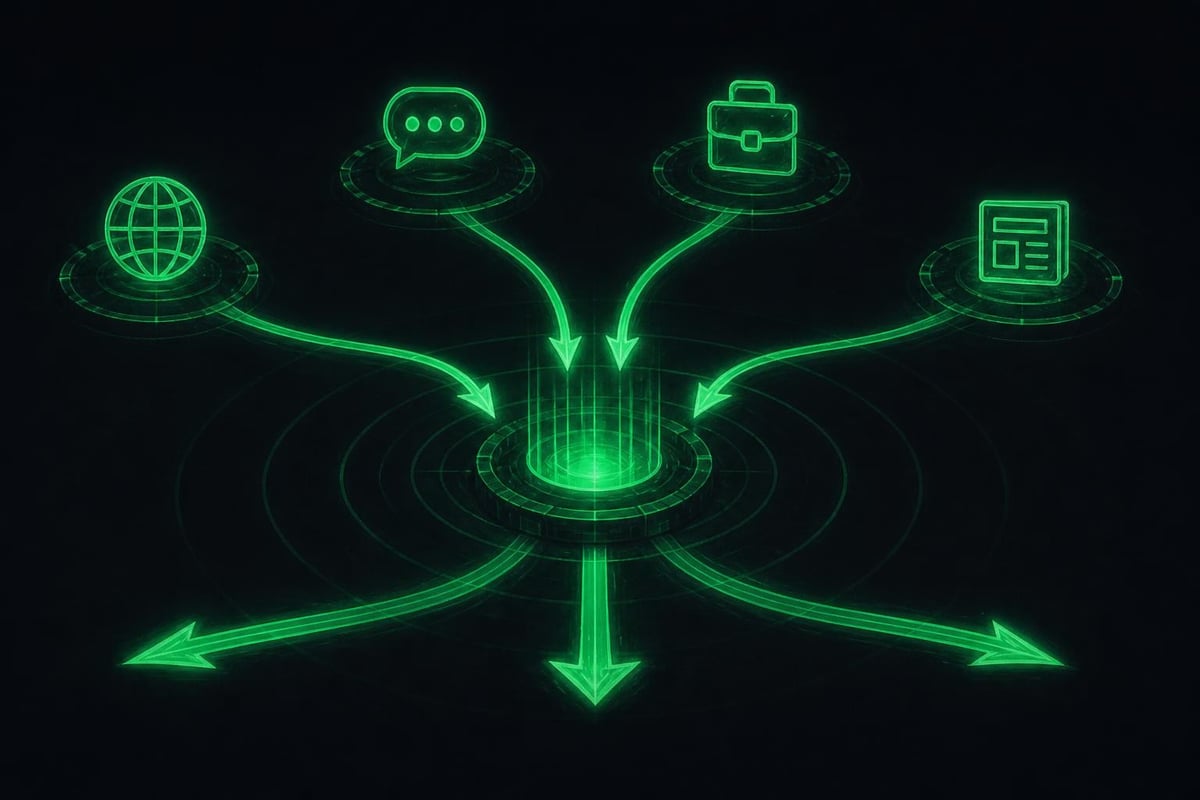
Manual tracking dies the moment priorities shift. Automation keeps the system alive through distraction, turnover, and busy quarters. The right tools track changes across web properties, social channels, job boards, and news sources without human intervention.
Set up automated monitoring for:
- Website changes (pricing pages, feature pages, homepages)
- Social media activity (LinkedIn, Twitter, company blogs)
- Job posting patterns (roles, locations, volume)
- News mentions and press releases
- Product review sites and G2/Capterra updates
Modern competitive monitoring relies on tools that reduce manual effort without sacrificing relevance.
Filter for Strategic Relevance
Raw signals overwhelm. A competitor's blog post about office snacks doesn't matter. Their pricing page rewrite does. Filtering separates what's actionable from what's ambient.
Build filters that flag:
- Changes to pricing or packaging
- New feature launches in your core areas
- Messaging shifts that reposition against you
- Geographic or vertical expansion
- Executive team changes
The goal isn't to see everything. It's to see what changes your next decision.
Route Insights to Decision-Makers
Intelligence that doesn't reach the right person at the right time is just trivia. Competitive monitoring only works if insights land with the teams who can act on them before the window closes.
| Signal Type |
Who Needs It |
Why It Matters |
| Pricing change |
Sales, leadership |
Affects deal strategy immediately |
| Feature launch |
Product, marketing |
Informs roadmap and positioning |
| Messaging shift |
Marketing, brand |
Reveals repositioning opportunity |
| Executive hire |
Leadership |
Signals strategic direction |
Distribution can't be "send a weekly email everyone ignores." It needs to be integrated into existing workflows where decisions already happen.
Turning Monitoring Into Strategic Moves
Data collection isn't the end goal. The purpose of competitive monitoring is better decisions: knowing when to accelerate, when to pivot, when to defend, when to ignore. Raw signals only matter when they change what you do next.
Early Threat Detection
Competitive monitoring buys you time. A competitor testing new messaging in ads means they're preparing a repositioning. Job postings for enterprise sales in your region mean expansion is coming. Product updates in adjacent categories suggest they're looking for new growth vectors.
Spotting these moves early gives you options: adjust positioning before they land, accelerate roadmap items to beat them to market, or prepare counter-messaging that blunts their advantage.
Competitive Battlecards That Stay Current
Sales teams lose deals when their competitive intelligence is months old. Monitoring keeps battlecards accurate by flagging when competitor strengths, weaknesses, or messaging changes invalidate old talking points.
Instead of annual battlecard rewrites, monitoring triggers updates when:
- Pricing structures change
- New features launch
- Customer reviews surface new objections
- Messaging repositions against you
Strategic Framework Application
The best competitive monitoring doesn't stop at "here's what changed." It connects those changes to strategic implications using proven frameworks. Porter’s Five Forces helps interpret whether new entrants weaken your position. SWOT analysis maps how competitor moves create threats or reveal weaknesses you can exploit.
When a competitor drops pricing, that's a signal. Whether it represents a threat, an opportunity, or desperation depends on context only frameworks provide.
Common Monitoring Mistakes and How to Avoid Them
Even teams committed to competitive monitoring make predictable errors that waste effort and miss threats. Recognizing these patterns early saves months of wasted work.
Monitoring Too Many Competitors
Watching twenty competitors means you're effectively watching none. Attention diffuses. Updates slow. Nothing gets deep analysis. Pick the three to five that can actually take your customers or block your growth, and go deep on those.
Collecting Without Analyzing
A database full of competitor signals you never review is surveillance, not intelligence. The work isn't capturing data. It's interpreting what it means for your position and what you should do differently.
No Clear Distribution Path
Intelligence locked in a dashboard nobody checks might as well not exist. Build distribution into existing workflows: Slack channels people actually read, CRM notes that surface in deal reviews, roadmap discussions that reference competitive context.
Ignoring Second-Order Effects
A competitor launching a feature doesn't just affect your product roadmap. It changes how buyers evaluate the category, what sales objections you'll face, and which partnerships become strategic. Effective competitive intelligence traces the full chain of implications, not just the immediate move.

Choosing the Right Competitive Monitoring Tools
Manual tracking breaks at scale. The right tools extend what one person can monitor from three competitors to dozens, and they filter noise so only relevant signals surface. Competitive intelligence tools in 2026 range from simple web change trackers to full platforms that automate collection, analysis, and distribution.
What to Look for in Monitoring Tools
Automated data collection across web properties, social channels, news sources, and job boards. If you're copy-pasting competitor updates into spreadsheets, you're using 2018 methods in 2026.
Smart filtering that separates strategic signals from noise. A competitor's social media post about their team retreat doesn't matter. Their pricing page rewrite does.
Integration with existing workflows so insights reach decision-makers where they already work: Slack, CRM, project management tools, not another dashboard to check.
Historical tracking that shows changes over time, not just current snapshots. Understanding how a competitor's messaging evolved reveals strategic direction better than today's homepage alone.
From Monitoring to Strategy
The best tools don't stop at alerts. They connect signals to strategic frameworks and generate options. Best practices for competitive monitoring emphasize reducing the gap between "we detected this" and "here's what we should do about it."
A platform like BrandScout bridges that gap by running proven frameworks automatically when new competitive signals arrive, turning monitoring into strategic recommendations instead of just another data source to interpret manually.
How High-Growth Companies Use Competitive Monitoring
Companies that outpace their markets don't just track competitors. They use monitoring to inform every major decision: which features to prioritize, how to position new products, where to expand, and when to defend versus attack.
Product and Roadmap Decisions
When competitors ship features in specific areas repeatedly, that's a signal about where buyer demand is concentrating. Monitoring helps product teams distinguish between chasing features and identifying genuine market shifts worth addressing.
The question isn't "should we copy this feature?" It's "does this pattern suggest the category is moving in a direction we need to account for?"
Pricing and Packaging Strategy
Competitive monitoring reveals how pricing structures evolve across the category. When multiple competitors introduce new tiers, expand free offerings, or bundle features differently, it suggests buyers are signaling new expectations.
Instead of reacting to individual competitor moves, monitoring the pattern helps you position pricing strategically: where to compete directly, where to differentiate, and which segments to own versus concede.
Sales Enablement and Win Rates
Sales teams need current intelligence, not quarterly reports. Competitive monitoring keeps enablement materials accurate by flagging when competitor positioning, pricing, or products change in ways that affect deal strategy.
When win rates drop against specific competitors, monitoring helps diagnose why: did they change pricing, launch a feature that neutralizes your advantage, or shift messaging that repositions you unfavorably?
Market Expansion and Entry Decisions
Before entering a new geography or vertical, monitoring reveals who's already there, how they position themselves, and whether the market is open or defended. Understanding your strategic position relative to entrenched players determines whether expansion makes sense or wastes resources fighting uphill.
Connecting Monitoring to Execution
Competitive monitoring is worthless if it doesn't change what you do. The purpose isn't awareness. It's advantage. That requires connecting intelligence to execution: roadmap decisions, campaign adjustments, pricing changes, messaging pivots.
Building a Competitive Response Process
When monitoring surfaces a significant competitor move, you need a documented process that moves from detection to decision to execution:
- Signal validation: Is this real and confirmed, or speculation?
- Impact assessment: Does this threaten our position or create an opportunity?
- Strategic analysis: What framework explains this move and its implications?
- Option generation: What could we do in response?
- Decision and execution: What will we do, who owns it, and when does it ship?
Without this structure, monitoring becomes a stream of "did you see what they did?" conversations that never turn into action.
Integrating Intelligence Into Planning Cycles
Quarterly planning that ignores competitive context is wishful thinking. Roadmaps that don't account for where competitors are moving assume the market stays frozen. Budgets that ignore competitive threats leave you underfunded when it matters.
Market intelligence integrated into planning means competitive monitoring informs every major allocation: which features get resources, which campaigns get budget, which markets get focus.
Measuring Monitoring Effectiveness
How do you know if competitive monitoring is working? Not by the volume of signals collected, but by the quality of decisions it improves:
- Did we spot threats early enough to respond effectively?
- Did intelligence change our roadmap, pricing, or positioning?
- Did sales win rates improve after updating competitive battlecards?
- Did we avoid costly mistakes by seeing competitor failures first?
If monitoring doesn't visibly improve decisions, it's noise collection, not intelligence.
Competitive monitoring transforms how you read the market: from reacting after competitors move to anticipating threats while you still have time to act. It's the difference between playing defense on every deal and shaping the battlefield on your terms. Brandscout turns scattered competitive signals into structured intelligence and strategic options automatically, so you stop tracking competitors manually and start making decisions with confidence.
Digital Advertising Intelligence: Your Competitive Edge
Digital advertising intelligence isn't about watching what your competitors spend. It's about understanding why they spend it, where they're vulnerable, and what that tells you about the market you're fighting for. Most companies drown in ad performance dashboards while missing the strategic signal: competitor creative shifts, budget reallocation patterns, and the gaps those moves create. The difference between tracking and intelligence is the difference between knowing someone bought billboard space and understanding they just abandoned digital because their conversion economics broke. One is trivia. The other is an opening.
What Digital Advertising Intelligence Actually Measures
The core components of digital advertising intelligence break into three layers, each revealing different competitive truths.
Spend patterns show where competitors believe value lives. When a rival doubles down on connected TV while pulling back from programmatic display, they're making a bet about audience attention and conversion paths. Nielsen’s Ad Intel platform tracks this across channels, but raw spend data becomes strategic intelligence only when you ask what changed and why now.
Creative evolution reveals positioning shifts before they show up in brand messaging. A competitor moving from feature-focused ads to emotional storytelling isn't just testing creative. They're repositioning. The cadence of creative refresh tells you whether they're iterating confidently or flailing for traction.
Audience targeting decisions expose who your competitors think their customer is. Cross-reference their targeting with your own customer data and you'll find three categories: customers you're both chasing (contested ground), customers they're ignoring (potential white space), and customers they're prioritizing that you've written off (a signal to reconsider or a confirmation you've segmented correctly).

The Fraud Problem That Distorts Your Intelligence
Digital advertising intelligence in 2026 carries a structural risk most teams ignore: AI-driven fraud that scales faster than detection. When competitor spend data includes bot traffic and spoofed impressions, you're reading a distorted signal.
The issue compounds because fraudulent activity often mimics legitimate patterns. A competitor's "surge" in display spending might reflect a fraud network, not a strategic offensive. This matters for intelligence work because you'll misread market movements.
Practical filters to apply:
- Cross-reference spend increases with correlated brand search volume
- Watch for sudden geographic expansion without PR or product launches
- Check whether creative refresh accompanies spend changes (fraud operations reuse assets)
- Monitor whether competitors acknowledge the campaigns in earnings calls or public statements
The academic research on inefficiencies in digital advertising markets highlights measurement challenges that affect both your campaigns and your competitive reads. If you can't trust the denominator, the competitive ratios you calculate are fiction.
Building Your Intelligence Collection System
Most companies approach digital advertising intelligence backwards. They subscribe to a monitoring tool, get overwhelmed by data, then use it to confirm what they already believed. Effective intelligence starts with strategic questions, not data feeds.
Frame Your Intelligence Requirements First
Before you track a single competitor ad, define what decisions this intelligence will inform. The framework matters:
| Decision Type |
Intelligence Requirement |
Data Sources Needed |
| Budget allocation across channels |
Competitor spend mix and trend direction |
Ad spend databases, filing disclosures |
| Creative differentiation strategy |
Messaging themes, visual systems, offer patterns |
Creative archives, A/B test signals |
| Market entry timing |
New market ad activity, localization signals |
Geographic targeting data, language variants |
| Defensive positioning |
Attack ad patterns, competitive claim tracking |
Mention monitoring, comparison ad archives |
This structure forces clarity. If you can't map an intelligence stream to a decision, you're collecting noise.
Choose Collection Methods That Match Your Resources
Digital advertising intelligence doesn't require enterprise budgets, but different approaches carry different blind spots.
Automated monitoring platforms like Nielsen Ad Intel provide comprehensive coverage but charge accordingly. They solve for breadth: every channel, every major advertiser, standardized metrics. The trade-off is depth. You see what everyone sees, which means no proprietary edge unless you analyze better than competitors using the same feed.
Manual competitive tracking through native ad libraries (Meta, Google, LinkedIn) costs only time. The Facebook Ad Library and Google Ads Transparency Center show creative, targeting parameters, and run dates. You build your own database and control the taxonomy. The cost is labor and coverage gaps: you'll miss channels without public libraries and you're vulnerable to sampling bias based on what you choose to track.
Hybrid approaches work for most growth-stage companies: automated monitoring for spend trends and share-shift detection, manual deep-dives on creative and messaging for your top five competitors. This balances cost against insight quality.
For teams managing competitive intelligence across multiple brands or clients, Competitive Analysis & Strategy workflows that systematize the collection-to-decision process prevent the repeat-work trap where each brand rebuilds the same intelligence infrastructure.
Turning Ad Data Into Strategic Advantage
Raw advertising data becomes intelligence when you connect it to competitive intent. This requires inference, not just observation.
Reading Competitor Budget Shifts
When a competitor reallocates spend from search to social, they're signaling one of three things:
- Search economics broke: Their cost-per-acquisition crossed an internal threshold and they're hunting for cheaper acquisition channels
- Audience shift hypothesis: They believe their target customer's attention moved from active search to passive social consumption
- Strategic repositioning: They're moving upmarket or downmarket and the channel mix follows customer sophistication
You determine which by cross-referencing product changes, pricing moves, and messaging evolution. A luxury brand shifting to TikTok while raising prices makes no sense unless they're chasing a younger cohort. A B2B software company pulling search spend while launching a freemium tier suggests they're moving from demand capture to demand creation.
The research on how digital advertising auctions influence product pricing reveals the feedback loop: channel costs affect pricing strategy, which affects positioning, which affects channel selection. Competitors stuck in this loop telegraph their constraints through ad spend patterns.

Decoding Creative Strategy Changes
Creative isn't art. It's encoded strategy. When you track creative evolution systematically, patterns emerge that predict competitive moves before they appear in product or pricing.
Watch for these signals:
- Benefit hierarchy shifts: Ads moving from speed to security suggest market research found a new primary objection
- Customer persona changes: Stock photo shifts from solo users to teams indicates enterprise repositioning
- Competitive framing: New comparison language means they've identified who they're displacing
- Offer structure evolution: Free trial to money-back guarantee suggests activation problems
The rapid adoption of generative AI in video ad creation in 2026 adds a new dimension: creative refresh velocity. Competitors using AI for ad production can test 10X more variants. If you're tracking creative manually, you're now sampling a subset of a much larger test matrix. Adjust your methodology or accept that you're seeing curated winners, not the full strategic exploration.
Mapping White Space Through Negative Signals
The most valuable intelligence often comes from what competitors aren't doing. Advertising gaps reveal either strategic blind spots or deliberate avoidance based on data you don't have.
Questions to ask:
- Which customer segments receive zero ad coverage from any competitor? (Possible white space or validated dead end)
- Which channels see no competitive spend despite audience presence? (Platform skepticism or unproven ROI)
- Which geographic markets get ignored despite demographic fit? (Regulatory barriers, localization complexity, or oversight)
- Which value propositions never appear in competitor messaging? (Undefendable claims or irrelevant benefits)
For each gap, develop two hypotheses: opportunity and trap. Test the opportunity hypothesis cheaply before committing. Sometimes competitors ignore a segment because three companies before you already proved it doesn't convert.
Operationalizing Intelligence for Team Decisions
Digital advertising intelligence fails most often not in collection but in activation. The insights sit in dashboards while teams make decisions based on gut feel or outdated assumptions.
Build a Competitive Ad Intelligence Brief
Weekly or biweekly competitive briefs force consistent analysis and pattern recognition. Structure matters more than frequency.
Essential sections:
- What Changed: New campaigns, spend shifts, creative tests, targeting expansions
- What It Means: Strategic interpretation with confidence levels (confirmed, likely, speculative)
- What We Do: Recommended responses with owners and timelines
- What We Watch: Open questions requiring more data before action
This format prevents intelligence from becoming trivia. If an observation doesn't generate either an action or a watch-list item, it doesn't belong in the brief.
Connect Ad Intelligence to Your Strategic Frameworks
Advertising intelligence should feed directly into strategic positioning decisions and marketing decisions. When competitor ad patterns contradict their stated strategy, you've found either deception or internal misalignment. Both create openings.
| Competitor Signal |
Strategic Implication |
Potential Response |
| Premium brand running discount-heavy ads |
Price pressure or inventory problem |
Hold pricing, emphasize quality in messaging |
| Enterprise-focused company targeting SMB |
Upmarket stall or market expansion |
Defend SMB with feature parity claims |
| Direct competitor goes silent on ads |
Budget constraint or channel pivot |
Increase share of voice while cost is low |
| New entrant outspends category leaders |
VC-funded land grab |
Optimize for efficiency, let them overpay |
The key is building institutional memory. Track what competitors signal versus what they execute. Over 12-24 months, you'll identify which companies telegraph moves accurately (respond preemptively) and which use advertising as misdirection (ignore the signal, watch product).
The Measurement Challenge Nobody Solves Cleanly
Every digital advertising intelligence system faces the same paradox: the metrics that matter most are the hardest to measure competitively. You can see what competitors spend and where. You can reconstruct creative and targeting. You cannot see their conversions, retention, or customer economics.
This forces inference. The counterfactual-based methodology for measuring incremental effectiveness works for your own campaigns but remains opaque for competitors. You're left with proxy signals:
Spend persistence as a conversion proxy: Campaigns that run for quarters with consistent spend likely work. Campaigns that spike and disappear probably don't. But you'll miss nuance: maybe they hit CAC targets but LTV disappointed. Maybe they converted well but to the wrong customer profile.
Creative iteration patterns as optimization signals: Competitors running static creative for months either found a winner or gave up. Rapid creative cycling suggests active optimization, but you can't tell if they're climbing toward better performance or thrashing in failure.
Channel concentration as confidence indicators: When a competitor goes all-in on a single channel, they've either found dominant ROI or backed themselves into a dependency. Context determines which.

Accept Uncertainty and Act Anyway
Strategic decisions never wait for perfect information. Digital advertising intelligence gives you better questions and educated guesses, not certainty. The competitive advantage goes to teams that act on 70% confidence while competitors wait for 90%.
Use confidence levels explicitly in recommendations:
- High confidence (act now): Competitor launched comparison campaign naming us directly, tripled social spend, creative emphasizes our weakest feature
- Medium confidence (prepare response): Competitor creative shifted from features to outcomes, suggests repositioning but unclear if test or commit
- Low confidence (monitor): Competitor spend increased 40% but could be seasonal, new product launch, or investor pressure for growth
This calibration prevents both paralysis and overreaction. When you mark intelligence as speculative, you can act on it without betting the company.
The AI Arms Race in Advertising Intelligence
Platforms like Viamedia’s AI-driven advertising technologies and DirecTV’s AI-powered Connected TV platform represent a fundamental shift in how advertising intelligence must evolve. AI changes both what you can learn about competitors and what they can learn about you.
The offensive capability: AI-powered creative analysis at scale means you can now process every competitor ad variant, extract messaging patterns, identify A/B tests, and map strategic shifts in near real-time. What used to require manual review of 50 ads per month now covers 5,000 automatically.
The defensive reality: Your competitors gain the same capability. Every ad you run feeds their intelligence systems. Deception becomes viable: run test campaigns in cheap channels to signal false strategic direction while your real play unfolds elsewhere. But deception costs money and organizational discipline most companies lack.
The data quality problem: As AI generates more ad creative, distinguishing human-directed strategy from algorithm-generated variants becomes harder. When a competitor tests 200 headline variations via generative AI, which one represents their strategic intent? Probably none individually. The pattern across all 200 might, but that requires different analytical methods than tracking discrete creative decisions.
The solution isn't better AI for intelligence collection. It's better strategic frameworks for interpretation. AI finds patterns. Humans determine which patterns matter and why. Teams that maintain that distinction win. Teams that delegate strategic thinking to algorithms get statistically significant nonsense.
Common Intelligence Failures and How to Avoid Them
Even sophisticated teams make predictable mistakes in digital advertising intelligence. Awareness helps.
Mistaking Activity for Strategy
The most common error: seeing a competitor launch a campaign and assuming it reflects strategic conviction. Sometimes it's a junior marketer's test. Sometimes it's contractual obligation to a media partner. Sometimes it's a founder's pet project that defies all data.
The filter: Ask whether the ad activity aligns with other signals. If a B2B company suddenly runs consumer-style emotional branding on TikTok but their website, sales process, and product positioning remain unchanged, it's probably not a strategic shift. It's noise. Ignore it until corroborating signals appear.
Over-indexing on Your Own Customer Profile
Your customers aren't the market. When competitors target segments you've rejected, the default assumption is they're wrong. Sometimes they are. Sometimes they've found product-market fit in a segment you missed or discounted.
The discipline: Periodically test abandoned segments with small campaigns. If your intelligence shows three competitors now targeting mid-market when you focused exclusively on enterprise, at least validate your original decision with fresh data. Markets evolve. Your 2024 reasoning might be outdated in 2026.
Ignoring Resource Asymmetry
A venture-backed startup burning cash for market share follows different logic than a profitable incumbent defending position. When you see a competitor "overspending" relative to likely ROI, consider their resource position and incentives.
Startups optimize for growth and market share at the expense of efficiency. Public companies optimize for quarterly metrics and margin. Private equity-owned competitors optimize for EBITDA. These different objectives produce different advertising strategies. Judge competitors against their own goals, not yours.
Treating All Competitors Equally
Not every competitor deserves equal intelligence investment. The company with 2% market share testing a new positioning needs less attention than the category leader moving into your segment. Prioritize intelligence resources where competitive moves actually threaten your position or opportunity.
Tier your competitors:
- Tier 1 (daily monitoring): Direct competitors for same customers with comparable resources
- Tier 2 (weekly review): Adjacent competitors who could pivot into your space or whose moves affect market dynamics
- Tier 3 (monthly check-in): Distant competitors tracked for early-warning signals only
This prevents intelligence overload while ensuring you don't miss the threat that matters.
Digital advertising intelligence transforms from a reporting exercise into a strategic capability when you connect competitive signals to the decisions they should inform. The companies winning in 2026 don't just track what competitors spend. They understand what those spending patterns reveal about market beliefs, strategic constraints, and the openings those constraints create. Brandscout helps businesses move from scattered competitive signals to structured intelligence that drives both strategic clarity and tactical execution, turning the market's complexity into your advantage.
Market to Business: Intelligence That Wins B2B Sales
Most companies that market to business fail at the same chokepoint. They build campaigns on guesswork about what competitors are doing, what buyers actually care about, and which positioning still has open ground. The result is predictable: messages that echo everyone else, pricing that invites comparison wars, and growth that stalls the moment a competitor notices you exist. The fix isn't better creative or more budget. It's structured intelligence that tells you where to attack before you spend a dollar.
Why Market to Business Campaigns Die Without Intelligence
The traditional market to business playbook assumes you know your competitive landscape. You don't. Most B2B marketers work from memory, rumor, and the last competitor they happened to notice. They build entire go-to-market strategies on incomplete data, then wonder why their differentiation gets copied in three months or why their messaging lands flat with buyers who've already heard it from four other vendors.
The intelligence gap kills campaigns in three specific ways:
- You position against competitors who aren't actually threats while missing the one climbing behind you
- You claim differentiation on features buyers stopped caring about two quarters ago
- You enter price wars you could have avoided if you'd mapped positioning gaps first
Understanding the Business-to-Business market structure reveals why this happens. B2B buying involves committees, long cycles, and rational evaluation. Every stakeholder researches. Every stakeholder compares. And every stakeholder expects you to explain, clearly, why you're different from the last three vendors they evaluated. If your intelligence doesn't tell you what those vendors said, you're guessing.
The Real Cost of Flying Blind
When you market to business without structured competitive intelligence, you don't just waste budget. You burn strategic options. You claim a positioning that three competitors already occupy. You launch features that matter less than the problem you're ignoring. You telegraph your next move to rivals who are tracking you better than you're tracking them.
Here's what bad intelligence costs in practice:
| Intelligence Failure |
Strategic Consequence |
Timeline to Damage |
| Missed emerging competitor |
They take your positioning before you defend it |
6-12 months |
| Outdated feature priority |
Product roadmap solves yesterday's fight |
3-6 months |
| Wrong market timing |
Launch into a space three others just entered |
Immediate |
| Weak differentiation claims |
Buyers lump you with alternatives, choose on price |
First sales call |
The damage compounds. Once you're positioned as "similar but cheaper" or "another option in the category," climbing out requires either a rebrand or years of proof. Both cost more than getting intelligence right the first time.

Building Intelligence That Actually Informs Strategy
Intelligence isn't data collection. It's the system that turns market signals into decisions. Most teams collect competitor lists, bookmark a few websites, maybe track some keywords. Then they sit in a room and guess what it all means. That's not intelligence. That's procrastination with better aesthetics.
What Structured Intelligence Looks Like
Real intelligence answers the questions that determine whether your market to business campaign wins or wastes money. It starts with discovery: who competes for the same budget, solves similar problems, or blocks your path to the buyer. Then it layers analysis: what they're claiming, where they're vulnerable, which positions are still open, and how the market is shifting underneath everyone.
The intelligence stack for B2B marketing:
- Competitor identification – every direct and adjacent threat, including the ones climbing quietly
- Positioning analysis – what they claim, how they differentiate, where messaging overlaps
- Feature and pricing mapping – capabilities, packaging, and the trade-offs they're offering
- Market signal tracking – funding rounds, leadership changes, product launches, customer wins
- Strategic framework application – running the data through proven models that surface decisions
That last step is where most intelligence efforts collapse. Teams gather data but don't know what to do with it. They have spreadsheets but no strategic direction. Effective B2B marketing strategies require turning intelligence into plays: which competitor to flank, which positioning gap to claim, which message will separate you from the noise.
From Data to Decisions in 90 Days
The best intelligence systems produce action, not reports. They take scattered market signals and output a plan: where to position, how to differentiate, which competitors to watch, and what to build next. The timeline matters. If your intelligence process takes six months, the market moves before you do.
BrandScout's Competitor Discovery & Tracking solves the first problem – identifying every threat without the manual research grind. Enter your category and the system surfaces competitors you'd miss, organizes them, and keeps the view current as new players emerge. That ends the "who are we actually up against" question in hours, not weeks. But discovery is just the entry point. The leverage comes when you run that data through strategic frameworks that tell you what to do next.
The Frameworks That Turn Intelligence Into Market Position
Intelligence without analysis is just organized anxiety. You know more competitors exist. You've cataloged their features. Now what? The gap between "I have data" and "I know what to do" is where most market to business strategies stall. Frameworks bridge that gap. They're the systematic way to turn what you know into where you move.

PESTEL: Reading External Forces Before They Hit
PESTEL maps the macro forces reshaping your market: Political, Economic, Social, Technological, Environmental, Legal. These aren't abstract trends. They're the winds that determine whether your positioning works in twelve months or gets obsolete. When you market to business in a regulated industry, legal shifts can kill your advantage overnight. When economic cycles tighten, buyer priorities flip from innovation to cost.
Running PESTEL on your intelligence tells you which external forces matter most and which ones you're ignoring. It surfaces the risks that kill strategies after launch and the opportunities competitors haven't noticed yet. Most teams skip this because it feels theoretical. They regret it when a regulatory change or technology shift invalidates six months of positioning work.
Porter's Five Forces: Mapping Power and Threat
Porter's model asks five questions: How intense is rivalry? How much power do buyers have? What about suppliers? How easy is new entry? How threatened are you by substitutes? The answers tell you where competitive pressure comes from and where you have room to maneuver.
Porter's Five Forces applied to B2B markets:
- Competitive rivalry – how many players fight for the same customer, and how differentiated they are
- Buyer power – whether customers can easily switch or negotiate, and how price-sensitive they've become
- Supplier power – dependencies on platforms, data sources, or partners that constrain your flexibility
- Threat of new entrants – how low the barriers are, and how fast new competitors can copy your position
- Threat of substitutes – alternative solutions that solve the problem differently and pull budget away
This framework exposes vulnerabilities before they become losses. If buyer power is high and rivalry is intense, competing on features alone is suicide. If barriers to entry are low, your current advantage won't last. The intelligence tells you what's true. Porter's tells you what it means.
SWOT and Ansoff: Position and Growth Path
SWOT maps your strengths, weaknesses, opportunities, and threats relative to the competitive set. It's not navel-gazing if you ground it in intelligence. Your strengths matter only if competitors lack them. Your weaknesses matter only if rivals exploit them. Understanding your strategic position means seeing yourself through the market's eyes, not your own.
Ansoff comes next: which growth path makes sense given what SWOT revealed. Market penetration, market development, product development, or diversification. Each has a risk profile. Each requires different capabilities. Running Ansoff on real competitive data tells you which path is open and which ones competitors already dominate.
Execution: Turning Analysis Into Campaigns That Win
Frameworks mean nothing if they don't produce execution. The intelligence stack builds to one output: a plan that tells you what to say, where to compete, and how to win over the next 90 days. Most B2B marketing efforts stall because the gap between "we ran the analysis" and "here's what we're doing Monday" never closes.
The 90-Day Play
The best market to business strategies compress strategy into a quarter. Longer and the market shifts. Shorter and you're just reacting. Ninety days gives you enough time to position, launch, measure, and adjust before competitors respond. The play needs five components: positioning, messaging, target accounts, channel tactics, and success metrics.
| Component |
What It Defines |
Why It Matters |
| Positioning |
The specific competitive gap you're claiming |
Without this, you echo competitors |
| Messaging |
How you articulate differentiation to buyers |
Weak messaging gets ignored in evaluation |
| Target Accounts |
Which buyers fit your advantage best |
Wrong targets waste budget on lost deals |
| Channel Tactics |
Where and how you reach decision-makers |
Channel mismatch kills strong positioning |
| Success Metrics |
What winning looks like in 90 days |
No metrics means no learning, no adjustment |
This isn't a marketing plan. It's a strategic move grounded in competitive intelligence. You're not guessing what might work. You're executing what the analysis said would work based on where competitors are weak and where buyers have unmet needs.
Building Battlecards That Scale Intelligence
The best intelligence systems arm every conversation with competitive truth. Battlecards do this. They distill positioning analysis into a format sales can use: here's the competitor, here's what they claim, here's where they're vulnerable, here's how we win the comparison. Effective battlecards turn abstract competitive advantage into specific objection handling and differentiation talking points.
What goes into a battlecard:
- Competitor positioning and core claims
- Feature and pricing comparison with specific trade-offs
- Common buyer objections and how to handle them
- Proof points that separate you from alternatives
- Situations where this competitor wins (so you don't waste time on bad fits)
Battlecards fail when they're built on opinion instead of intelligence. Sales reps spot that immediately and ignore them. When they're built on structured competitive analysis, they become the reference that closes deals in evaluations where five vendors look similar.
How Markets to Business Actually Differentiate in 2026
Differentiation used to mean features. It doesn't anymore. Every B2B market is crowded. Every capability gets copied. Every "unique" positioning gets claimed by three competitors within a quarter. The companies that win when they market to business in 2026 differentiate on execution, intelligence, and speed.
Execution Differentiation
You can't own features, but you can own outcomes. The vendors who win aren't selling capabilities. They're selling proof that they deliver results faster, with less risk, and with clearer ROI than alternatives. That requires case studies, data, and a relentless focus on customer success that competitors can't fake.
Intelligence Differentiation
Most competitors market blind. They guess at positioning, react to whoever's loudest, and hope their message lands. If you're the one company that actually knows the competitive landscape, you move faster and smarter. You claim gaps before others see them. You defend positions before attacks land. Intelligence becomes a structural advantage that competitors can't match without building the same system.
Speed Differentiation
Markets reward the first mover who gets positioning right. Not the first mover who launches fastest. Speed without direction is just expensive failure. But speed with intelligence is dominance. The companies that compress the cycle from "we see an opportunity" to "we own that position" win market share while competitors are still running their analysis.

The Intelligence Platforms That Change How You Market to Business
The technology that supports market to business intelligence has split into two camps: tools that help you collect data, and platforms that turn data into decisions. Most teams use the first and wonder why their competitive intelligence still doesn't produce strategy.
What Collection Tools Actually Do
Competitor tracking tools, social listening platforms, and market research databases give you inputs. They tell you what competitors said, what buyers searched, and what the market talked about. That's valuable. It's also not sufficient. Collection without analysis leaves you with the same problem in a prettier package: lots of data, no direction.
What Decision Platforms Deliver
The platforms that matter in 2026 run the full intelligence cycle. They discover competitors, organize signals, apply strategic frameworks, and output actionable plans. Making better marketing decisions requires closing the loop from data to strategy to execution. The platforms that do this eliminate the gap where most competitive intelligence efforts die: the translation from "what we know" to "what we do."
What separates decision platforms from data tools:
- Automated competitor discovery that surfaces threats you'd miss manually
- Framework application that runs PESTEL, Porter's, SWOT, and Ansoff on your actual competitive data
- Strategy generation that produces specific positioning recommendations and 90-day plays
- Living intelligence that updates as market conditions shift, not static reports that age out
The business case is simple. If intelligence cuts your time from market research to strategic decision from months to days, you move faster than competitors. If it surfaces positioning gaps they haven't seen, you claim territory while it's open. If it arms your sales team with battlecards grounded in real analysis, you win more evaluations.
Common Failures When Companies Market to Business
Most market to business strategies fail in predictable ways. The patterns repeat across industries, company sizes, and market conditions. Knowing where others break doesn't guarantee you won't. It just gives you a checklist of risks to address before they cost you growth.
Failure One: Competing on Features in a Parity Market
When every competitor has the same core capabilities, competing on features is a race to the bottom. Buyers compare spec sheets, see rough equivalence, and choose on price. If your differentiation relies on "we have X feature," you're one product update away from irrelevance. The fix is repositioning around outcomes, use cases, or execution that competitors can't replicate by adding a feature.
Failure Two: Ignoring Emerging Competitors Until They've Taken Position
The competitors who kill you aren't the ones you're tracking today. They're the ones climbing quietly, targeting adjacent segments, building positioning you haven't defended yet. By the time they show up in your awareness, they've already claimed territory. The challenges B2B companies face include longer sales cycles and committee-based decisions, which means emerging threats compound slowly then catastrophically. You need intelligence systems that surface rising competitors before they're obvious.
Failure Three: Building Strategy on Outdated Assumptions
Markets shift faster than planning cycles. The positioning that worked last year doesn't work now. The buyer priorities you assumed are stable have changed. The competitor you dismissed as weak just got funded and hired your strategy playbook. Strategy built on stale intelligence optimizes for the wrong game. Winning requires live data, continuous analysis, and the discipline to adjust when the ground moves.
Failure Four: Separating Intelligence from Execution
The most common failure is treating competitive intelligence as a research project instead of an execution system. Teams spend months on analysis, produce a beautiful deck, then file it and go back to guessing. Intelligence only matters if it changes what you do. If your process doesn't end in a 90-day plan, specific positioning, and tactical plays, it's not intelligence. It's procrastination dressed as rigor.
Who Wins When Intelligence Becomes the Advantage
The companies that dominate when they market to business in 2026 and beyond aren't the biggest or best-funded. They're the ones who compress the cycle from market signal to strategic decision to executed play. They know their competitive landscape better than rivals know theirs. They claim positioning gaps while competitors are still mapping the terrain. They adjust faster because their intelligence updates continuously, not quarterly.
This isn't about technology alone. It's about building systems that treat competitive intelligence as a strategic function, not a research project. It's about running proven frameworks on real data instead of guessing in conference rooms. And it's about moving from analysis to action fast enough that you shape markets instead of reacting to them.
The market rewards clarity. The vendors who know exactly where they stand, which competitors threaten them, which positions are still open, and what buyers actually care about win the evaluations that matter. Everyone else fights on price, copies features, and wonders why growth stalls. Intelligence is the difference.
When you market to business without structured competitive intelligence, you're optimizing in the dark. You build campaigns on assumptions, defend positions you don't fully understand, and react to threats you should have seen months earlier. The companies that win in 2026 treat intelligence as infrastructure: the system that turns scattered market signals into strategic clarity and executable plays. Brandscout gives you that system: AI-powered competitive discovery, strategic framework analysis, and 90-day plans that move you from "what's happening" to "what we're doing" faster than manual research ever could. If your current intelligence process takes months and ends in reports instead of action, you're already behind.
Competitive Intelligence Research: The Strategic Guide
Competitive intelligence research is the discipline of gathering, analyzing, and acting on information about your rivals before they move against you. It's not corporate espionage or guesswork. It's structured, systematic work that converts scattered market signals into decisions that hold up under pressure. Most companies claim they do it, but their "research" amounts to checking a competitor's pricing page once a quarter and calling it strategy. That's not intelligence. That's browsing. Real competitive intelligence research builds a live picture of the battlefield, identifies where rivals are strong and where they're exposed, and gives you the clarity to choose your next move with confidence instead of hope.
Why Competitive Intelligence Research Fails in Most Organizations
The typical approach to competitive intelligence research collapses under its own good intentions. Teams collect everything, organize nothing, and act on less. You'll see spreadsheets with 47 tabs tracking features, pricing tiers, blog post frequency, and executive bios, but no one can tell you what any of it means or what to do next. The problem isn't lack of data. It's lack of structure.
Here's where it breaks down:
- No clear objective. Teams gather intelligence without defining what decision it's supposed to inform. You end up with facts but no direction.
- One-time efforts. Someone builds a competitor matrix before a board meeting, then it sits untouched for six months while the market shifts.
- No framework for analysis. Raw data about competitors doesn't become intelligence until you run it through a strategic lens that reveals advantage and risk.
- Siloed findings. Product knows one thing, marketing knows another, sales hears a third story. No unified view.
Best practices for conducting competitive intelligence emphasize defining objectives upfront, but most companies skip this step entirely. They research because it feels responsible, not because they know what they're looking for. That's how you end up with intelligence that informs nothing.
Effective competitive intelligence research starts with a question: What decision am I trying to make, and what do I need to know to make it correctly? Everything flows from there.
The Core Components of Competitive Intelligence Research
Competitive intelligence research isn't a single task. It's a system with distinct layers, each feeding the next. Miss one layer and your intelligence collapses into trivia.
Competitor Identification and Mapping
You can't analyze rivals you don't know exist. The first step is building a complete roster: direct competitors, adjacent players who could pivot into your space, rising challengers still below the radar, and substitute solutions that solve the same customer problem differently.
Most teams only track the obvious names. They miss:
- Stealth competitors building in private or selling through channels you don't monitor
- Horizontal threats from adjacent categories testing your market
- Emerging players with early traction and venture backing who'll be major threats in 18 months

Brandscout’s Competitor Discovery & Tracking solves this by surfacing every competitor in your category automatically, including hidden and rising ones, then organizing them in one living database that stays current as new intelligence arrives. It ends the scattered-tabs problem.
Data Collection and Source Validation
Once you know who to track, you need reliable streams of information. Competitive intelligence research depends on credible sources, not rumors or assumptions.
| Source Type |
What It Reveals |
Reliability Level |
| Public filings (S-1s, 10-Ks) |
Financial health, growth rates, strategic priorities |
High |
| Product releases and updates |
Feature roadmap, customer focus, technical capability |
High |
| Job postings |
Hiring priorities, expansion plans, capability gaps |
Medium-High |
| Customer reviews (G2, Capterra) |
Strengths, weaknesses, switching triggers |
Medium |
| Social media and executive interviews |
Messaging, positioning, cultural signals |
Medium-Low |
Combine multiple sources to validate findings. If a competitor's CEO claims dominance in enterprise but their job postings are all for SMB account executives, you've found a gap between narrative and reality.
Strategic Analysis Frameworks
Raw data becomes intelligence when you process it through frameworks that reveal patterns and implications. Competitive intelligence research isn't about knowing what competitors do. It's about understanding why they do it, what it tells you about their strategy, and where it creates openings for you.
Key frameworks for analysis:
- SWOT to map each competitor's strengths, vulnerabilities, opportunities they're pursuing, and external threats they face
- Porter's Five Forces to understand competitive intensity, bargaining power, and threat dynamics across your market
- PESTEL to track political, economic, social, technological, environmental, and legal forces shaping the landscape
- Positioning maps to visualize where competitors sit on key dimensions and where white space exists
Understanding Porter’s Five Forces helps you see beyond individual rivals to the structural forces that determine who wins. Comprehensive guides to competitive intelligence outline these methods, but most companies struggle to apply them consistently.
Building a Competitive Intelligence Research Process That Scales
One-off research projects don't create advantage. You need a repeatable system that runs continuously and delivers intelligence when decisions require it.
Establish Collection Rhythms
Set regular intervals for updating each intelligence stream:
- Daily: Product changes, pricing updates, major announcements
- Weekly: Content and marketing campaigns, customer review sentiment
- Monthly: Strategic moves, partnerships, leadership changes, market share shifts
- Quarterly: Financial performance, strategic priorities, capability assessments
Automate what you can. Use tools to monitor competitor websites, track keywords and content, and flag significant changes. Save human judgment for analysis, not data entry.
Create Structured Intelligence Outputs
Competitive intelligence research must end in artifacts that inform action. The most effective formats:
- Competitor profiles: One-page summaries covering positioning, target customers, key strengths/weaknesses, recent moves, and strategic direction
- Battlecards: Sales-focused documents highlighting how to position against specific competitors in deals
- Threat assessments: Analysis of which competitors pose the greatest risk in the next 6-12 months and why
- Strategic recommendations: Specific moves you should make based on competitive gaps and opportunities
Creating effective competitive intelligence reports requires clear structure and actionable insights, not just data dumps. Each output should answer: What does this mean for us, and what should we do about it?
Distribute Intelligence Where Decisions Happen
Intelligence sitting in a strategy team's folder helps no one. Push findings to the teams who need them:
- Product: Feature prioritization, roadmap decisions, differentiation opportunities
- Marketing: Messaging, positioning, campaign strategy, content direction
- Sales: Objection handling, competitive positioning, deal strategy
- Executive: Market entry decisions, M&A opportunities, resource allocation

Each team needs intelligence formatted for their decisions. Sales doesn't need a 40-page market analysis. They need a one-page battlecard they can reference in a live call.
Converting Intelligence Into Strategic Action
The purpose of competitive intelligence research is decision advantage. You see the landscape more clearly than rivals, which lets you position where they're weak, defend where they're likely to attack, and move while they're still gathering information.
Defensive Strategy Applications
Intelligence reveals where competitors might strike next. Look for:
- Market segments where rivals are increasing investment (hiring, marketing spend, product development)
- Capability gaps they're closing through acquisitions or new hires
- Pricing experiments that signal an upcoming assault on your position
- Partnership announcements that give them access to distribution or technology they previously lacked
When you spot these signals early, you can reinforce your position before the attack lands. Understanding how to extend your defensive line helps you protect vulnerable market positions before competitors exploit them.
Offensive Strategy Applications
Competitive intelligence research also reveals where rivals are exposed:
- Neglected customer segments where their product doesn't fit well
- Capability weaknesses you can exploit (slow product cycles, poor support, limited integrations)
- Positioning gaps between what they claim and what customers experience
- Strategic distractions where they're focused elsewhere and can't respond quickly
These openings don't stay open forever. When you identify one, you need to move decisively. The companies that win use intelligence to strike before competitors realize they're vulnerable.
Ethical Boundaries and Legal Considerations in Competitive Intelligence Research
Effective competitive intelligence research operates entirely within legal and ethical boundaries. There's no need to cross lines. Public information, properly analyzed, gives you everything you need.
Always acceptable:
- Analyzing public websites, product demos, marketing materials, and documentation
- Reading financial filings, press releases, and news coverage
- Reviewing customer feedback on public platforms
- Attending competitor webinars and public events
- Tracking job postings and LinkedIn profiles
Never acceptable:
- Misrepresenting yourself to gain access to confidential information
- Asking customers to violate NDAs or share proprietary details
- Hacking, unauthorized access, or obtaining information through deception
- Paying employees of competitors for insider information
The line is clear: use information that's publicly available or willingly shared. Don't lie, steal, or manipulate to get it. Companies that cross ethical lines don't just risk legal trouble. They build intelligence operations on foundations that crumble under scrutiny.

Common Competitive Intelligence Research Mistakes and How to Avoid Them
Even teams committed to competitive intelligence research make predictable errors that undermine their work.
Mistake 1: Tracking Too Many Competitors Superficially
You can't deeply analyze 30 companies. Focus on the 5-7 that matter most: direct competitors with similar positioning and target customers, rising challengers with momentum, and potential acquirers or market consolidators. Know these competitors better than they know themselves.
Mistake 2: Confusing Activity With Strategy
Tracking every blog post, social media update, and minor product tweak creates noise, not signal. Focus on moves that reveal strategic intent: pricing changes, market expansion, major feature releases, executive hires, funding rounds, partnerships.
Mistake 3: Analyzing in Isolation
Competitive intelligence research must connect to your own strategy. Understanding what a competitor does only matters if you know what it means for your positioning, priorities, and next moves. Every insight should answer: How does this change what we should do?
Mistake 4: Treating Intelligence as Static
Markets shift. Competitors pivot. Intelligence from six months ago might be completely irrelevant today. Build systems that refresh continuously, not one-time research projects that go stale.
Mistake 5: Failing to Validate Assumptions
Your intelligence is only as good as its accuracy. Triangulate findings across multiple sources. When you see a pattern, test whether it's real or confirmation bias. Companies make catastrophic mistakes when they act on intelligence they assumed was true but never validated.
Competitive Intelligence Research for Different Business Contexts
The approach to competitive intelligence research varies based on your market position and strategic needs.
| Business Context |
Intelligence Priorities |
Key Questions |
| Early-stage startup |
Direct competitors, category leaders, emerging alternatives |
Who owns this space? Where are the gaps? What's the minimum viable differentiation? |
| Growth-stage company |
Market share shifts, competitive positioning, customer switching patterns |
Who's winning and why? Where are we exposed? What's our path to leadership? |
| Market leader |
Challengers' strategies, disruptive threats, adjacent market movements |
Who's coming for us? What would disrupt our position? Where should we expand? |
| Challenger brand |
Leader's vulnerabilities, neglected segments, positioning opportunities |
Where is the leader weak? Which customers are underserved? How do we win without outspending them? |
Early-stage companies need breadth: understand the full landscape quickly. Market leaders need depth: monitor threats with precision and predict moves before they happen. Tools like marketing cloud intelligence help connect competitive insights to execution across different business contexts.
Competitive intelligence research isn't optional in crowded markets. It's the difference between moving with confidence and hoping your guess was right. The companies that win don't have better products by accident. They see the battlefield clearly, understand where competitors are strong and where they're exposed, and position themselves in gaps rivals can't close. If you're tracking competitors in spreadsheets and still don't know what to do next, Brandscout runs the full discovery-to-strategy workflow automatically, ending in actionable plans grounded in your real competitive landscape.
Marketing Campaign Plan: Build Strategy That Survives Contact
Most marketing campaign plans fail before they launch. Not because the creative is weak or the budget is wrong, but because they're built in a vacuum. They assume the market will sit still, that competitors won't counter, that customers exist in a static state waiting to be persuaded. A proper marketing campaign plan is not a creative brief with a budget attached. It's a strategic document that acknowledges you're operating in contested territory, where every move you make will be met with resistance, indifference, or a competitor's countermove.
What a Marketing Campaign Plan Actually Is
A marketing campaign plan is the bridge between strategic intent and tactical execution. It translates what you want to achieve into what you will actually do, when, with what resources, and how you'll know if it worked.
The core components are:
- Objective: What specific outcome you're driving toward, tied to business results
- Target: Who you're trying to reach, defined by behavior and need, not demographics alone
- Positioning: The ground you're claiming in the customer's mind relative to alternatives
- Tactics: The specific channels, messages, and formats you'll deploy
- Resources: Budget, team, technology, and time allocated
- Measurement: How you'll track progress and define success
The difference between a campaign plan and a to-do list is competitive awareness. A real plan accounts for what your competitors are doing, what the market expects, and where the openings are. It's not about outspending. It's about out-positioning.
Why Most Plans Are Built Blind
The standard approach to creating a marketing campaign plan follows a clean seven-step process: set goals, identify your audience, choose tactics, allocate budget, create content, execute, measure. It's logical. It's also incomplete.
What's missing is the competitive layer. Most teams build campaigns by looking inward at their product, their brand, their message. They never map the landscape they're entering. They don't know who else is targeting the same customers, what messages are already saturated, or where the gaps are.
This creates two problems:
- You waste budget fighting in crowded channels where your message gets buried under competitor spend
- You miss openings where competitors are weak or absent and your entry would face less resistance

Building a Campaign Plan with Competitive Intelligence
Start with the market, not your product. Before you write a single objective, map the competitive landscape you're entering. Who's already talking to your target audience? What claims have they staked? Where are they spending?
| Intelligence Layer |
What to Map |
Why It Matters |
| Competitor messaging |
Core claims, differentiation angles, proof points |
Avoid positioning overlap; find white space |
| Channel presence |
Where competitors are active, their spend levels, creative formats |
Identify saturated vs. open channels |
| Campaign timing |
When competitors launch, seasonal patterns, event hooks |
Avoid direct clashes or time for counterplay |
| Audience coverage |
Which segments competitors target, neglected niches |
Find underserved audiences |
This isn't analysis paralysis. It's reconnaissance. You need to know the terrain before you commit resources. Competitive landscape mapping gives you that picture.
Setting Objectives That Account for Opposition
Most campaign objectives are set in isolation: "Generate 500 MQLs" or "Increase brand awareness by 20%." They ignore the fact that competitors are also running campaigns targeting the same prospects.
Better objectives acknowledge the competitive reality:
- Market share goal: "Capture 15% of new SaaS CRM buyers in Q3" (not just "acquire 200 customers")
- Positioning shift: "Own 'ease of implementation' as our primary differentiator against Enterprise CRM" (not just "improve perception")
- Defensive hold: "Maintain 90%+ retention among mid-market customers despite Competitor X's aggressive downmarket push"
This forces you to think in relative terms. Your campaign isn't succeeding in a vacuum. It's succeeding against alternatives.
Choosing Tactics Based on Market Position
The tactics you choose should reflect where you stand competitively. A market leader defends differently than a challenger attacks differently than a niche player expands.
Defensive Campaigns for Established Players
If you're the incumbent, your campaign plan should prioritize retention, barrier reinforcement, and rapid response to challenger moves. Your advantages are existing customer relationships and brand recognition. Your vulnerabilities are complacency and the premium your customers pay.
Tactics to emphasize:
- Customer expansion campaigns: Upsell and cross-sell to your base before they look elsewhere
- Loyalty reinforcement: Case studies, community events, exclusive access that deepens switching costs
- Preemptive messaging: Address competitor claims before customers hear them secondhand
- Barrier building: Content, integrations, or programs that make leaving harder
According to traditional campaign planning wisdom, you'd focus on reach and frequency. But if you're defending, precision matters more. You need to reach your existing base and high-intent prospects before challengers do.
Offensive Campaigns for Challengers
If you're attacking an established player, your marketing campaign plan should exploit their weaknesses and avoid their strengths. You can't outspend them. You need to out-maneuver them.
Challenger tactics:
- Concentrated channel strategy: Dominate one channel they ignore or underserve instead of spreading thin across all channels
- Niche targeting: Go after a segment they can't serve profitably or have neglected
- Contrast positioning: Define yourself by what the leader isn't (faster, simpler, cheaper, more specialized)
- Guerrilla timing: Launch when they're distracted (product transitions, leadership changes, earnings pressure)
The BrandScout approach to competitive analysis and strategy runs proven frameworks then generates attack strategies grounded in actual competitive data. It solves the "I know who my competitors are but don't know how to beat them" problem.

Resource Allocation Under Competitive Pressure
Your budget isn't allocated in a vacuum. Competitors are also spending, and in many channels, you're bidding against them directly. A marketing campaign plan that ignores competitive spend dynamics will either overpay or get drowned out.
The Channel Saturation Problem
If three competitors are already spending heavily in paid search for your core terms, adding more budget there delivers diminishing returns. You're fighting for the same impressions, driving up CPCs, and likely converting the same prospect pool.
Better allocation approach:
- Map competitor channel presence first: Where are they heavy? Where are they absent?
- Calculate efficiency by competitive density: High-saturation channels need either overwhelming spend (expensive) or better creative (hard to sustain)
- Invest in uncontested or lightly contested channels: You get more reach per dollar and establish presence before competitors follow
| Channel Type |
Competitor Density |
Allocation Strategy |
| Saturated (paid search, LinkedIn ads for B2B SaaS) |
5+ direct competitors |
Minimal spend unless you have decisive creative advantage; focus on defense (brand terms) |
| Moderate (industry podcasts, niche communities) |
2-3 competitors |
Efficient spend; establish presence before it saturates |
| Open (emerging platforms, underserved content types) |
0-1 competitors |
Heavy early investment to claim the ground; risk is audience fit |
Understanding how much to spend on marketing requires understanding what you're fighting for and against whom.
Building the Execution Timeline
A marketing campaign plan is not a single-event launch. It's a sequence of moves over time, and timing matters because competitors are also moving.
Phasing Your Campaign
Most plans treat execution as a simultaneous push: launch the ads, publish the content, send the emails, all at once. That assumes the market is static and your campaign operates in isolation.
Better phasing accounts for competitive response:
- Reconnaissance phase (weeks 1-2): Soft launch with limited spend to test messaging, gather early response data, see if competitors react
- Exploitation phase (weeks 3-6): Scale what's working before competitors can adjust; this is where you capture the opening
- Defense phase (weeks 7-10): Shift budget to protect gains as competitors counter; reinforce successful positioning
- Adaptation phase (weeks 11-12): Adjust based on competitive response, market feedback, and early results
This isn't rigidity. It's preparing for the fact that markets are dynamic and competitors don't sit still. Campaign planning guides will tell you to set a timeline and stick to it. That works if you're alone in the market. You're not.
Preparing for Competitive Countermoves
Every effective campaign invites a response. If your message is working, competitors will either copy it, counter it, or attack your weak points. Your marketing campaign plan should anticipate this.
Countermove scenarios to prepare for:
- Direct copy: Competitor mimics your messaging or offer (common in B2B SaaS)
- Undercutting: They drop price or add features to neutralize your advantage
- Flanking attack: They target a different segment or channel while you're focused on your campaign
- FUD campaign: They seed doubt about your claims through content, reviews, or sales enablement
Your plan should include contingency budget and pre-approved counter-responses. Not paranoia. Preparation.
Measurement That Reflects Competitive Reality
Standard campaign metrics are internally focused: impressions, clicks, conversions, CAC, ROI. They tell you whether your campaign worked. They don't tell you whether you're winning or losing ground relative to competitors.
Competitive Performance Metrics
Add these to your marketing campaign plan measurement framework:
- Share of voice: Your ad impressions or content visibility as a percentage of total category impressions
- Message penetration vs. competitors: Whether your key claims are being associated with your brand or theirs in customer research
- Win rate trend: Are you closing a higher percentage of competitive deals this quarter vs. last?
- Competitor response intensity: Did they increase spend, launch counter-campaigns, or adjust messaging after your launch?
| Metric Type |
What It Measures |
Why It Matters |
| Absolute (leads, revenue, conversions) |
Your campaign output |
Tells you if the campaign hit targets |
| Relative (share of voice, win rate, position shift) |
Your standing vs. competitors |
Tells you if you're advancing or losing ground |
| Adaptive (competitor response time, message shift) |
Market reaction to your moves |
Tells you whether you found an opening or just got noticed |
Most campaign measurement frameworks stop at the absolute. That's half the picture.

Common Planning Failures and How to Avoid Them
The reason most marketing campaign plans underperform isn't poor execution. It's flawed assumptions baked into the plan itself.
Failure Mode 1: Planning Without Positioning
You define your message in isolation, without checking what customers already believe or what competitors have claimed. Your campaign launches into a saturated message space where customers have already formed opinions.
Fix: Map existing customer perceptions and competitor positioning before you write a single headline. Your campaign should either reinforce an existing advantage or deliberately shift perception away from crowded ground. Tools that analyze competitive positioning make this faster than manual research.
Failure Mode 2: Static Audience Assumptions
You define your target audience based on firmographics or demographics, then assume they'll remain available and receptive throughout your campaign. In reality, competitors are also targeting them, their needs are shifting, and your window may be narrower than your timeline assumes.
Fix: Segment by behavior and urgency, not just attributes. Prioritize high-intent, near-decision prospects where timing matters more than perfect message fit. Then expand to broader awareness segments once you've secured quick wins.
Failure Mode 3: Channel Selection Based on Preference, Not Opportunity
You choose channels where you're comfortable or where you've succeeded before, ignoring whether those channels are now saturated or whether competitors own them. Comfort is expensive in contested markets.
Fix: Build a channel opportunity matrix that weights both audience fit AND competitive density. Sometimes the best channel is one you've never used but where competitors are absent. Guidance on modern channel strategy emphasizes agility over tradition.
Failure Mode 4: Budget Allocation by Habit
You split budget the same way you did last quarter: 40% paid, 30% content, 20% events, 10% tools. This ignores shifts in channel efficiency, competitive spend changes, and new openings.
Fix: Reallocate quarterly based on competitive intelligence and performance data. If paid channels are saturated and organic is underinvested by competitors, shift there. If a competitor just pulled out of an event series, take that ground.
Translating Strategy Into Actionable Campaign Plans
The gap between strategic analysis and campaign execution is where most plans stall. You run a SWOT, identify opportunities and threats, then… what? How does "strengthen digital presence" become a campaign plan with budget, timeline, and tactics?
This is where frameworks translate into action. Once you've mapped your competitive position using structured analysis, the campaign plan becomes the execution layer that exploits what you've learned.
Translation process:
- Strategic finding (from SWOT, Five Forces, etc.): "Competitor X is weak in mid-market with slow implementation times"
- Campaign objective: "Capture 20% of mid-market prospects comparing us to Competitor X in Q3"
- Positioning: "3x faster implementation for mid-market teams without enterprise complexity"
- Tactics: Comparison landing page, mid-market case studies, LinkedIn campaign targeting their ICP, sales battlecards for head-to-head deals
- Resource allocation: 60% to mid-market demand gen, 25% to proof content, 15% to sales enablement
- Timeline: 8-week sprint, first 3 weeks testing message variations, weeks 4-8 scaling what converts
The campaign planning frameworks available today are solid on structure but weak on competitive context. They'll tell you to set SMART goals and choose KPIs. They won't tell you how to set goals that account for what your competitors are doing.
Building Campaign Plans at Scale
If you're managing campaigns across multiple brands, divisions, or clients, the complexity multiplies. You're not just building one marketing campaign plan. You're managing several competitive contexts simultaneously, each with different landscapes, different competitors, different market positions.
The standard approach is to repeat the same planning process for each brand. That's slow and creates coordination gaps. Better approach: build a shared intelligence layer that feeds all campaign plans but adapts tactics to each context.
What to centralize:
- Competitive intelligence gathering and updates
- Framework application (SWOT, positioning analysis, etc.)
- Measurement infrastructure and dashboards
- Channel performance benchmarks across brands
What to customize per brand:
- Specific tactics and creative
- Budget allocation based on competitive density in each category
- Timing and sequencing based on market conditions
- Positioning relative to that brand's specific competitors
This is the scale problem that agencies and multi-brand companies face: how to maintain strategic rigor without rebuilding competitive research from scratch every time. The answer is infrastructure that separates intelligence collection from campaign execution.
When to Revise vs. When to Hold
Markets shift. Competitors launch counter-campaigns. Economic conditions change. Your marketing campaign plan will face pressure to adapt. The question is: when do you adjust, and when do you hold course?
Signals that warrant revision:
- Competitor countermove eliminates your advantage (they drop price, add your key feature, launch a better offer)
- Channel efficiency drops 40%+ with no recovery trend (CPCs spike, engagement falls, conversion rates collapse)
- Customer feedback contradicts your positioning (your message isn't landing; they don't believe the claim)
- Macro shift affects viability (regulatory change, platform policy update, economic shock)
Signals to ignore:
- Slower start than hoped: Most campaigns take 3-4 weeks to stabilize
- Competitor noise without substance: They talk about you but don't actually change tactics
- Internal impatience: Stakeholders want faster results but metrics are trending correctly
The discipline is holding long enough to learn but adapting before you waste budget fighting a losing position. Most teams err on the side of premature adjustment because they lack confidence in their plan. If you built the plan with competitive intelligence, you have reason to hold longer than gut instinct suggests.
A marketing campaign plan is only as strong as the intelligence underneath it. You can have brilliant creative, a generous budget, and flawless execution, but if you're fighting in the wrong place against the wrong competitors with the wrong positioning, you're just spending efficiently on a bad strategy. The teams that win are the ones who build campaigns on competitive clarity, not creative intuition. Brandscout maps your competitive landscape, runs the strategic analysis, and generates the attack strategies and 90-day plans that turn intelligence into executable campaigns. Start with the landscape. Build the plan second.
Salesforce Marketing Cloud Intelligence in 2026
Marketing teams drown in dashboards. Facebook Ads in one tab, Google Analytics in another, email metrics in a third, CRM data in a fourth. Every platform reports success differently, and reconciling them manually burns hours that should go toward strategy. Salesforce Marketing Cloud Intelligence exists to solve that problem: it pulls every marketing data source into one view, harmonizes the metrics, and automates the reporting so you can see what's working across every channel without stitching spreadsheets together at midnight.
What Salesforce Marketing Cloud Intelligence Actually Does
Salesforce Marketing Cloud Intelligence (formerly Datorama) is a marketing analytics platform built to unify performance data from every channel you run. It connects to advertising platforms, social media, web analytics, CRM systems, and offline sources through pre-built API connectors, then normalizes the data so you can compare apples to apples.
The core value is consolidation. Instead of logging into twelve different platforms to pull campaign metrics, you build dashboards that aggregate everything. Facebook spend, Google Ads conversions, email open rates, Salesforce lead data – all in one interface. The platform handles the data ingestion, transformation, and visualization automatically.
Key Capabilities
Data integration is the foundation. Marketing Cloud Intelligence includes 170+ pre-built connectors for major platforms: Google Ads, Meta, LinkedIn, TikTok, Salesforce CRM, HubSpot, Adobe Analytics, and dozens more. If a connector doesn't exist, you can build custom integrations via API or upload CSVs.
Data harmonization solves the naming problem. Facebook calls it "Cost Per Result," Google calls it "Cost Per Conversion," and your CRM calls it "Cost Per Lead." Marketing Cloud Intelligence maps these into unified metrics so you can compare performance across platforms without translation work.
Automated reporting eliminates manual updates. You build a dashboard once, and the platform refreshes it automatically as new data flows in. Stakeholders see current performance without waiting for someone to update a deck.
AI-powered insights highlight anomalies and trends. The platform flags when a metric moves outside expected ranges, suggests optimization opportunities, and forecasts performance based on historical patterns. This isn't strategic advice – it's pattern recognition applied to your data.

Who This Platform Serves Best
Salesforce Marketing Cloud Intelligence targets mid-market to enterprise marketing teams running multi-channel campaigns with meaningful budgets. If you're spending six figures monthly across paid media, social, email, and other channels, the consolidation saves real time. If you're a startup spending five thousand dollars a month on two platforms, the overhead isn't justified yet.
Marketing operations teams get the most immediate value. These are the people responsible for pulling reports, tracking budgets, and ensuring data flows correctly. Marketing Cloud Intelligence removes the manual aggregation work and gives them time back for analysis instead of data wrangling.
CMOs and marketing leaders use the platform for executive visibility. Instead of asking their team for an updated performance summary every week, they log into a live dashboard that shows spend, pipeline, and ROI across every channel in real time. The platform doesn't make strategic decisions for you, but it surfaces the data to inform them.
Agencies managing multiple clients benefit from multi-account management. You can build templates, apply them across client accounts, and maintain consistent reporting standards without rebuilding dashboards from scratch for each client. This is where economies of scale appear. Similarly, companies tracking competitive research across multiple clients might appreciate how Multi-Brand Competitive Intelligence solves the scale-and-repetition problem when running CI for each brand or client separately.
| User Type |
Primary Benefit |
Threshold for Value |
| Marketing Ops |
Eliminates manual reporting |
5+ data sources |
| CMO/Leadership |
Real-time executive visibility |
$100k+ monthly spend |
| Agencies |
Template-driven client reporting |
3+ active clients |
| Analysts |
Faster insight generation |
Complex attribution needs |
What It Costs You Beyond the License
Salesforce doesn't publish pricing publicly, but industry benchmarks put Marketing Cloud Intelligence starting around $3,000 monthly for mid-market deployments and scaling into five figures for enterprise contracts with premium connectors and support. That's the license. The real cost is implementation.
Setup time ranges from weeks to months depending on how many data sources you're integrating and how complex your attribution models are. You need technical resources who understand your marketing stack, your data structure, and how to map everything correctly. Botch this phase and you'll spend months cleaning bad data instead of using good insights.
Ongoing maintenance is required. Marketing platforms change their APIs, new channels get added, old ones get retired, and your business evolves. Someone on your team needs to own the platform, monitor data quality, update dashboards, and troubleshoot when connections break.
Training matters more than most teams expect. The platform is powerful, which means it's not simple. Your marketers need to learn how to build dashboards, interpret the data correctly, and avoid common pitfalls like double-counting conversions or misattributing credit. Budget time for onboarding and continuous education.
Opportunity cost is the hidden expense. If you implement poorly or fail to act on the insights the platform surfaces, you've spent money to confirm what you already knew. The value isn't in having unified data – it's in making better decisions because of it.
Integration Architecture and Data Flow
Marketing Cloud Intelligence sits between your marketing execution platforms and your business intelligence layer. Data flows in from advertising platforms, web analytics, CRM systems, and offline sources. The platform transforms that data into a common schema, then outputs it to dashboards, reports, or downstream systems.
Common Integration Patterns
Most implementations follow one of three patterns. The replacement model uses Marketing Cloud Intelligence as the primary analytics interface, replacing native platform reporting entirely. Teams log in here first and rarely check individual platform dashboards.
The aggregation model keeps native platforms for tactical optimization but uses Marketing Cloud Intelligence for cross-channel analysis and executive reporting. Media buyers still use Facebook Ads Manager for day-to-day campaign adjustments, but strategic reviews happen in unified dashboards.
The data hub model treats Marketing Cloud Intelligence as an ETL layer that feeds other tools. The platform pulls data from sources, harmonizes it, then pushes it into your data warehouse, CRM, or other analytics tools. This works when you have existing BI infrastructure and want consistent data without replacing your entire stack.
The technical capabilities include robust API connectors, data transformation rules, and export options that support all three patterns. Your choice depends on whether you want Marketing Cloud Intelligence to be your analytics destination or a data pipeline component.

Where the Platform Shows Limits
Marketing Cloud Intelligence solves the data consolidation problem well, but it doesn't solve the strategic problem. Unified dashboards tell you what happened. They don't tell you what to do next.
Attribution modeling is technically sophisticated but strategically limited. The platform offers last-touch, first-touch, linear, time-decay, and custom attribution models. These distribute credit across touchpoints based on rules you define. But attribution models don't account for competitive context, market conditions, or strategic positioning. You might learn that paid search drives 40% of conversions, but you won't learn whether doubling down on that channel is wise given what your competitors are doing or where the market is heading.
Competitive intelligence isn't included. Marketing Cloud Intelligence shows your performance, not your competitors'. You can track your spend efficiency, conversion rates, and ROI, but you're flying blind on whether you're gaining or losing ground relative to others in your category. If a competitor shifts strategy, launches a new offer, or changes their messaging, you won't see it in your dashboards until it impacts your metrics – by which time they've already moved.
Strategic frameworks aren't built in. The platform won't run a SWOT analysis, apply Porter's Five Forces to your market, or suggest which of your initiatives to prioritize based on competitive threat assessment. It reports numbers. You supply the strategy. For teams that need help turning awareness into strategic advantage, the gap between data and decision remains.
Market context is missing. You might see your cost per acquisition rising, but the platform can't tell you whether that's because your creative is stale, your competitors raised their bids, new regulations changed targeting options, or economic conditions shifted demand. Marketing Cloud Intelligence lives inside your own data universe. External factors that shape that universe require separate research.
How to Evaluate If This Fits Your Operation
Start with three questions. First, how many marketing data sources are you currently managing? If the answer is fewer than five, a simpler tool might suffice. If it's ten or more, consolidation delivers clear value.
Second, how much time does your team currently spend on manual reporting? Track it honestly for a month. If someone is spending two full days weekly pulling data and building reports, automating that work justifies investment. If reporting is a minor annoyance, the platform solves a small problem expensively.
Third, what will you do with unified data once you have it? This is the question most teams skip. Having better dashboards doesn't automatically improve decisions. If your organization lacks the discipline to review data regularly, act on insights quickly, and adjust strategy based on performance, the problem isn't your analytics stack – it's your decision-making process.
Practical Implementation Checklist
- Audit your current data sources and document every platform, spreadsheet, and manual process you use to track marketing performance
- Identify your most painful reporting gaps – not the ones that annoy you, the ones that cost you opportunities or budget
- Map your decision cadence – how often do executives review marketing performance, and what specific questions do they ask every time
- Assess your technical capacity – do you have someone who can own implementation, troubleshoot data issues, and maintain connections over time
- Define success metrics upfront – what specific outcomes would make this investment worth it, and how will you measure them
The use cases outlined by practitioners show the platform working best for organizations with mature marketing operations, consistent review processes, and leadership that acts on data rather than collecting it.
Real-World Deployment Challenges
Implementation difficulty scales with organizational complexity. A company running campaigns across three channels with straightforward attribution needs can deploy in weeks. An enterprise with dozens of brands, hundreds of campaigns, multiple regions, and custom attribution models should expect months of setup followed by ongoing refinement.
Data quality issues surface immediately. If your source platforms have inconsistent naming conventions, duplicate tracking, or incomplete tagging, Marketing Cloud Intelligence will surface those problems. The platform doesn't clean your data automatically – it reveals how messy it already is. Many teams spend their first quarter post-implementation fixing foundational data hygiene problems they didn't know they had.
Stakeholder alignment determines whether insights lead to action. Marketing Cloud Intelligence can show that your brand campaigns deliver better long-term ROI than performance campaigns, but if your organization compensates based on short-term conversion metrics, no dashboard will change behavior. The platform provides evidence. You still need political capital to act on it.
Integration breaks happen regularly. Marketing platforms change their APIs without warning, authentication tokens expire, data formats shift, and new fields get added. Someone needs to monitor data freshness, investigate discrepancies, and fix connections when they break. This isn't a one-time setup – it's ongoing infrastructure maintenance.

Advanced Capabilities Worth Understanding
Beyond basic data consolidation, Marketing Cloud Intelligence includes features that separate it from simpler analytics tools. Harmonic functions let you create calculated metrics using data from multiple sources. You might combine CRM opportunity data with ad spend to calculate cost per qualified pipeline dollar, or blend customer lifetime value with acquisition cost for cohort-level ROI analysis.
Data mapping tables solve the challenge of inconsistent dimensions across platforms. If you run campaigns across regions and each platform uses different geographic labels (US vs USA vs United States), you build a mapping table that standardizes them. This seems minor until you try to aggregate spend by region and discover your data is split across three versions of the same location.
Custom connectors extend the platform beyond pre-built integrations. If you use niche marketing tools, proprietary systems, or offline data sources, you can build API connections or schedule automated file uploads. This flexibility matters for companies with unique tech stacks, but it requires technical resources most marketing teams don't have in-house.
Automated alerting notifies stakeholders when metrics cross thresholds you define. Set an alert for when cost per lead exceeds target, when conversion rates drop below baseline, or when a specific campaign outperforms expectations. This shifts the platform from passive reporting to active monitoring, catching problems or opportunities faster.
The analytics capabilities documented by Salesforce include predictive forecasting, budget optimization recommendations, and anomaly detection. These features work well when you have consistent historical data and stable market conditions. They struggle during rapid market shifts, seasonal volatility, or when external factors override historical patterns.
Alternatives and Competitive Positioning
Marketing Cloud Intelligence competes in a crowded analytics market. Google Analytics 4 offers free multi-channel tracking for companies in the Google ecosystem. Looker and Tableau provide business intelligence tools that can be configured for marketing analytics. HubSpot includes reporting for companies using its marketing suite. Supermetrics and Windsor.ai focus specifically on marketing data integration.
The differentiation comes down to depth versus breadth. Google Analytics is free but limited to digital channels and requires significant configuration for true multi-channel attribution. General BI tools are flexible but require custom development to handle marketing-specific data structures. HubSpot is convenient but siloed if you run significant campaigns outside its platform.
Marketing Cloud Intelligence positions itself as purpose-built for marketing analytics at scale. The pre-built connectors, marketing-specific data models, and native attribution frameworks reduce configuration time compared to general BI tools. The Salesforce ecosystem integration matters if you're already using Sales Cloud, Service Cloud, or other Salesforce products – data flows more naturally within the same vendor stack.
The trade-off is vendor lock-in and cost. Once you've built your analytics infrastructure on this platform, migrating away requires rebuilding everything. The pricing reflects enterprise positioning – this isn't a tool for bootstrapped startups or small businesses testing channel mix.
Connecting Analytics to Strategic Execution
Unified data alone doesn't win markets. You need frameworks to interpret what the data means and processes to act on those interpretations quickly. Marketing Cloud Intelligence shows you performance. Understanding whether that performance is competitive requires external context.
When your dashboards show rising customer acquisition costs, that's a signal. But it's not a strategy. The cost increase might mean your creative is stale, your competitors intensified their spending, your target market shifted preferences, or economic headwinds reduced conversion rates. Each explanation demands a different response.
This gap between data and decision is where most marketing intelligence investments stall. Teams implement expensive platforms, build beautiful dashboards, and then continue making the same decisions they made before because they lack frameworks to turn metrics into moves. For organizations looking to translate marketing data into strategic decisions, the challenge isn't collecting data – it's developing the analytical capability to know what it means in competitive context.
Similarly, attribution modeling tells you which channels contributed to conversions, but not which channels are vulnerable to competitive attack or which represent unexploited opportunities. A channel might perform well today because competitors are ignoring it, not because you're executing brilliantly. That context matters for resource allocation decisions.
Data Governance and Compliance Considerations
Marketing Cloud Intelligence handles sensitive performance data, customer information, and financial metrics. Your implementation needs to address data access controls, privacy regulations, and security standards from day one.
Role-based access lets you control who sees which data. Your media buyers might need detailed campaign performance but shouldn't access overall budget figures. Executives need high-level trends but don't need individual ad set metrics. Agency partners need client-specific data but shouldn't see other accounts. Configure permissions carefully and audit them regularly.
Data retention policies should align with legal requirements and business needs. GDPR, CCPA, and other privacy regulations impose limits on how long you can store personal data. Even non-regulated data should have retention policies – keeping five years of detailed campaign data might be overkill if your attribution window is 30 days.
Audit trails track who accessed what data and when. This matters for compliance, security incident investigation, and troubleshooting data quality issues. If a dashboard suddenly shows anomalous numbers, you need to know whether it's a data problem, a configuration change, or a legitimate business shift.
The European implementation guidance emphasizes privacy-by-design principles, but compliance ultimately depends on your configuration choices and internal processes, not just platform capabilities.
Building Internal Capability Around the Platform
Technology doesn't create capability. People do. Marketing Cloud Intelligence requires someone to own it, use it well, and evolve your implementation as your business changes. Most implementations fail not because the platform underperforms, but because organizations treat it like a dashboard service rather than strategic infrastructure.
Dedicated ownership is non-negotiable. Someone needs this as a primary responsibility, not a side project. They need technical skills to troubleshoot integrations, analytical skills to design meaningful metrics, and business context to know which questions matter. Without dedicated ownership, the platform degrades slowly as connections break, dashboards go stale, and data quality erodes.
Continuous training prevents capability decay. Marketing platforms evolve, team members turn over, and new features get released. Schedule regular training sessions, document your configuration decisions, and build internal knowledge bases. The person who implemented your platform won't be there forever.
Decision rhythm determines value extraction. If you build dashboards but don't have regular meetings to review them and act on findings, you've built expensive decoration. Establish weekly tactical reviews, monthly strategic assessments, and quarterly planning sessions explicitly built around the insights the platform surfaces.
Most organizations focus their evaluation on features and pricing. The real question is whether you have the people, processes, and discipline to extract value. A simpler tool used consistently beats a sophisticated platform used occasionally.
Salesforce Marketing Cloud Intelligence solves the scattered-dashboard problem and automates multi-channel reporting for marketing teams with complex operations. It won't tell you what to do strategically, but it removes the data wrangling barrier that prevents teams from getting to strategy in the first place. If you're looking to go beyond performance dashboards and turn competitive intelligence into executable strategy, Brandscout maps your competitive landscape, runs proven strategic frameworks automatically, and generates specific moves grounded in real market context – ending with a plan, not just a report.
The Hidden Market: Where Competition Really Lives
Most competitive intelligence stops where the visible market ends. Companies track public announcements, published reports, and documented product launches. They monitor the competitors they already know exist. But the hidden market – the unmapped space where threats emerge, where new entrants organize, where purchasing decisions finalize before any RFP hits the street – operates outside that visibility. By the time you see movement in the visible market, positioning has already happened. The decision is often made.
The hidden market isn't a secret conspiracy. It's the natural result of how business actually works: through relationships, informal networks, trusted referrals, and opportunities that never get advertised because they don't need to be. Understanding this reality changes how you gather intelligence and where you focus attention.
What the Hidden Market Actually Contains
The hidden market includes every competitive signal that doesn't appear in official channels. Job openings filled through referrals before posting. Contract decisions made through existing vendor relationships. Product development happening inside stealth startups. Strategic partnerships forming through board connections.
Research on unmeasured economic activities within capitalism shows that informal markets represent substantial portions of total economic activity – often larger than measured GDP in emerging economies, but present everywhere. The corporate equivalent operates the same way: significant competitive movement happens outside documented channels.
The hidden market contains:
- Competitive threats organizing before public launch
- Purchasing decisions progressing through informal networks
- Talent movements signaling strategic shifts
- Partnership discussions happening off-record
- Product development in stealth or beta phases
- Market positioning tests run through small segments
The phenomenon of ghost jobs – positions posted publicly with no intent to fill them – illustrates the gap between visible signals and actual activity. Employers post to maintain appearance, test the market, or satisfy internal process while the real hiring happens through networks. Your competitive landscape works the same way: public moves often mask where real action occurs.

The Cost of Ignoring Unmapped Competition
When you only track visible competitors, you optimize for yesterday's battlefield. The threat that displaces you often comes from a space you weren't watching.
Netflix didn't lose to Blockbuster's public strategy. Blockbuster lost to Netflix's hidden market positioning – relationships with content owners, technology infrastructure built quietly, customer preference data gathered while Blockbuster watched retail metrics. By the time the threat became visible, Blockbuster's position was already compromised.
The hidden market punishes reactive intelligence. You can't defend against a threat you haven't mapped. You can't exploit an opening you don't see forming.
Where Hidden Market Intelligence Lives
Finding the hidden market requires looking where official channels don't reach. Traditional competitive intelligence tools track press releases, SEC filings, and social media. Useful, but incomplete. The hidden market reveals itself through different signals.
Network Movement and Relationship Signals
Watch who's talking to whom. Partnership announcements lag actual relationship-building by months or years. Board appointments signal strategic direction before product launches confirm it. Executive movements between companies often precede competitive shifts.
Job markets contain particularly dense hidden market signals. Research on hidden capabilities within industries shows that hiring patterns reveal strategic intent better than public statements. When a competitor hires specialists in an adjacent technology, they're signaling expansion before announcing it.
| Signal Type |
Visibility Lag |
Strategic Value |
| Executive hiring |
3-6 months before strategy shifts |
High – shows capability building |
| Partnership formation |
6-12 months before public announcement |
High – reveals positioning intent |
| Technology adoption |
12-18 months before product launch |
Medium – indicates direction |
| Supplier relationships |
Ongoing, rarely announced |
Medium – shows operational focus |
The hidden job market – positions filled through networking rather than public posting – represents 70-80% of senior hires in most industries. Apply that ratio to competitive intelligence: most strategic positioning happens through channels you're not monitoring if you only watch public announcements.
Informal Market Channels
The hidden market operates through communities, conferences, industry groups, and informal networks. The conversations happening in Slack communities, at industry dinners, and in beta testing groups contain intelligence that won't reach official channels for months.
These spaces reveal:
- Early product feedback before official reviews
- Customer frustration with incumbents creating openings
- Technology adoption patterns in specific segments
- Pricing pressure points competitors are exploiting
- Feature requests showing unmet needs
Many companies miss these signals entirely because they require human presence in spaces that don't scale easily. But competitive advantage often lives in non-scalable intelligence gathering. You can't automate relationship-based signals – you have to be present where they form.
How to Map the Hidden Market Systematically
Accessing the hidden market isn't about lucky breaks or insider connections. It's about building systems that surface unmapped signals before they become visible threats.
Build Listening Posts in Multiple Layers
Intelligence operations work through distributed listening posts, not centralized monitoring. You need presence in different market layers simultaneously.
Strategic layer: Track executive movements, board appointments, funding rounds, strategic hires in adjacent technologies. These signals reveal direction 12-24 months before execution becomes visible.
Operational layer: Monitor supplier relationships, technology partnerships, infrastructure investments. These show capability building 6-12 months before launch.
Tactical layer: Watch pricing tests, feature releases in small markets, customer service changes, messaging variations. These reveal positioning 1-3 months before broad rollout.
For founders and growth leaders who already track competitors but struggle to turn intelligence into decisions, Competitive Analysis & Strategy runs proven frameworks automatically across your competitive data – PESTEL, Porter's Five Forces, SWOT, Ansoff – then generates specific attack and defense strategies grounded in your actual market position.

Map Competitor Networks, Not Just Competitors
Traditional competitor lists miss the hidden market entirely. You need to map the network around each competitor: their investors, board members, technology partners, key customers, former executives who left for other companies.
These network connections reveal:
- Where strategic guidance comes from (board expertise areas)
- What technologies they're evaluating (partner ecosystems)
- Which markets they're prioritizing (customer concentration)
- What talent they're building (hiring from which companies)
A competitor's network often telegraphs their next move more clearly than their public statements. When they add a board member with experience in enterprise sales, they're signaling expansion into enterprise – even if their product still targets SMB today.
Track the Spaces Between Markets
The hidden market often exists in spaces between defined categories. A competitor positioning as "not quite CRM, not quite marketing automation" is creating new space. They're redefining the battlefield before you recognize you're on it.
Watch for:
- New category names appearing in multiple places
- Analyst firms creating new quadrants
- Investors grouping companies in novel ways
- Customers describing needs that don't fit existing categories
These signals indicate the hidden market becoming visible. By the time analysts formalize a new category, early movers have already claimed position.
Acting on Hidden Market Intelligence
Finding hidden market signals is worthless without a system to act on them. Most companies drown in signals because they lack frameworks to sort meaningful from noise.
Separate Threats by Emergence Stage
Not every hidden market signal demands immediate response. Sort threats by how far along they are in emerging from hidden to visible.
Forming threats: Early signals, low certainty, 18-24 month horizon. Track but don't react yet. Example: competitor hiring in adjacent technology with no product signal yet.
Organizing threats: Multiple confirming signals, medium certainty, 6-12 month horizon. Begin defensive preparation. Example: competitor partnership announcement plus hiring plus early customer tests.
Advancing threats: Clear competitive intent, high certainty, 1-3 month horizon. Active response required. Example: competitor beta program in your core market with confirmed customer interest.
This sorting prevents both overreaction to early noise and underreaction to real threats. The hidden market contains both – the skill is distinguishing which is which.
Build Response Protocols Before Threats Materialize
The hidden market moves faster than consensus-building processes. By the time you see a threat clearly, gather stakeholders, debate response options, and commit to action, the competitive moment has often passed.
Effective hidden market response requires:
- Pre-authorized response budgets for competitive threats
- Clear decision rights (who can act without full consensus)
- Prepared defensive plays for common threat types
- Regular war-gaming sessions using hidden market scenarios
The companies that win in the hidden market don't make better decisions – they make faster decisions because they've rehearsed responses before threats fully emerge. Understanding how to create actionable intelligence frameworks separates reactive monitoring from proactive competitive positioning.

The Hidden Market in Different Competitive Positions
Your relationship to the hidden market changes based on your market position. Leaders defend against hidden market threats. Challengers exploit hidden market openings. The intelligence you need differs by role.
Leaders: Defending Against Unseen Challengers
Market leaders face hidden market threats constantly. Startups organize below your visibility threshold. Adjacents prepare entry without telegraphing intent. Technology shifts create openings for displacement before you recognize the vulnerability.
Your defensive intelligence must focus on:
- Funding flowing into adjacent categories (where is capital building competitors?)
- Technology adoption in customer segments you underserve
- Talent movements out of your company into stealth ventures
- Complaints and feature requests you're not addressing
The hidden market is where your position gets eroded before you see it happening. Most displacement starts with customer segments you consider too small to matter, feature requests you've deprioritized, or use cases you think are edge cases. By the time these become visible strategic threats, the challenger has built position.
Challengers: Finding Openings Leaders Don't See
For challengers, the hidden market is where opportunity lives. Leaders can't monitor everything – their scale creates blind spots. Your intelligence should map those blind spots systematically.
Look for:
- Customer segments the leader treats as low priority
- Feature requests that haven't been addressed in 12+ months
- Technology transitions the leader is slow to adopt
- Partnership opportunities the leader has passed on
- Geographic or vertical markets the leader ignores
The pattern behind successful disruption is almost always the same: the challenger finds an opening the leader doesn't consider worth defending, builds position there, then expands before the leader takes the threat seriously. That opening exists in the hidden market long before it becomes a visible competitive battlefield.
Why Most Companies Miss the Hidden Market
The hidden market requires different collection methods, different analytical frameworks, and different organizational commitments than visible market intelligence. Most companies fail at one or more of these.
Collection Gaps
Traditional tools track structured data: press releases, financial filings, product announcements, reviews. The hidden market generates mostly unstructured signals: conversations, relationships, informal tests, early feedback. You can't scrape your way to hidden market intelligence.
Many companies assume that better automation will solve this. It won't. The most valuable hidden market signals come through human networks and require human interpretation. The solution isn't better scraping – it's better network positioning and clearer analytical frameworks for unstructured signals.
Analytical Frameworks
Finding hidden market signals is relatively easy. Knowing which ones matter is hard. Without frameworks to assess threat significance, teams either ignore everything (too much noise) or chase everything (no prioritization).
The frameworks that work for visible market analysis often fail for hidden market signals. SWOT analysis assumes you know who the competitors are. Porter's Five Forces assumes stable industry boundaries. These tools help analyze known threats – but the hidden market is about unknown or emerging ones. You need different lenses.
Organizational Commitment
The hidden market rewards continuous attention, not periodic analysis. Most competitive intelligence operates on a quarterly or campaign-driven cycle: gather intelligence when launching something, then go quiet. The hidden market doesn't wait for your planning cycle.
Building real hidden market capability requires:
- Dedicated intelligence resources (not "when we have time")
- Network development as a formal responsibility
- Regular analytical cycles independent of campaign timing
- Clear escalation paths from signal to decision
- Cultural permission to act on incomplete information
That last point is often the hardest. Hidden market signals are always incomplete. If you wait for certainty, you've already lost timing advantage. The companies that win in the hidden market have learned to act on probable threats, not just proven ones.
The Hidden Market as Strategic Reality
The hidden market isn't an exotic concept requiring specialized access or insider knowledge. It's simply where real competitive movement happens – in conversations, relationships, informal networks, and spaces that don't generate press releases.
Every market has a hidden layer. The question is whether you're building systems to find it or assuming the visible market tells you everything you need to know. Most of your competitors make that assumption. That's the opportunity.
The companies that dominate their markets ten years from now are building hidden market intelligence capability today. They're placing listening posts in informal networks. They're mapping competitor ecosystems, not just competitor products. They're rehearsing responses to threats that haven't fully formed yet.
The visible market rewards execution. The hidden market rewards preparation. By the time everyone can see the competitive threat, your response options have already narrowed. But if you catch the threat while it's still forming in the hidden market, you have time to position, time to build capability, time to shape the battlefield before the fight becomes visible.
Understanding the hidden market changes your entire competitive posture. You stop reacting to announced moves and start anticipating them. You stop monitoring what competitors say and start tracking what they're building. You stop defending your current position and start positioning for markets that haven't fully formed yet.
That's not mystical strategic insight. It's just intelligence gathering done where intelligence actually lives – in the spaces between official announcements, in the networks around your competitors, in the early signals that precede visible competitive moves by months or years.
The hidden market is where your next threat is organizing right now. Whether you see it forming or wake up to it when everyone else does – that determines whether you're leading the response or scrambling to catch up.
The hidden market will always move faster than consensus-driven intelligence processes, and the threats organizing there won't wait while you debate their significance. Brandscout transforms scattered market signals – including those hidden relationship movements, early positioning tests, and network shifts – into structured intelligence with clear strategic recommendations. Instead of drowning in signals or missing threats until they're obvious, you get frameworks that separate meaningful movement from noise and turn competitive awareness into executable strategy.