Company and Marketing Strategy in 2026
Most company and marketing strategy work fails before it touches a customer. Not because the frameworks are wrong. Because they're built in parallel universes. Corporate teams set growth targets without asking what messaging can carry them. Marketing builds campaigns without knowing which competitive vulnerabilities to exploit. The gap between what the company wants and what marketing can execute kills more plans than bad products or poor timing. In 2026, that gap is a choice, not a constraint. Intelligence platforms now let you map competitive terrain, run proven analysis, and build executable plans from the same data. The question isn't whether strategy and marketing should align. It's whether you're willing to do the work to make them.
Why Company and Marketing Strategy Split in the First Place
The traditional divide isn't philosophical. It's structural. Company strategy lives in annual plans, board decks, and five-year models. Marketing strategy lives in quarterly campaigns, channel budgets, and creative briefs. Different timelines. Different stakeholders. Different success metrics. Corporate teams optimize for shareholder value, market share, and competitive position. Marketing teams optimize for pipeline, conversion rates, and cost per acquisition. Both matter. Neither talks to the other until something breaks.
This split made sense when markets moved slowly. You could set corporate direction once a year and let marketing execute within those guardrails. Volatile markets broke that model. Competitors launch in weeks. Customer preferences shift mid-quarter. Pricing strategies collapse overnight. Marketing can't wait for annual strategy refresh cycles. Corporate can't ignore what's happening in-market while they model scenarios.
The Cost of Misalignment
When company and marketing strategy diverge, you see three failure patterns:
- Strategy without distribution: Corporate sets ambitious growth targets with no path to reach new customers at scale
- Marketing without positioning: Campaigns run with no clear competitive advantage or differentiation thesis
- Execution without intelligence: Tactical teams make daily decisions blind to competitor moves or market shifts
The last one kills you slowly. Your corporate strategy assumes certain competitive dynamics. Your marketing assumes certain customer responses. Neither checks whether those assumptions still hold. By the time the quarterly review surfaces the gap, you've burned budget and time you can't recover.

Building Strategy That Marketing Can Execute
Alignment starts with shared intelligence, not shared goals. Goals diverge naturally. Corporate wants market leadership. Marketing wants pipeline efficiency. But both need the same understanding of competitive terrain. Who's winning which segments. Which value propositions are working. Where positioning gaps exist that you can exploit.
Traditional strategy consulting treated this as separate work streams. Corporate strategy got the frameworks. PESTEL, Porter's Five Forces, strategic group analysis. Marketing got the creative brief and the media plan. The handoff happened at "target customer" and "value proposition." Everything upstream stayed corporate. Everything downstream went marketing. That handoff is where clarity died.
Modern company and marketing strategy workflows collapse that handoff. You run competitive analysis once, with frameworks that serve both corporate positioning and marketing execution. When you map your competitive landscape, you're not just identifying rivals. You're surfacing which competitors own which customer segments, which messages are saturating which channels, and which strategic vulnerabilities exist that both product and marketing can exploit.
| Strategic Question |
Corporate Needs |
Marketing Needs |
Shared Intelligence |
| Who do we compete with? |
Market structure, strategic groups |
Message differentiation, channel conflicts |
Competitor roster, positioning map |
| What do customers value? |
Product roadmap, pricing strategy |
Creative direction, offer design |
Value driver analysis, willingness to pay |
| Where can we win? |
Resource allocation, M&A targets |
Campaign focus, segment priorities |
Whitespace analysis, competitive gaps |
| How do we defend position? |
Operational moats, switching costs |
Retention messaging, loyalty programs |
Customer satisfaction drivers, churn triggers |
The Intelligence Layer That Connects Them
Company and marketing strategy converge when you treat competitive intelligence as infrastructure, not a project. Most organizations run competitor analysis once during strategic planning, then let it decay. By the time marketing needs competitive context for a campaign, the intelligence is stale or siloed in a strategy deck no one can find.
The solution isn't more research. It's a living intelligence layer that both corporate and marketing draw from. When a competitor launches a product, that intelligence updates your strategic group map and triggers a marketing response checklist. When pricing changes, it informs both your corporate positioning review and your promotional calendar. When customer language shifts, it updates both your value proposition and your ad copy guidelines.
Bain’s perspective on strategy as a capability frames this well. Strategy isn't an annual output. It's a continuous process of sensing, deciding, and adapting. Marketing is the execution arm of that process. When intelligence flows between them, you don't need perfect plans. You need fast feedback loops.
What Shared Intelligence Actually Looks Like
- One competitor roster that feeds corporate strategy reviews and marketing battlecards
- One positioning framework that corporate uses for M&A evaluation and marketing uses for messaging
- One set of strategic priorities that corporate funds and marketing operationalizes in campaigns
- One feedback mechanism where in-market signals from marketing update corporate assumptions
This isn't about tools. It's about workflow. When your CMO and your Head of Strategy look at the same competitive data and reach different conclusions, that's a conversation worth having. When they're looking at different data entirely, you're running blind.

Offensive and Defensive Doctrine in Unified Strategy
The most useful framing for company and marketing strategy alignment comes from competitive strategy doctrine. Not metaphor. Actual frameworks for when to attack, when to defend, and how to execute each. Jorge Vasconcellos e Sá identified 14 distinct competitive strategies: eight defensive, six offensive. Each doctrine serves different competitive positions and requires different marketing execution.
Defensive doctrines protect existing position. If you're a market leader defending share, your corporate strategy focuses on operational efficiency, customer retention, and raising barriers to entry. Your marketing strategy executes that through loyalty programs, customer success content, and messaging that emphasizes stability and proven results. The alignment is doctrine. Both corporate and marketing are executing the same strategic intent.
Offensive doctrines capture new position. If you're a challenger targeting an incumbent's weakest segment, your corporate strategy allocates resources to product differentiation and sales infrastructure in that segment. Your marketing strategy executes through targeted campaigns, competitor comparison content, and messaging that highlights the incumbent's weakness. Again, the alignment flows from shared doctrine, not shared KPIs.
How Doctrine Creates Marketing Clarity
When your company and marketing strategy share a competitive doctrine, every tactical decision has a strategic frame:
- Which competitors to engage (determined by doctrine, not just market share)
- Which customer segments to prioritize (based on where doctrine yields advantage)
- Which messages to emphasize (derived from the competitive vulnerabilities doctrine exploits)
- Which channels to dominate (selected for where doctrine plays out)
This is where BrandScout’s Competitive Analysis & Strategy workflow connects the layers. You map your competitive landscape, run strategic frameworks (PESTEL, Five Forces, SWOT), and the system generates both attack and defense strategies grounded in your actual competitive position. Corporate gets the strategic recommendation. Marketing gets the 90-day execution plan. Both built from the same intelligence and the same doctrine.
From Framework to Execution Plan
Strategy frameworks are useless unless they produce executable plans. This is where most company and marketing strategy efforts collapse. Corporate produces a beautiful strategy deck with all the right frameworks. Marketing gets a two-sentence summary in a kickoff email. The gap between framework output and campaign input is too wide to cross.
The fix is forcing strategy outputs into execution format from the start. When you run a SWOT analysis, don't stop at identifying strengths, weaknesses, opportunities, and threats. Force each insight into an action. Strengths become messaging pillars. Weaknesses become product roadmap items or positioning work-arounds. Opportunities become campaign targets. Threats become monitoring triggers and contingency plans.
A real execution plan includes:
- Specific competitors to outmaneuver (named, with their vulnerabilities mapped)
- Specific customer segments to win (sized, with acquisition and retention tactics assigned)
- Specific messages to deploy (with channel distribution and creative briefs attached)
- Specific metrics to track (leading indicators tied to both marketing performance and strategic position)
- Specific decision points (conditions that trigger strategy review or tactical pivot)
| Strategy Component |
Framework Output |
Execution Translation |
| Market opportunity |
"Growing SMB segment underserved by incumbents" |
"Launch Q2 campaign targeting 1,000-5,000 employee companies in financial services with messaging focused on speed and flexibility" |
| Competitive threat |
"New entrant using freemium model to capture early adopters" |
"Develop product-led growth motion and launch free tier by Q3; counter messaging emphasizes enterprise security and support" |
| Strategic priority |
"Expand into adjacent vertical while defending core" |
"Allocate 60% marketing budget to retention and upsell in core vertical, 40% to acquisition campaigns in healthcare vertical" |
This level of specificity requires intelligence you can update. Static strategy decks can't accommodate it. You need competitive data, customer data, and market signal data in a format that both corporate and marketing can query and act on.
Measurement That Serves Both Strategy and Marketing
Company and marketing strategy alignment dies when measurement diverges. Corporate measures market share, competitive position, and strategic goal progress. Marketing measures pipeline, conversion rates, and campaign ROI. Both optimize their own metrics and wonder why the other team isn't contributing.
Research on customer value and marketing metrics points to a solution: measure what matters to strategic position and what matters to marketing efficiency in the same framework. Customer lifetime value (CLV) bridges both. It's a strategic metric (which customers are worth defending or acquiring) and a marketing metric (which campaigns generate valuable customers, not just volume).
Metrics That Connect Strategy to Execution
- Share of voice in target segments (marketing efficiency driving strategic positioning)
- Win rate against specific competitors (competitive strategy effectiveness measurable in sales outcomes)
- Customer acquisition cost by competitive context (marketing performance segmented by which competitor you're displacing)
- Message resonance by strategic doctrine (whether offensive or defensive messaging is landing)
These aren't just marketing metrics or strategy metrics. They're both. When your CMO reports that CAC is increasing in Segment A, and your strategy team knows you're executing a flanking doctrine that requires higher upfront investment in that segment, the metric doesn't trigger panic. It confirms execution. Context from shared intelligence turns a red flag into a validation.

The Scenarios Where Alignment Breaks
Even with shared intelligence and unified frameworks, company and marketing strategy diverge under three conditions. Recognizing them early lets you intervene before the split becomes permanent.
First scenario: corporate strategy assumes capabilities marketing doesn't have. Your strategic plan targets enterprise customers, but your marketing team has only run SMB campaigns. The skills, content, and channels required are entirely different. Corporate set direction without auditing execution capacity. Marketing can't object because they weren't in the strategy conversation. Fix: include marketing leadership in corporate strategy development, not just the readout.
Second scenario: marketing discovers market reality that invalidates corporate assumptions. Your strategy assumes customers care about Feature X. Marketing runs campaigns and learns customers actually care about Feature Y. But corporate already committed to Feature X in board presentations and funding decisions. Marketing keeps executing the wrong message because changing it requires unwinding corporate commitments. Fix: build feedback loops where in-market learnings trigger strategy reviews, not just campaign pivots.
Third scenario: competitive dynamics shift faster than planning cycles. Your annual strategy designated Competitor A as the primary threat. Mid-year, Competitor B launches a product that makes them the real threat. Corporate won't revisit strategy until next planning cycle. Marketing can't shift resources without corporate approval. You spend six months fighting yesterday's war. Fix: treat strategy as a continuous capability, not an annual event, with quarterly strategy check-ins that can redirect resources.
Building the Operating Rhythm
Company and marketing strategy alignment requires an operating rhythm that forces regular synchronization. Annual strategy retreats aren't enough. Quarterly business reviews that separate strategy discussion from marketing performance reviews aren't enough. You need a cadence that brings both teams to the same table, reviewing the same intelligence, and making decisions together.
Monthly competitive intelligence reviews bring corporate strategy and marketing together to assess:
- Which competitors changed positioning, pricing, or product (and whether that affects our strategy)
- Which market signals emerged that validate or challenge our assumptions
- Which campaigns are working against which competitors (and what that means for resource allocation)
- Which strategic priorities need tactical adjustment based on what we learned in-market
Quarterly strategy-to-execution planning translates updated strategy into marketing plans:
- Revisit competitive doctrine: are we still defending the right positions or attacking the right opportunities?
- Update target segments based on where we're winning and losing
- Refresh messaging and positioning based on competitor moves and customer feedback
- Reallocate marketing budget to highest-priority strategic initiatives
This rhythm doesn't require new meetings. It requires different agendas for existing meetings. Your QBR already happens. Make half of it a joint corporate-marketing strategy session instead of separate readouts.
What to Do Monday Morning
If your company and marketing strategy are misaligned today, you don't need to wait for the next planning cycle. Start with intelligence.
Build or update your competitor roster. Not just the obvious rivals. Every company that competes for your target customer's budget, attention, or preference. Map them by strategic group, not just by product category. This becomes the shared reference both corporate and marketing use when they say "competitive landscape."
Pick one strategic framework and run it with marketing in the room. SWOT is the easiest start. Map strengths, weaknesses, opportunities, and threats with both corporate strategy and marketing leadership. Force every insight into an action. Strengths become message points. Weaknesses become objection handling. Opportunities become campaigns. Threats become monitoring dashboards.
Define one shared metric that measures strategic progress and marketing efficiency. Win rate against your top three competitors works for most companies. It's a strategy metric (are we gaining competitive ground?) and a marketing metric (are our campaigns converting?). Report it monthly. Investigate together when it moves.
Set a 90-day checkpoint. Not to evaluate success. To force a conversation about what you learned. What competitive assumptions held? Which broke? What does marketing now know that should change corporate strategy? What does corporate now know that should change marketing tactics?
Alignment isn't about agreement. It's about operating from shared intelligence and deciding together where to diverge. When corporate chooses a strategic direction marketing thinks is wrong, but both are looking at the same competitive data, you're having the right argument. When they're not even seeing the same battlefield, you're just guessing.
Company and marketing strategy alignment is a workflow problem with an intelligence solution. When both teams draw from the same competitive data, use the same strategic frameworks, and update plans together based on what's working in-market, you don't need perfect coordination. You need shared visibility and fast feedback. Brandscout gives you the intelligence layer that connects them: map your competitive landscape, run proven analysis, and generate executable strategies grounded in real market position. Stop running strategy and marketing in parallel. Start running them from the same intelligence.
Emerging Competitors: Spot Threats Before They Scale
Every market leader eventually faces a challenger that didn't exist two years ago. The question isn't whether emerging competitors will appear – it's whether you'll recognize them while you still have room to respond. Most organizations don't. They track known rivals while a startup or adjacent-market player quietly builds the capability to disrupt them. By the time the threat becomes obvious, the new entrant has already secured funding, locked in early adopters, and positioned itself as the alternative. You're not just competing on features anymore – you're defending against a different value proposition entirely. The advantage goes to whoever spots the pattern first.
What Makes a Competitor "Emerging"
An emerging competitor isn't just small or new. It's a business that doesn't yet compete directly with you but is building the capability or market position to do so. They may serve a different customer segment today, use a different business model, or operate in an adjacent category – but the trajectory points toward your territory.
Key characteristics of emerging competitors:
- Rapid growth in a related segment – faster revenue or user growth than incumbents, often with different unit economics
- Technology or business model differentiation – solving the same job differently, making legacy approaches look expensive or slow
- Hiring patterns that signal expansion – recruiting for capabilities they don't need in their current market but would need in yours
- Customer overlap beginning to appear – your buyers are testing their product even if it's not a direct substitute yet
The European Commission’s 2024 staff report on protecting competition highlights how established firms increasingly acquire these players before they become threats, precisely because they recognize the trajectory before most market observers do.

The Trajectory Problem
Competitive intelligence built around current market share misses emerging competitors entirely. If your tracking system flags only businesses already competing for the same customers, you're seeing threats when it's already late to act. The businesses that matter most are the ones your sales team hasn't heard of yet – the ones your customers mention in passing as "something we're testing" or "an interesting alternative."
Emerging competitors exploit whitespace – gaps in the market incumbents consider too small, too experimental, or too low-margin to defend. By the time that whitespace grows into a viable segment, the emerging player owns it and uses it as a base to move upmarket or adjacent.
Why Incumbents Miss Them
Organizations don't ignore emerging competitors on purpose. They miss them because their intelligence systems weren't designed to catch trajectory – they were built to monitor current threats. The competitor you're tracking this quarter got there because someone else missed them last year.
Three structural reasons explain why incumbents fail to see emerging competitors early:
-
Category bias – if a new player doesn't describe itself using your industry's language, it won't appear in keyword-based competitive research. A "workflow automation platform" and a "project management tool" might serve overlapping needs, but they won't show up in each other's keyword monitoring.
-
Signal-to-noise ratio – hundreds of startups launch each quarter. Most fail. Most of the remainder stay subscale. Filtering for real threats requires separating "growing fast in a small niche" from "growing into a position that will let them challenge us."
-
Attribution lag – by the time a challenger appears in analyst reports, press coverage, or third-party market share data, they've already been growing for 18-36 months. Public visibility trails private momentum.
BrandScout’s Competitor Discovery & Tracking solves the category bias problem by using AI to surface competitors across naming conventions, business model variations, and go-to-market approaches – including rising players that haven't hit mainstream awareness yet.
How to Identify Them Early
You need a detection system that looks for capability, momentum, and positioning – not just revenue or customer count today.
| Signal Type |
What to Track |
Why It Matters |
| Funding rounds |
Series A+ in related categories |
Capital enables rapid expansion; indicates investor belief in scalability |
| Product launches |
Features targeting unmet needs in your core segment |
Shows intent to move from adjacent into direct competition |
| Executive hires |
VP Sales, VP Enterprise, or vertical-specific roles |
Hiring for capabilities they don't need yet signals near-term expansion |
| Partnership announcements |
Integration with platforms your customers use |
Creates distribution advantage and embeds the product in familiar workflows |
| Regulatory filings |
HSR filings, geographic expansion notices |
Legal requirement before entering certain markets or completing acquisitions |
The FTC’s updated HSR reporting requirements explicitly target serial acquisitions of emerging competitors, recognizing that incumbents use M&A to neutralize threats before they scale. If you're tracking acquisition rumors around smaller players in your space, you're not being paranoid – you're watching the same signals regulators watch.
Customer Behavior as a Leading Indicator
Your customers see emerging competitors before you do. They attend the same conferences, browse the same communities, and get pitched by the same outbound sales teams. If you're not systematically capturing what alternatives your prospects and customers are evaluating, you're flying blind.
Questions to ask in win/loss interviews:
- What other solutions did you evaluate before choosing us (or a competitor)?
- Are you testing any tools or platforms for adjacent workflows?
- What products do your peers or competitors use that you're curious about?
Patterns in these answers reveal emerging competitors months before they show up in competitive matrices. A single mention means nothing. Three mentions in one quarter means someone is gaining traction in your segment.

Assessing the Threat Level
Not every emerging competitor deserves immediate response. Some will flame out. Others will stay niche. A few will grow into existential threats. The difference comes down to structural advantage – whether they've built something difficult to replicate or whether they're just executing a known playbook faster.
Structural vs. Execution Advantage
Structural advantages compound over time. They include:
- Network effects – each new user makes the product more valuable (marketplaces, collaboration tools, data platforms)
- Proprietary data or IP – assets competitors can't easily recreate, especially if built from unique first-party sources
- Regulatory moats – licenses, compliance certifications, or relationships that take years to establish
- Switching costs – integration depth or workflow dependency that makes changing vendors expensive
Execution advantages are temporary. They're about doing known things better:
- Faster product iteration
- Better marketing or brand positioning
- Lower customer acquisition cost due to timing or channel arbitrage
- Superior customer support
A competitor with structural advantages in your category is a long-term threat even if they're small today. A competitor with only execution advantages may grow quickly but can be matched by an incumbent willing to invest in the same capabilities.
Research on incumbent–entrant interactions using game theory shows that incumbents typically respond to execution-based threats by copying features or undercutting price. They respond to structural threats by acquisition or defensive partnerships – because those advantages can't be copied.
Strategic Responses to Emerging Competitors
Once you've identified a credible emerging competitor, you have four basic options. None of them is universally right. Each fits different circumstances.
1. Contain and Monitor
Appropriate when the competitor is growing in a segment you don't prioritize or when their model doesn't translate well to your core market. You track their progress but don't engage directly.
When to use:
- Low overlap in target customers
- Their business model requires trade-offs (lower margin, higher support cost) that don't fit your economics
- You have time to observe before deciding whether to respond
Risk: You misjudge the trajectory and they expand faster than expected.
2. Competitive Blockade
Directly counter their positioning by accelerating your own roadmap, launching features that neutralize their differentiation, or securing partnerships that deny them distribution. This is Blocking Detours, one of the defensive doctrines – closing off paths the challenger needs to reach your customers.
When to use:
- They're targeting a segment critical to your growth
- You can match or exceed their capability with focused investment
- First-mover advantage matters (land-and-expand markets, enterprise sales cycles)
Risk: You divert resources from other priorities and may still lose if their structural advantage is real.
3. Acquire or Partner
Neutralize the threat by integrating the competitor into your ecosystem. If they've built something genuinely differentiated, acquisition eliminates the competitive risk and adds their capability to your platform. Partnership works when full acquisition isn't viable but you can co-opt their distribution or product.
When to use:
- Their capability is genuinely difficult to replicate
- Acquisition cost is lower than the revenue risk of letting them grow independently
- Cultural or regulatory factors make acquisition feasible
Risk: Regulatory scrutiny is increasing, especially for acquisitions of emerging competitors that might have grown into independent challengers. The FTC’s HSR administrative record explicitly discusses nascent competition and the need to prevent "killer acquisitions" that eliminate future rivals.
4. Differentiate Upmarket or Laterally
Concede the segment they're attacking and double down on areas where you have durable advantage – typically upmarket (enterprise vs. SMB) or in adjacent use cases. This is Retrenching, another defensive doctrine: pulling back to defensible ground when holding the current position is too costly.
When to use:
- The segment they're attacking is low-margin or strategically secondary
- You have stronger positioning elsewhere
- Fighting for that segment would weaken your core
Risk: The competitor uses the segment they win as a base to move into your core. What starts as "we're fine, they're only taking the low end" becomes "they've moved upmarket and now they're credible with our customers."
The Role of Competitive Intelligence Platforms
Manual tracking doesn't scale when the number of potential emerging competitors runs into the hundreds. You need competitive intelligence infrastructure that continuously scans for new entrants, flags momentum changes, and organizes the landscape so you can assess threats without starting from scratch each quarter.
Effective platforms don't just aggregate data – they interpret it. That means:
- Automatic discovery of competitors across naming conventions, categories, and business models
- Momentum tracking that highlights changes in funding, product launches, hiring, and market positioning
- Relationship mapping that shows how emerging competitors connect to your ecosystem (shared customers, overlapping partnerships, adjacent technologies)
BrandScout's Competitive Analysis & Strategy runs proven frameworks – PESTEL, Porter's Five Forces, SWOT, Ansoff – to assess whether an emerging competitor represents a tactical nuisance or a strategic threat, then generates a 90-day response plan grounded in your actual competitive position.
The difference between a dashboard and a decision is structure. Competitive intelligence that stops at "here's a list of companies" leaves the strategic work to you. Intelligence that applies frameworks and generates options turns awareness into action.

Regulatory and Market Structure Implications
Emerging competitors don't just matter to your business – they matter to regulators. Antitrust enforcement in 2026 increasingly focuses on potential competition – whether mergers or business practices reduce the number of credible future challengers, not just current market participants.
Academic analysis of revised merger guidelines shows that enforcers now explicitly consider whether an acquisition target could have grown into an independent competitor if left alone. This shifts the evaluation from "do they compete today?" to "would they compete tomorrow?"
What This Means for Market Leaders
If you're an incumbent tracking emerging competitors with an eye toward acquisition, expect deeper scrutiny. Regulators are specifically targeting patterns where:
- A dominant firm repeatedly acquires small, fast-growing companies in adjacent markets
- The acquired companies were developing capabilities that would enable them to challenge the acquirer
- Post-acquisition, the acquirer discontinues or integrates the product rather than operating it independently
This doesn't mean acquisitions are impossible – it means the justification needs to go beyond "eliminate a potential threat." You need a credible operational or strategic rationale that improves competition or accelerates innovation.
What This Means for Challengers
If you're the emerging competitor, understanding that incumbents face acquisition constraints creates opportunity. Markets where consolidation is scrutinized more heavily give independent players more time to scale before facing buy-or-bury pressure.
Use that time to build structural moats – network effects, proprietary data, customer lock-in – that make your position defensible even if acquisition becomes viable later.
Building a Continuous Detection System
Emerging competitors don't announce themselves. They appear gradually in fragments: a funding round here, a product launch there, a hiring spree, a partnership. By the time the pattern is obvious, response options have narrowed.
A continuous detection system combines:
- Automated monitoring of funding databases, product launch announcements, hiring activity (LinkedIn, company career pages), and partnership press releases
- Customer and prospect feedback loops that systematically capture what alternatives buyers are evaluating
- Analyst and community scanning to identify which startups are gaining traction in thought leadership, conference presence, or community discussions
- Quarterly review cadence where leadership explicitly asks "who are we missing?" and stress-tests the assumption that the current competitive set is complete
Most organizations do one or two of these. Few do all four. The gap is where emerging competitors slip through.
Practical Implementation
Start with signal prioritization. You can't track every startup in every adjacent category. Define the characteristics that would make a competitor strategically meaningful:
- Serving a customer segment you're targeting or defending
- Building a capability that would threaten your differentiation
- Raising capital at a pace that suggests imminent scale
- Partnering with platforms or ecosystems central to your distribution
Then build monitoring around those signals specifically. Generic competitor tracking finds everyone. Focused signal tracking finds the few that matter.
The Cost of Waiting
The asymmetry in competitive intelligence is brutal: emerging competitors see you clearly because you're visible. You have to work to see them because they're not. They study your pricing, messaging, product roadmap, customer reviews, and job postings. You often don't know they exist until a prospect mentions them in a sales call.
That asymmetry compounds over time. Every quarter you're unaware of an emerging competitor is a quarter they're learning, iterating, and positioning without interference. By the time you respond, they've built relationships, refined their narrative, and locked in early adopters who become reference customers.
The cost isn't just lost deals – it's lost optionality. Early awareness gives you time to:
- Adjust your roadmap to neutralize their differentiation before they scale
- Secure partnerships or integrations that would otherwise go to them
- Reposition your messaging to preempt their narrative
- Evaluate acquisition while they're still affordable and open to it
Late awareness forces reactive mode. You're responding to their moves instead of shaping the battlefield.
Emerging competitors define the future of your market – whether you're shaping it or reacting to it depends on whether you see them coming. Most don't, because their intelligence systems track the present, not the trajectory. Brandscout builds competitive intelligence that surfaces rising threats before they scale, applies strategic frameworks to assess what they mean, and generates response options grounded in your actual position. If you're relying on manual research or static lists, you're already behind.
Data and Decisions: Intelligence That Changes Outcomes
Most companies drown in data while starving for direction. The gap between what you measure and what you decide keeps widening. Spreadsheets multiply, dashboards proliferate, and the fundamental question remains unanswered: what do we do Monday morning? The relationship between data and decisions determines whether your organization moves with confidence or paralysis. This isn't about collecting more information. It's about transforming scattered signals into structured intelligence that changes outcomes.
The Intelligence Gap Nobody Talks About
You have customer demographics, website analytics, sales pipeline reports, and competitive monitoring alerts arriving hourly. What you don't have is a system that tells you which competitor to counter first, which market segment to defend, or where your next growth opportunity hides.
The problem isn't volume. It's coherence.
Raw data becomes strategic intelligence only when:
- Context explains what the numbers mean in your specific competitive situation
- Frameworks organize signals into patterns you can act on
- Analysis connects observations to strategic options
- Recommendations translate insight into executable moves
Most organizations stop at observation. They track market share shifts, monitor competitor launches, and measure customer sentiment without ever asking the harder question: given what we now know, what position should we take?
When Data Creates Confusion Instead of Clarity
Harvard Business Review identifies several failure modes in data-driven decision-making that plague even sophisticated organizations. The most common: treating correlation as strategy. You notice customers who engage with feature X have higher lifetime value, so you pour resources into promoting feature X without understanding whether it attracts valuable customers or creates the value itself.
Another trap: optimizing locally while losing strategically. Your conversion rates improve, your cost per acquisition drops, and your market position deteriorates because you've been so focused on efficiency metrics you missed the competitor who just redefined your category.
Data and decisions diverge when measurement becomes the goal rather than the means. You track what's easy to quantify while the actual competitive dynamics – positioning shifts, ecosystem changes, strategic intent of rivals – happen in the gaps between your dashboards.
Frameworks Turn Signals Into Intelligence
Strategic frameworks don't replace data. They give data meaning.
When a competitor launches a new product line, the raw fact tells you nothing. Run that signal through competitive analysis and it becomes intelligence: are they attacking your core market (requiring immediate defense), testing adjacent territory (watch and prepare), or retreating from a position that's no longer tenable (opportunity to advance)?
The Four-Layer Analysis Stack
The best competitive intelligence operations structure analysis in layers, each adding strategic context:
| Layer |
Function |
Output |
| Environmental |
PESTEL analysis of external forces |
Threat and opportunity landscape |
| Industry Structure |
Porter's Five Forces |
Competitive intensity, profit potential |
| Competitive Position |
SWOT across key rivals |
Relative strengths, attack surfaces |
| Strategic Options |
Ansoff, doctrines |
Executable moves with risk/reward |
This stack transforms observation into strategy. A pricing change by a competitor is just a number until you understand the industry's price sensitivity (Porter), their financial position (SWOT), and whether they're defending share or attacking yours (strategic doctrine). Then it becomes actionable intelligence.

Most teams skip straight to tactics because frameworks feel academic. That's a mistake. The organization that maps competitive terrain systematically beats the one that reacts to scattered signals every time.
The Decision Bottleneck in Market Intelligence
You've gathered the data. You've run the analysis. Now you're stuck in the valley between insight and action.
This bottleneck kills more strategic initiatives than bad data ever will. Leaders recognize a competitive threat, see the opportunity cost of inaction, and still hesitate because the path from "we should respond" to "here's the 90-day plan" remains unclear.
The bottleneck has three causes:
-
Gap between frameworks and tactics: Porter's Five Forces tells you the industry is attractive, but doesn't tell you whether to enter through partnership, acquisition, or organic build.
-
Analysis paralysis: Every strategic option has downsides. Without a doctrine that says "in this situation, this approach historically works," teams endlessly debate instead of deciding.
-
Execution disconnect: Even when the strategic direction is clear, translating that into coordinated cross-functional action plans exposes how little most frameworks say about implementation.
From Analysis to Attack Plan
The defensive and offensive doctrines from strategic competition theory solve this. They're not abstract concepts. They're battle-tested responses to specific competitive situations.
When a larger competitor enters your market, you don't need more data. You need to know whether to defend through differentiation, retreat to a defensible niche, or launch a guerrilla campaign that exploits their scale as a weakness. Each doctrine carries implications for product, pricing, positioning, and partnerships.
BrandScout’s competitive analysis framework applies these doctrines systematically. The platform doesn't just identify that a competitor poses a threat. It evaluates which defensive doctrine fits your position, generates the strategic response, and builds the 90-day execution plan. Data and decisions collapse into a single workflow.
When Humans Plus AI Beat Either Alone
The hype around AI-powered decisions misses the reality: MIT Sloan research shows that human-AI collaboration doesn't always improve outcomes. Sometimes the AI alone performs better. Sometimes the human does. The trick is knowing when each applies.
For competitive intelligence, the pattern is clear:
AI excels at:
- Scanning thousands of competitor signals daily
- Identifying pattern matches to known strategic doctrines
- Running systematic framework analysis across multiple rivals
- Generating initial strategic options based on position
Humans excel at:
- Understanding organizational constraints AI can't see
- Evaluating strategic options against risk tolerance
- Recognizing when standard doctrine doesn't apply
- Making the final call when data is ambiguous
The mistake is trying to replace human judgment with algorithms. The right approach: let AI collapse the intelligence-gathering and analysis timeline from weeks to minutes, then apply human strategic thinking to the synthesized options.
The Speed Advantage
In competitive markets, timing matters as much as correctness. A good decision executed fast beats a perfect decision delivered late. AI doesn't make better strategic choices than experienced operators. It makes those operators faster by handling the mechanical work of data collection, pattern recognition, and framework application.

You still make the call. You just make it with better intelligence, faster, and with execution plans already mapped.
Data Equity and Decision Legitimacy
Here's an uncomfortable truth: whose data you trust shapes which decisions you make. If your competitive intelligence comes exclusively from publicly traded companies with robust disclosure requirements, you're blind to private competitors, regional players, and emerging threats that don't publish quarterly reports.
The World Economic Forum’s framework on data equity addresses this directly. Decisions based on incomplete or biased data sets don't just miss opportunities. They systematically favor certain competitive responses over others because the intelligence itself is skewed.
Common blind spots in market intelligence:
- Geographic bias: Overweighting competitors in your home market while missing regional players building strength elsewhere
- Size bias: Tracking established rivals while new entrants grow under the radar
- Channel bias: Monitoring direct competitors while ecosystem players quietly build moats
- Temporal bias: Reacting to recent moves while missing longer-term positioning shifts
The solution isn't collecting everything. It's being deliberate about coverage and honest about gaps. If your intelligence system primarily surfaces threats from companies spending heavily on digital advertising, you're structurally blind to competitors winning through partnership strategies or grassroots community building.
Building Decision Systems That Scale
One-off analysis doesn't compound. You run a competitive deep-dive, make a decision, and six months later you're starting from scratch because the intelligence aged out and nobody maintained it.
Strategic decision-making scales only when you build systems that:
- Continuously update the competitive map: Not monthly reports, but living intelligence that flags position changes as they happen
- Maintain framework consistency: Using the same analytical lenses across decisions so insights compound
- Archive decision rationale: Recording not just what you decided but what intelligence drove it
- Track outcome patterns: Connecting decisions to results so the system improves
| Decision System Element |
Ad Hoc Approach |
Systematic Approach |
| Data Collection |
Manual, triggered by events |
Automated, continuous |
| Analysis |
One-time deep dives |
Ongoing, incremental |
| Framework Application |
Varies by analyst |
Standardized, repeatable |
| Decision Record |
Email threads, lost |
Structured, searchable |
| Learning Loop |
Informal, anecdotal |
Measured, systematic |
For agencies managing multiple clients or companies running several brands, this becomes critical. You can't reinvent competitive intelligence for each new engagement. You need a system that applies proven frameworks consistently while adapting to different competitive contexts.
The Research Data Foundation
When decisions rest on research data, NIST’s Research Data Framework becomes relevant. Market intelligence often incorporates industry research, academic studies, and proprietary surveys. The framework addresses data lifecycle, governance, and reproducibility.
Here's why it matters: if your strategic decision cites a market sizing study, can you trace back to the methodology? If a competitor analysis references customer satisfaction data, do you know the sample size and timing? Research data underpins many strategic choices, but few organizations treat it with the rigor it demands.
Key principles:
- Provenance: Track where research data originated and how it was transformed
- Stewardship: Assign clear ownership for data quality and updates
- Reproducibility: Document enough context that someone else can validate the analysis
- Governance: Define who can use research data for which decisions
This sounds bureaucratic until you make a major market entry decision based on a two-year-old market study that used a methodology that wouldn't pass peer review. Due diligence on research data saves more strategies than it slows down.

Uncertainty in Competitive Intelligence
Every data point in competitive intelligence carries uncertainty. You don't know if the competitor's job posting signals expansion or replacement hiring. You can't be sure whether their pricing change is tactical or strategic. Market signals are noisy.
Research on communicating data uncertainty shows that how you present ambiguity affects downstream decisions. Leaders who see a "70% probability" interpret that differently than those who see "likely but uncertain." The language of confidence matters.
The Certainty Trap
The pressure in business contexts pushes toward false precision. Analysts hesitate to say "we don't know" or "the data supports multiple interpretations," so they pick the most plausible story and present it as fact. This feels professional. It's actually dangerous.
Better approach: stratified recommendations based on confidence levels.
High confidence (strong signal, clear pattern): Immediate action recommended with specific doctrine and execution plan.
Medium confidence (mixed signals, partial pattern): Prepare contingent responses; monitor for confirmation before committing resources.
Low confidence (weak signal, ambiguous): Track but don't act; flag for review if additional supporting evidence emerges.
This three-tier approach keeps you from ignoring real threats while preventing overreaction to noise. Data and decisions stay properly calibrated when you're honest about what you actually know versus what you're inferring.
Operationalizing Intelligence
Google Cloud’s guidance on analytics platforms addresses the technical architecture for turning data into production decision systems. Most competitive intelligence dies in slide decks because it never connects to operational systems.
The gap: analysis lives in documents while execution happens in project management tools, CRM systems, marketing platforms, and product roadmaps. You can have brilliant competitive intelligence and still lose if it never reaches the teams who can act on it.
Integration points that matter:
- Product roadmap tools: Competitive feature analysis should surface directly in prioritization discussions
- Campaign planning systems: Market positioning insights need to flow into messaging and creative briefs
- Sales enablement: Competitive battle cards must update automatically as new intelligence arrives
- Strategic planning cycles: Framework analysis should feed directly into quarterly objective setting
This isn't about more software. It's about ensuring intelligence informs action instead of just informing people. The best data and decisions workflow is one where strategic insights automatically become operational tasks.
Community-Led Intelligence Models
Brookings Institution’s work on community-led data infrastructure offers a different lens: what if competitive intelligence wasn't centralized but distributed?
For certain markets, the best intelligence comes from practitioners close to customer interactions, not analysts at headquarters. Sales teams see competitor tactics before they show up in public data. Customer success hears positioning shifts in prospect conversations. Product teams notice feature patterns in competitor releases.
The question: can you build intelligence systems that aggregate distributed observations while maintaining strategic coherence? This matters especially for organizations operating across regions or verticals where local competitive dynamics diverge from the broader market.
Distributed intelligence requires:
- Common vocabulary: Everyone describes competitors using the same strategic concepts
- Structured capture: Observations flow into the system in analyzable form, not just anecdotes
- Central synthesis: Local signals get aggregated and analyzed for pattern recognition
- Feedback loops: Strategic insights flow back to contributors so they see how their input shapes decisions
This model respects that people closest to markets often see threats first while solving the coherence problem that makes most grassroots intelligence unusable.
The Execution Bridge
The hardest part of data and decisions isn't analysis. It's the bridge between "we should do this" and coordinated organizational action. You've identified the threat, chosen the defensive doctrine, and agreed on the strategic response. Now you need product to shift roadmap priorities, marketing to adjust positioning, sales to update their approach, and operations to reallocate resources.
This coordination failure is why most competitive insights never become competitive moves. The analysis was solid. The decision was right. Execution fragmented across silos that didn't align.
Campaign Plans as Decision Artifacts
One solution: end every significant competitive decision with a 90-day campaign plan that assigns specific actions to specific functions with clear dependencies.
Not a strategy document. A campaign plan:
- Week 1-2: Research and preparation tasks
- Week 3-6: Initial execution across functions
- Week 7-10: Measurement and adjustment
- Week 11-12: Review and decision on continuation
When analysis automatically generates these plans, the gap between decision and execution shrinks. Teams know what they're doing Monday because the intelligence system told them, not because someone remembered to follow up after the strategy meeting.
BrandScout’s competitive analysis platform takes this approach systematically. Run competitor discovery, apply strategic frameworks, generate doctrine-based recommendations, and end with a 90-day execution plan that assigns specific tactics to relevant functions. The platform doesn't stop at telling you what's happening in your market. It tells you what to do about it.
Intelligence Operations for Scale
For agencies managing competitive intelligence across multiple clients, or companies with multiple brands, the challenge compounds. You can't run the same discovery-to-strategy workflow separately for each engagement without drowning your team.
You need intelligence operations that:
- Separate competitive landscapes: Client A's competitors aren't Client B's; keep them isolated
- Reuse methodology: Apply the same frameworks consistently across all engagements
- Aggregate learning: Patterns you spot in one market inform analysis in others
- Scale delivery: Generate strategic recommendations across all brands without multiplying analyst time
This is where AI-powered intelligence platforms create leverage. The system runs proven frameworks automatically across as many competitive landscapes as you need to track. Human strategists focus on the interpretation and decision-making that requires judgment, not the mechanical work of gathering signals and running analysis.
The scaling equation changes from:
More clients = More analysts = Linear cost growth
To:
More clients = Same platform + Incremental strategist time = Sublinear cost growth
This matters if competitive intelligence is core to your value proposition. You can serve more clients with the same team quality or serve the same clients with deeper, more frequent analysis.
Data and decisions must collapse into a single system, not separate phases that lose intelligence in translation. The market moves too fast for analysis that lives in decks while execution happens elsewhere. BrandScout solves this by running competitive discovery, strategic frameworks, and doctrine-based planning in one workflow that ends with executable campaign plans. Your team gets intelligence that actually changes outcomes, not just adds to the pile of things you know but don't act on.
Market Opportunities: How to Spot and Act First
Every business wants to grow, but growth doesn't come from working harder at what already exists. It comes from finding openings that others miss or haven't exploited yet. Market opportunities aren't handed to you with a bow on top. They show up as weak signals, customer complaints, regulatory shifts, or gaps in what competitors offer. The companies that win are the ones that spot these moments first and commit resources before the window closes. This article walks through how to identify real market opportunities, separate signal from noise, and move with speed when the opening is genuine.
What Actually Qualifies as a Market Opportunity
Not every customer request or industry trend is a market opportunity worth chasing. A real opportunity meets three tests: it's large enough to justify investment, it's accessible given your current position and resources, and it's defensible once you enter. Miss any one of these and you're building on sand.
Size and Growth Trajectory
An opportunity needs scale. A niche of 500 potential customers might be interesting for a lifestyle business, but it won't support a venture-backed growth plan or justify pulling engineering resources from your core product. Look for segments where demand is either already large or growing fast enough that it will be large by the time you're ready to serve it.
Growth matters more than current size if you're early. A market growing at 40% annually will double in two years. A flat market ten times larger stays flat. The Deloitte industry outlooks track sector-specific growth patterns across energy, retail, and consumer goods, giving you baseline expectations for different verticals.
Key sizing questions:
- How many potential customers exist today?
- What's the annual growth rate for this segment?
- What's the total addressable spend in this category?
- Will this market be larger or smaller in three years?
Accessibility and Timing
You can spot an enormous opportunity and still lose if you can't reach it. Accessibility depends on distribution, brand recognition, regulatory clearance, partnerships, or technical capability. If you're a three-person startup, a market opportunity that requires FDA approval and a national sales team isn't accessible yet, no matter how attractive it looks.
Timing separates good ideas from good opportunities. Early entry means you build with no reference points and educate a market that isn't ready. Late entry means you fight entrenched competitors with loyal customers and established unit economics. The ideal window is when the market has validated demand but before a dominant player has locked in the category.

| Entry Timing |
Market State |
Challenge |
Advantage |
| Too Early |
Unvalidated demand |
Customer education cost |
Category definition control |
| Ideal Window |
Validated, unconsolidated |
Fast-follower execution |
Demand exists, no lock-in |
| Too Late |
Dominated by 1-2 players |
Switching costs, loyalty |
Proven business model |
Defensibility After Entry
Entering is one thing. Holding the position is another. A market opportunity is only valuable if you can defend it once competitors notice you're winning. Defensibility comes from network effects, switching costs, proprietary data, regulatory moats, brand trust, or cost advantages that accumulate with scale.
Ask what happens after you succeed. If your differentiation is a feature that can be copied in two sprints, you don't have a defensible opportunity; you have a temporary edge. If your advantage compounds over time (more users make the product better, more data improves recommendations, more supply attracts more demand), you've found something worth committing to.
Where Market Opportunities Hide
Most businesses look for market opportunities in the wrong places. They chase headlines about "hot sectors" or mimic what funded startups are doing. Real opportunities emerge quietly in four specific locations: shifts in customer behavior, regulatory or policy changes, competitive failures, and technology enablement.
Behavioral Shifts and Unmet Needs
Customer behavior changes constantly, but most companies react slowly. The gap between when behavior shifts and when supply adjusts is where market opportunities live. Remote work created demand for home office furniture, async communication tools, and virtual team-building services years before most incumbents repositioned.
Watch what customers are trying to do that your product wasn't designed for. If they're using your project management tool to track sales leads, there's a CRM opportunity. If they're jury-rigging three separate tools together with Zapier to accomplish one workflow, there's an integration or unified platform opportunity.
Behavioral signals to track:
- Feature requests that fall outside your product vision
- Workarounds customers build to bypass limitations
- Cancellations citing "we need something that does X"
- High engagement with one narrow use case you didn't emphasize
Regulatory and Policy Windows
Regulation creates market opportunities by changing the cost structure, compliance burden, or legality of certain activities. GDPR created an entire category of consent management and data privacy tools. Open banking regulations in the EU forced incumbents to share data, enabling fintech challengers. Every regulatory shift redistributes advantage.
The Deloitte Tech Trends report tracks infrastructure and policy changes that signal where technology investment opportunities are emerging, from AI governance to climate-tech incentives.
Pay attention to pending legislation, not just enacted law. The companies that win regulatory opportunities are the ones that build before the mandate goes live, so they're ready to serve when compliance becomes mandatory.
Competitive Gaps and Failures
Your competitors' weaknesses are your market opportunities. When an incumbent raises prices, cuts support, or deprioritizes a segment, they're handing you an opening. When a well-funded startup pivots away from a vertical, they're admitting something about that market – either it's harder than expected or they found something better. Both are useful signals.
Competitive intelligence isn't about copying. It's about finding the spaces competitors have chosen not to defend. Using frameworks like Porter’s Five Forces helps you map where competitive pressure is weak and entry might be easier than it appears.
BrandScout's Competitive Analysis & Strategy runs proven frameworks automatically and generates attack strategies grounded in your real competitive data, so you're not guessing where the gaps are.
Technology Enablement
New technology doesn't create market opportunities by itself. It enables solutions to problems that were previously too expensive, too slow, or technically impossible to solve. Cloud infrastructure made SaaS viable for small teams. Mobile connectivity made on-demand services practical. AI is making personalized content, real-time analysis, and predictive workflows accessible at scale.
The opportunity isn't "AI" – it's using AI to solve a specific problem that was unsolvable before. Translation services existed for decades, but real-time voice translation only became viable when latency dropped and model accuracy crossed a usability threshold. The technology enabled the opportunity; it didn't create the need.

Evaluating Which Opportunities Are Real
You'll find dozens of possible market opportunities if you're looking. The hard part is choosing which ones to chase. Bad prioritization kills more companies than bad execution. You need a filter that separates real opportunities from distractions.
Strategic Fit and Capability Match
An opportunity might be real but wrong for you. If it requires capabilities you don't have and can't build quickly, it's not your opportunity. If it pulls you away from your core differentiation, it weakens your main position without guaranteeing success in the new one.
Evaluate fit across three dimensions:
- Customer overlap: Do you already serve this audience, or do you need to build new distribution from scratch?
- Technical leverage: Can you reuse existing platform, data, or IP, or is this a ground-up build?
- Brand alignment: Does this strengthen your positioning or confuse it?
The best opportunities let you extend existing strengths into adjacent spaces. The worst require you to become a different company.
Competitive Intensity and Incumbent Response
A market opportunity with no competition is either very early or not real. Some competition validates demand. Too much competition means you're late or the market is fragmenting toward commodity. The question isn't whether competitors exist – it's whether they're entrenched and whether they'll fight back.
Evaluate incumbent response: if you entered this market tomorrow, would the current leader drop price by 40%, lock customers into three-year contracts, or acquire you to eliminate the threat? If the answer is yes and you can't survive that response, the opportunity isn't accessible yet.
Use the SWOT framework to map your position relative to competitors and identify whether you have a realistic path to differentiation.
Economic Viability and Unit Economics
An opportunity is only valuable if you can make money at it. Revenue without profit is a vanity metric. Calculate what it costs to acquire a customer, how much they'll spend over their lifetime, and how long it takes to break even. If the math doesn't work at small scale, it probably won't work at large scale either.
Be brutally honest about pricing power. Can you charge enough to cover acquisition cost and still grow? Or are you entering a race to the bottom where customers expect free and monetization is theoretical? Market opportunities that depend on "we'll figure out monetization later" usually don't work.
Moving Fast When the Window Opens
Recognizing a market opportunity is pointless if you move too slowly to capture it. Speed wins in early markets. Once one player establishes momentum, they attract the best talent, the most capital, and the loudest word-of-mouth. The gap between first and second place widens fast.
Build Minimum Viable Positioning, Not Minimum Viable Product
Most teams waste time building features for an opportunity they haven't validated. Build positioning first. Can you articulate why this market needs a new solution and why you're the one to provide it? If you can't explain it clearly, you don't understand it well enough to build it.
Test positioning before code:
- Write the landing page copy
- Draft the sales pitch
- Outline the onboarding flow
- Describe the "aha moment" for new users
If any of these feel forced or unclear, you're not ready to build. If they're crisp and obvious, you've found something real.
Commit Resources or Don't Start
Half-measures lose in competitive markets. If an opportunity is real, staff it properly, fund it adequately, and give it leadership attention. If you can't commit enough resources to win, don't start. A side project that gets 10% of your focus will lose to a competitor's main bet every time.
This doesn't mean bet the company on every opportunity. It means don't treat strategic opportunities like experiments. Run cheap tests to validate demand, then commit or kill. Lingering in the middle is the worst option.
Lock in Early Wins Before Competitors Mobilize
Your first customers in a new market opportunity are disproportionately valuable. They validate demand, provide case studies, and create reference momentum. Lock them in with onboarding support, pricing incentives, and product customization that makes switching painful.
Early wins also buy you time. If you can show traction before competitors fully mobilize, you attract better investors, better hires, and better partnerships. Use the Ansoff Matrix to decide whether you're penetrating an existing market or developing a new one, and resource accordingly.

Common Mistakes That Kill Opportunity Execution
Knowing where to look and how to evaluate isn't enough. Execution is where most market opportunities die. These are the mistakes that show up repeatedly.
Mistaking Trends for Opportunities
A trend describes what's happening. An opportunity describes what you can do about it. "Remote work is growing" is a trend. "Companies need async standup tools because Zoom fatigue is real" is an opportunity. The first is observation. The second is actionable.
Don't chase trends. Chase the specific problems trends create that you can solve better than anyone else.
Overestimating Your Speed, Underestimating Theirs
You'll move slower than you think. Competitors will move faster than you expect. If your plan assumes you have 18 months before anyone notices, cut that to nine. If you think you can ship the MVP in two months, budget four.
The companies that win market opportunities assume they have half the time and twice the competition. They're usually closer to reality.
Failing to Define What Success Looks Like
You can't capture an opportunity if you don't know what "won" means. Define success before you start: revenue targets, customer count, market share, product milestones, partnership deals. Without clear targets, you'll drift and never know whether to double down or cut losses.
Set a decision point: "If we don't hit X customers or Y revenue by this date, we shut this down and reallocate resources." Stick to it. Most teams know an opportunity isn't working but keep going anyway because they've already invested. That's sunk cost fallacy, and it's expensive.
Turning Intelligence Into Opportunity
Market opportunities don't announce themselves. They emerge from patterns in customer behavior, competitive movement, regulatory shifts, and technology enablement. The businesses that win are the ones that see these patterns early, evaluate them honestly, and move decisively when the opportunity is real.
You need a system that tracks competitive shifts, monitors market signals, and surfaces opportunities as they emerge. Manual tracking fails because markets move faster than humans can synthesize. Spreadsheets and browser tabs don't scale when you're watching dozens of competitors, hundreds of customers, and constantly shifting external conditions.
The best market opportunities live in the gaps between what customers need and what competitors deliver. Finding them requires constant attention to competitive movement, customer behavior, and industry shifts. Brandscout turns scattered market signals into structured intelligence, helping you spot opportunities early, evaluate them with proven frameworks, and move before rivals mobilize. Map your competitive landscape, analyze where the openings are, and build the plan that captures them.
Business Strategy for Marketing: A Framework That Works
Most companies confuse marketing activity with marketing strategy. They run campaigns, test channels, optimize funnels, and call it strategic. It isn't. Strategy determines where you compete and how you win. Marketing executes that choice. Without a business strategy for marketing grounded in competitive reality, you're spending budget on motion instead of progress. The difference between the two is the difference between noise and market share.
The Gap Between Business Strategy and Marketing Execution
Marketing teams inherit strategic assumptions they rarely question. Leadership says "target mid-market SaaS companies" or "focus on thought leadership," and marketing builds programs around those directives. But if the underlying strategy is wrong – if you're attacking a fortified position with no leverage, or defending share you can't hold – no amount of optimization will fix it.
A business strategy for marketing starts upstream. It maps the competitive landscape, identifies where you can credibly win, and defines the positioning that makes that victory achievable. Marketing then translates that strategy into messages, campaigns, and channels that execute the plan.
What Strategy Actually Decides
Strategy is about choice under constraint. You don't have infinite resources, infinite time, or infinite market access. Aligning goals, strategy, and tactics means deciding:
- Which segment to pursue (and which to ignore)
- Which competitors to challenge (and which to avoid)
- Which capabilities to emphasize (and which to deprioritize)
- Which messages will resonate (and which will be ignored)
Marketing without these decisions is guesswork dressed up with metrics. You test everything, optimize incrementally, and never break through because you haven't committed to a direction that compounds over time.
How Competitive Intelligence Informs Marketing Strategy
You can't build a business strategy for marketing without understanding who you're fighting and where they're vulnerable. Competitive intelligence is the foundation. Not the dashboard kind that tracks feature parity – the structural kind that reveals positioning gaps, messaging weaknesses, and strategic openings.

Start by mapping every competitor in your category. Not just the three you already know – the rising challengers, the niche specialists, the adjacent players who could pivot into your space. BrandScout’s competitive landscape mapping builds this foundation by surfacing the full competitor set, including threats you'd miss manually.
Turning Intelligence Into Strategic Positioning
Once you know the field, analyze where each competitor has staked their claim:
| Competitor Type |
Positioning Strategy |
Marketing Implication |
| Market leader |
Broad appeal, trust, scale |
You can't outspend; find a niche they ignore |
| Specialist |
Deep expertise in one vertical |
Match their depth elsewhere or go broader |
| Low-cost provider |
Price as primary lever |
Compete on value, outcome, or experience |
| Feature leader |
Innovation, cutting-edge tech |
Emphasize ease, reliability, or integration |
Your business strategy for marketing isn't "be better" – it's "be different in a way that matters to a segment you can defend." That requires knowing what's already claimed and what's open.
The Offensive and Defensive Doctrines That Shape Marketing Strategy
Strategic frameworks give marketing direction. The doctrines – eight defensive, six offensive – define how you hold or take competitive ground. Marketing executes those doctrines through messaging, campaigns, and channel strategy.
Defensive Strategies That Protect Market Position
If you hold share, your business strategy for marketing defends it:
-
Position Defense: Build brand strength and customer loyalty so challengers can't dislodge you through price or features alone. Marketing reinforces why customers stay.
-
Flank Defense: Protect vulnerable segments before competitors exploit them. Launch sub-brands, new tiers, or partnerships that close gaps.
-
Preemptive Defense: Strike before threats materialize. Announce product expansions, lock in distribution, or dominate emerging keywords before challengers arrive.
-
Counteroffensive Defense: When attacked, hit back where the challenger is weak. If they undercut on price, emphasize outcome or support. If they promise innovation, highlight reliability.
-
Mobile Defense: Expand into adjacent markets so you're not dependent on one battleground. Diversify messaging and audiences to spread risk.
-
Contraction Defense: Retreat from indefensible positions and concentrate resources where you win. Cut underperforming channels, narrow targeting, and dominate what remains.
-
Strategic Withdrawal: Exit markets you can't hold and redeploy budget to higher-leverage opportunities. Marketing stops trying to be everywhere and commits fully to winnable ground.
-
Guerrilla Defense: Use speed and unpredictability to disrupt larger competitors. Limited-run campaigns, surprise launches, and tactical aggression keep them reactive.
Each doctrine translates into specific marketing tactics. Position defense means brand campaigns and retention programs. Preemptive defense means capturing search demand early and locking in partnerships. Strategic withdrawal means killing campaigns that don't compound and doubling down on what does.
Offensive Strategies That Capture New Ground
If you're challenging incumbents, your business strategy for marketing attacks their vulnerabilities:
-
Frontal Attack: Compete head-to-head on the incumbent's terms. Only viable if you have comparable resources or a decisive advantage (better product, lower cost, faster execution). Marketing mirrors their channels and messages but delivers more value.
-
Flanking Attack: Target segments the leader ignores or underserves. Go vertical, geographic, or demographic where they're weak. Marketing speaks directly to that niche with precision.
-
Encirclement: Attack on multiple fronts simultaneously – product breadth, market coverage, channel diversity. Marketing runs coordinated campaigns across segments to stretch the competitor's response.
-
Bypass Attack: Avoid direct competition entirely. Enter adjacent markets, redefine the category, or introduce a business model the incumbent can't match. Marketing repositions the problem and your solution.
-
Guerrilla Attack: Use speed and surprise to disrupt without committing to sustained battle. Flash campaigns, viral tactics, and tactical strikes that force larger competitors to respond inefficiently.
-
Strategic Alliance: Partner with non-competing companies to gain distribution, credibility, or resources you lack. Marketing co-promotes and leverages the partner's audience.
The right offensive doctrine depends on your resources and the competitor's posture. Flanking wins when you're smaller but focused. Encirclement works when you can execute across multiple fronts. Bypass succeeds when you redefine the market entirely.
Translating Strategic Frameworks Into Marketing Plans
Strategy without execution is philosophy. The business strategy for marketing must cascade into campaigns, messaging, and channel decisions that advance the strategic objective.
From Doctrine to Campaign
-
Strategic Objective: Define what you're defending or attacking (market share in mid-market SaaS, customer retention in existing accounts, expansion into healthcare vertical).
-
Doctrine Selection: Choose the offensive or defensive strategy that fits your resources and the competitive reality. If you're outgunned, flanking or bypass. If you hold share, position or preemptive defense.
-
Tactical Translation: Convert the doctrine into marketing actions.
| Doctrine |
Marketing Tactic |
| Flanking Attack |
Vertical-specific landing pages, niche SEO, industry events |
| Position Defense |
Brand awareness campaigns, customer case studies, loyalty programs |
| Preemptive Defense |
Capture emerging keywords, announce roadmap early, lock partner distribution |
| Bypass Attack |
Reposition category, launch new pricing model, introduce disruptive feature |
- Execution Plan: Assign budget, channels, timeline, and success metrics. Track whether the campaign advances the strategic objective, not just vanity metrics.

Aligning sales and marketing around shared revenue goals ensures execution doesn't drift from strategy. Both functions work from the same competitive intelligence and pursue the same positioning.
The Frameworks That Anchor Strategic Marketing Decisions
Proven frameworks structure the analysis that feeds your business strategy for marketing. They force clarity on what matters and what doesn't.
Porter's Five Forces
Understand the structural forces shaping your market:
- Threat of new entrants: How easy is it for competitors to enter? If barriers are low, your marketing must build switching costs and brand loyalty fast.
- Bargaining power of buyers: Can customers dictate terms? If yes, marketing emphasizes unique value they can't get elsewhere.
- Bargaining power of suppliers: Do vendors control critical inputs? If yes, vertical integration or partnerships become strategic advantages to promote.
- Threat of substitutes: Are there alternative solutions? Marketing must articulate why your approach is superior, not just different.
- Competitive rivalry: How intense is the fight for share? High rivalry demands sharper differentiation and more aggressive positioning.
This framework clarifies where you have leverage and where you're vulnerable. Marketing then emphasizes strengths and mitigates weaknesses.
SWOT Analysis
Map your position relative to competitors:
- Strengths: What do you do better? Marketing amplifies these relentlessly.
- Weaknesses: Where are you exposed? Marketing avoids head-to-head battles here or addresses gaps through messaging (e.g., "coming soon" roadmaps).
- Opportunities: What's open in the market? Marketing targets these segments aggressively.
- Threats: What could disrupt you? Marketing builds defensibility (brand, community, switching costs) before threats materialize.
SWOT isn't a one-time exercise. Competitive dynamics shift. Quarterly SWOT reviews keep your business strategy for marketing aligned with current reality.
Ansoff Matrix
Decide where to grow:
- Market Penetration: Sell more to existing customers in existing markets. Marketing focuses on retention, upsell, and referrals.
- Market Development: Enter new segments or geographies with existing products. Marketing adapts messaging for new audiences.
- Product Development: Launch new products for existing customers. Marketing educates and cross-sells.
- Diversification: New products for new markets. Highest risk, highest reward. Marketing must build awareness and credibility from scratch.
Your growth objective determines campaign structure. Penetration campaigns look nothing like diversification campaigns.
Building the Marketing Plan From Competitive Reality
Once strategy is clear, the marketing plan writes itself. You're not brainstorming creative ideas – you're executing a logical sequence.
Steps to Build a Strategic Marketing Plan
-
Map the competitive landscape: Identify every competitor and their positioning. Use AI-powered discovery if you're in a crowded market – manual research misses rising threats.
-
Run strategic analysis: Apply Porter's Five Forces, SWOT, and competitive positioning frameworks to understand where you have leverage.
-
Select strategic doctrine: Choose the offensive or defensive strategy that fits your position and resources. BrandScout's Competitive Analysis & Strategy runs these frameworks automatically and generates doctrine-based recommendations.
-
Define positioning: Articulate how you're different in a way that matters to a segment you can defend. This becomes your core message.
-
Translate into campaigns: Build campaigns that execute the chosen doctrine. Flanking attacks target niche keywords and vertical-specific content. Position defense invests in brand and retention.
-
Allocate budget by strategic priority: Don't spread budget evenly. Concentrate where the strategy says to concentrate.
-
Measure strategic progress: Track metrics that indicate whether you're taking or holding ground – market share, competitive win rate, brand recall in target segment – not just activity metrics.

This process forces honesty. If your budget can't support the strategy, you either change the strategy or accept slower progress. What you don't do is pretend tactics will substitute for strategic clarity.
Common Strategic Mistakes That Undermine Marketing
Most marketing plans fail strategically, not tactically. The campaigns execute well, but they don't advance a coherent objective.
Mistake 1: Fighting on Every Front
You can't win everywhere. Trying to compete head-to-head with market leaders while also flanking in niche segments while also bypassing into adjacent markets spreads resources too thin. Pick one doctrine, commit fully, and execute until you've captured the ground.
Mistake 2: Ignoring Competitive Response
Competitors aren't static. If you flank successfully, they'll defend. If you attack frontally, they'll counterattack. Your business strategy for marketing must anticipate response and plan the next move before the first one lands.
Mistake 3: Confusing Differentiation With Advantage
Being different isn't enough. You must be different in a way that matters to a segment and that competitors can't easily copy. "We have better customer service" is differentiation only if you can prove it and sustain it under competitive pressure.
Mistake 4: Optimizing Tactics Without Strategic Direction
Running A/B tests, tweaking ad copy, and improving conversion rates are valuable – but only if the underlying strategy is sound. Optimizing a flanking campaign aimed at the wrong segment just wastes budget faster.
Mistake 5: Building Strategy on Assumptions Instead of Intelligence
Most strategies assume competitive positioning without verifying it. "We're the best for enterprise" or "We're the affordable option" – but do customers and competitors agree? Competitive intelligence validates or refutes these assumptions before you commit budget.
Why Execution Without Strategy Burns Budget
Marketing teams operate under constant pressure to show results. Leadership wants pipeline, sales wants leads, and the easiest path is running more campaigns. So teams launch initiatives without asking whether those initiatives advance a strategic objective.
The result: motion without progress. Leads that don't convert because messaging doesn't align with positioning. Campaigns that generate awareness in segments you can't serve. Budget spent on channels that don't compound because there's no sustained strategic pressure behind them.
A business strategy for marketing solves this by defining success upfront. You're not optimizing for leads – you're optimizing for market share in a specific segment. You're not building awareness broadly – you're building it among decision-makers who value your differentiation. The metrics change, the campaigns change, and the outcomes improve.
The Role of AI in Competitive Strategy and Marketing Execution
Competitive intelligence used to require analysts, spreadsheets, and weeks of manual research. AI compresses that timeline and scales the analysis. Platforms can now surface every competitor in a category, analyze their positioning, run strategic frameworks, and generate doctrine-based recommendations in minutes.
This speed changes what's possible. You can test strategic hypotheses faster, adjust positioning as competitive dynamics shift, and enter markets with higher confidence because the intelligence is current and structured.
But AI doesn't replace strategic judgment. It accelerates analysis and removes tedious research. The choice of which doctrine to pursue, which segment to target, and how aggressively to commit – that's still leadership's call. AI gives you the structured intelligence to make that call with clarity instead of guesswork.
Measuring Whether Strategy Is Working
Vanity metrics lie. Impressions, clicks, and engagement don't tell you if you're winning competitive ground. Strategic measurement tracks:
- Competitive win rate: When you compete directly, how often do you win?
- Market share in target segment: Are you taking ground from competitors?
- Brand recall among decision-makers: Do the right people know you exist and understand your differentiation?
- Customer acquisition cost relative to competitors: Are you acquiring customers more efficiently?
- Retention and expansion: Are customers staying and growing, or churning to competitors?
These metrics answer whether your business strategy for marketing is advancing the objective. If win rate is climbing and market share is growing in your target segment, the strategy is working. If not, revisit the competitive analysis and adjust the doctrine.
Most companies don't fail because marketing executes poorly. They fail because marketing executes the wrong strategy, or no strategy at all. Building a business strategy for marketing grounded in competitive intelligence, structured by proven frameworks, and executed through offensive or defensive doctrines is how you turn budget into defensible market position. Brandscout turns scattered competitive signals into structured intelligence, runs strategic frameworks automatically, and generates actionable recommendations so you build strategy from reality instead of assumptions. Start mapping your competitive landscape and build the strategy that wins your market.
Market Players: Who They Are and Why They Matter in 2026
Every market is a system. And every system has participants who make it run. Some allocate capital. Others facilitate transactions. Some enforce the rules. Others fight for position. Understanding who these market players are and what they do is the foundation of competitive intelligence. Without that map, you're operating blind. With it, you can anticipate moves, identify risks, and find leverage points others miss.
What Market Players Actually Are
Market players are the entities that participate in a given market, each with distinct roles, incentives, and influence. They're not abstract. They're specific institutions, individuals, and organizations that buy, sell, regulate, or facilitate transactions. Financial markets break them into categories: issuers who need capital, investors who provide it, intermediaries who connect the two, infrastructure providers who maintain the plumbing, and regulators who set the boundaries.
The same logic applies beyond finance. In any competitive market, you'll find:
- Buyers: end users, procurement teams, institutional purchasers
- Sellers: competitors, suppliers, distributors
- Intermediaries: brokers, platforms, channel partners
- Influencers: analysts, media, regulatory bodies
- Enablers: infrastructure providers, data vendors, technology platforms
Each category operates with different goals. Buyers optimize for price, quality, or convenience. Sellers compete for share and margin. Intermediaries extract fees for reducing friction. Regulators enforce compliance. Enablers build the systems that let everyone else operate.
Why the Term Matters
"Market players" is shorthand for ecosystem participants. It's a neutral term that acknowledges everyone has a role, without assuming alignment or antagonism. That neutrality is useful. It lets you analyze behavior without moralizing. A competitor isn't good or bad; they're a market player with incentives you can model. A regulator isn't an obstacle; they're a player whose moves you can anticipate.
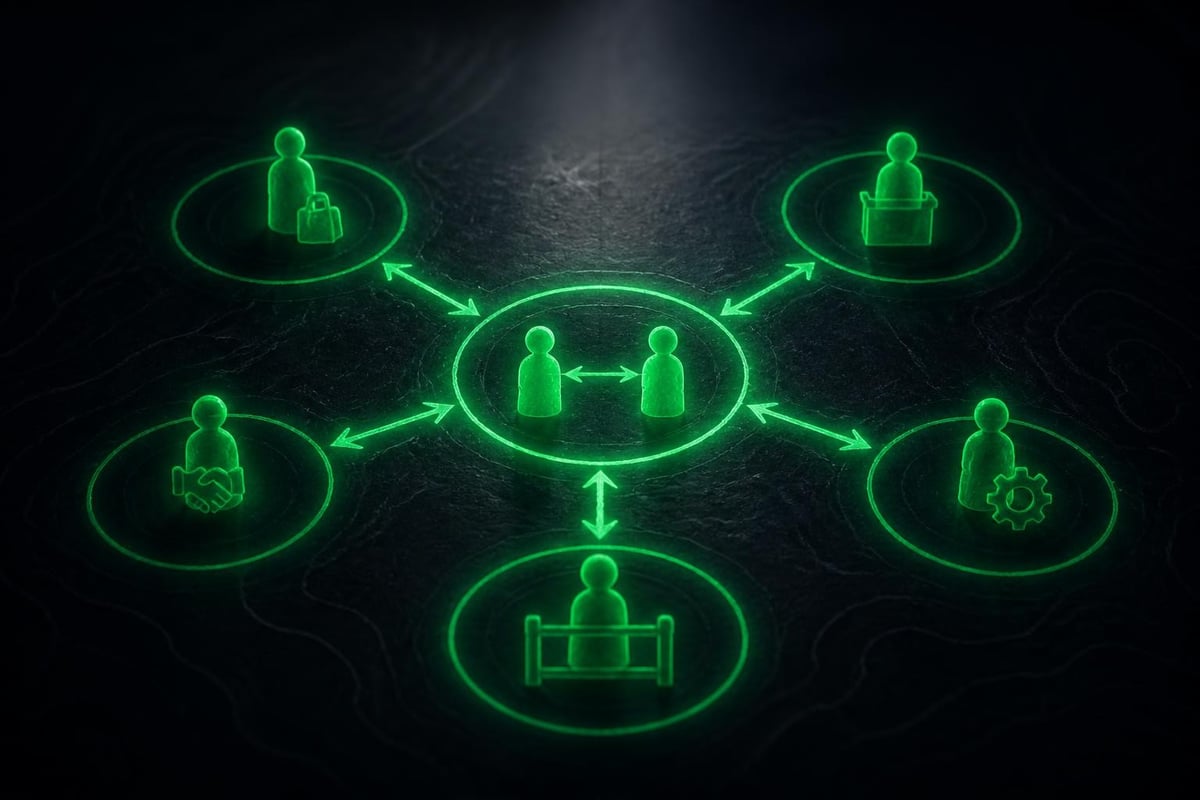
This framing shifts how you think about competitive intelligence. You stop treating the market as a static landscape and start treating it as a game with identifiable participants, each making moves based on their position and incentives. Once you know who the players are, you can start mapping their strategies.
Categories of Market Players and Their Roles
Not all market players have equal influence. Some set direction. Others follow. Some create volatility. Others stabilize. Breaking them into categories helps you understand who matters most in your specific market.
Buy-Side vs. Sell-Side
The buy-side consists of entities that purchase goods, services, or securities for their own portfolios or operations. Asset managers, pension funds, and corporate buyers fall here. They control capital allocation and drive demand.
The sell-side produces, distributes, and facilitates. Investment banks, brokers, and market makers operate here. In product markets, this includes manufacturers, distributors, and SaaS providers. Sell-side players compete for access to the buy-side.
| Player Type |
Primary Role |
Key Incentive |
| Buy-side |
Allocate capital or budget |
Maximize return or value |
| Sell-side |
Provide products or liquidity |
Maximize revenue or margin |
| Intermediaries |
Connect buyers and sellers |
Extract transaction fees |
| Regulators |
Enforce rules and standards |
Maintain market integrity |
Understanding which side of the market you're analyzing changes the questions you ask. If you're tracking competitors, you're analyzing sell-side positioning. If you're studying customer behavior, you're analyzing buy-side decision-making. If you're assessing channel strategy, you're mapping intermediaries.
Institutional vs. Retail
Institutional players operate at scale. They include corporations, funds, government agencies, and large procurement organizations. They have dedicated research teams, formal vendor evaluation processes, and long buying cycles. Decisions are committee-driven and documentation-heavy.
Retail players are individuals or small businesses making decisions with limited resources and shorter timeframes. They rely on reviews, referrals, and simplified evaluation criteria. Switching costs are lower. Emotional factors carry more weight.
The distinction matters for competitive strategy. Institutional players respond to thought leadership, case studies, and compliance guarantees. Retail players respond to ease of use, social proof, and transparent pricing. Your intelligence priorities shift depending on which segment you're targeting.
Active vs. Passive Participants
Active market players initiate moves. They launch products, change pricing, acquire competitors, or lobby regulators. They shape the market. Passive participants react. They follow trends, adopt industry standards, or wait for dominant players to make the first move.
Most markets have a small number of active players and a large number of passive followers. The active players drive most of the strategic risk and opportunity. That's where your competitive intelligence should concentrate. Algorithmic traders, for example, actively shape liquidity and volatility in financial markets, while traditional buy-and-hold investors remain passive. The same dynamic plays out in product markets: a few innovators set the pace, and everyone else adjusts.
How Market Players Influence Strategy
Knowing who the players are is only the first step. The real work is understanding how their actions create risk or opportunity for your position. Every move a market player makes changes the game board. New entrants shift competitive dynamics. Regulatory changes reset the rules. Channel partners change incentives. Each of these shifts demands a strategic response.
Competitive Positioning
Your competitors are the most obvious market players to track. But "competitor" is not a single category. Some compete head-to-head for the same customers. Others compete indirectly by pulling budget or attention. Some are emerging threats. Others are declining incumbents.
Mapping your competitive landscape means categorizing competitors by their strategic posture, not just their product features. Are they expanding aggressively or defending share? Are they moving upmarket or down? Are they integrating vertically or partnering horizontally? These questions reveal intent, and intent predicts future moves.
When you know a competitor is resource-constrained, you can anticipate slower product cycles. When you know they're investor-funded, you can anticipate aggressive discounting or M&A. When you know they're regulated differently, you can anticipate compliance advantages or constraints. Each insight reduces uncertainty.
Channel and Partner Dynamics
Intermediaries don't just connect buyers and sellers. They influence which sellers get access. A channel partner with strong buy-side relationships can accelerate your go-to-market. A platform with restrictive policies can block it. Understanding who controls distribution is as important as understanding who competes for share.
In B2B markets, system integrators, consultancies, and resellers act as gatekeepers. They shape buyer criteria and recommend vendors. If you're not visible to them, you're not visible to the end buyer. In consumer markets, app stores, marketplaces, and payment processors fill the same role. They set terms, take cuts, and enforce standards.

Tracking these players means monitoring their partnerships, policy changes, and economic incentives. When a major platform adjusts its fee structure, it shifts the economics for everyone operating on it. When a key integrator adds a new technology partner to their recommended stack, it signals a strategic bet. These moves create openings or threats.
Regulatory and Policy Shifts
Regulators are market players with enforcement power. They can rewrite the rules overnight. A compliance change can obsolete a business model or unlock a new market. Antitrust action can break up a dominant player. Privacy regulation can kill a data-driven strategy. Tariff policy can shift cost structures across an industry.
The SEC defines market participants with legal precision because their regulatory remit depends on accurate categorization. The same applies to GDPR, HIPAA, or any sector-specific regulation. Who you are determines what rules you follow, and what rules you follow determines what strategies you can execute.
Competitive intelligence should include regulatory monitoring. Not because compliance is inherently interesting, but because regulatory changes redistribute advantage. If new privacy rules ban a tracking method your competitor relies on, that's a strategic opening. If new safety standards require capital investment, that's a barrier to entry for smaller players. Policy is strategy by other means.
How to Map Market Players in Your Space
Mapping starts with identification. You can't analyze players you don't know exist. Most companies underestimate how many entities influence their competitive position. They track direct competitors and stop there. That's insufficient.
Start with Primary Competitors
Direct competitors are the baseline. These are companies targeting the same customers with similar solutions. If a buyer is evaluating you, they're probably evaluating them. This is the category most companies track first, and it's where most competitive intelligence begins.
But "direct competitor" is narrower than you think. A competitor might serve the same customer need with a completely different product architecture. Zoom and Microsoft Teams both solve video conferencing, but their go-to-market strategies, pricing models, and buyer personas differ. Are they direct competitors? Yes. Do they compete for every deal? No. Precision matters.
Steps to identify primary competitors:
- Survey your sales team for names that appear in deals
- Run customer interviews and ask who else they evaluated
- Search buyer intent data and review aggregator sites
- Monitor product comparison keywords in organic search
- Track funding announcements and industry coverage
BrandScout's Competitor Discovery & Tracking solves this systematically. Instead of manually assembling scattered lists, the platform surfaces every relevant competitor, including rising ones you'd miss, and organizes them in one living database that updates as new intelligence arrives.
Expand to Adjacent Players
Adjacent players don't compete directly, but they shape buyer behavior or market structure. A buyer might choose an alternative solution category instead of yours. A technology partner might build a competing feature. A supplier might integrate forward and become a competitor. Each of these shifts competitive dynamics.
Examples of adjacent players:
- Substitute products: different solutions to the same problem
- Upstream suppliers: vendors who could forward-integrate
- Downstream customers: buyers who could backward-integrate
- Complementary platforms: partners who could bundle or compete
- Emerging technologies: nascent solutions that could disrupt the category
Tracking adjacents is harder because they're not yet direct threats. But that's precisely why they matter. By the time an adjacent player becomes a direct competitor, they've already built momentum. Early identification creates time to respond.
Include Ecosystem Influencers
Some market players don't transact directly but influence decisions. Analysts like Gartner shape enterprise buying criteria. Media outlets shape perception. Industry associations shape standards. Activist investors shape public company strategy. Regulatory bodies shape operating constraints.
These players operate on a different timescale than product competitors. An analyst report might not impact this quarter's pipeline, but it sets the evaluation framework for the next two years. A regulatory proposal might not pass, but it signals political risk worth preparing for. Influencers create the context in which competition happens.
Using Market Player Intelligence to Make Decisions
Intelligence without application is trivia. The goal of mapping market players is to inform decisions: where to compete, how to position, what risks to mitigate, which opportunities to pursue. Every strategic framework assumes you know who the players are and what they're doing.
Choosing Where to Compete
Not all markets are equally attractive. Some are crowded with well-funded players. Others are fragmented with weak competition. Some are growing fast. Others are contracting. Porter’s Five Forces explicitly models market players as forces: competitor rivalry, buyer power, supplier power, substitute threats, and entry barriers.
| Force |
Market Player Type |
Strategic Impact |
| Rivalry |
Direct competitors |
Determines pricing power and differentiation needs |
| Buyer Power |
Customers and procurement |
Determines margin and contract terms |
| Supplier Power |
Vendors and input providers |
Determines cost structure and dependency risk |
| Substitutes |
Alternative solutions |
Determines category fragility |
| New Entrants |
Potential competitors |
Determines sustainability of position |
Analyzing these forces means analyzing the players behind them. If buyers are concentrated and price-sensitive, you face margin pressure. If suppliers are few and switching is costly, you face input risk. If barriers to entry are low, you face continuous competitive pressure. Each scenario demands a different strategy.

Timing Offensive and Defensive Moves
Competitive strategy is about timing. You attack when competitors are weak or distracted. You defend when they're strong or coordinated. You move into new segments when barriers are low. You exit when profitability collapses. All of these decisions depend on understanding what other market players are doing and why.
Jorge A. Vasconcellos e Sá's doctrine of competitive strategy offers a structured vocabulary for this. Eight defensive strategies protect position when rivals threaten. Six offensive strategies seize position when openings appear. The choice between them depends on your situation relative to other market players.
If a dominant competitor is distracted by regulatory scrutiny, that's an opening for offensive action. If a well-funded rival is pricing aggressively in your core segment, that's a signal to defend or concede and reallocate resources. The market players' moves determine which doctrine applies.
Structuring Your Intelligence Workflow
Ad-hoc intelligence creates blind spots. One exec tracks competitors. Another tracks partners. A third tracks regulatory risk. Nobody connects the dots. Structured intelligence workflows solve this by systematizing how you identify, monitor, and analyze market players.
The workflow should include:
- Discovery: identify all relevant players across categories
- Monitoring: track their moves, announcements, and signals
- Analysis: interpret what those moves mean for your position
- Dissemination: route insights to decision-makers in context
- Action: translate intelligence into strategic or tactical decisions
Most companies fail at step one. They never build a complete list. BrandScout’s Competitive Analysis & Strategy runs this workflow end-to-end. It maps your competitive landscape, applies proven frameworks automatically (PESTEL, Porter's Five Forces, SWOT, Ansoff), and generates strategic recommendations grounded in real competitive data. Instead of assembling intelligence manually and guessing at strategy, you get structured analysis and actionable plans.
Common Mistakes When Analyzing Market Players
Even experienced teams make predictable errors. They track the wrong players, misinterpret signals, or ignore systemic risks. Recognizing these mistakes improves the quality of your intelligence and the decisions that follow.
Focusing Only on Direct Competitors
This is the most common error. Companies obsess over product features, pricing, and messaging from head-to-head rivals while ignoring adjacent threats, regulatory shifts, and buyer behavior changes. Direct competitors matter, but they're only part of the system.
A SaaS company might track every competitor dashboard update while missing that a platform partner is building native functionality that obsoletes the category. An enterprise vendor might monitor rival win rates while missing that procurement policies are shifting toward open-source alternatives. Tunnel vision on direct competitors creates strategic blind spots.
The fix is systematic: map all player categories, not just the obvious ones. Track adjacent movers. Monitor regulatory proposals. Survey buyers for unmet needs and alternative solutions. Build a complete picture, not a narrow one.
Mistaking Activity for Strategy
Not every competitor move signals strategic intent. Some are tactical experiments. Others are reactive pivots. A pricing change might be a calculated attack or a desperate attempt to hit quarterly revenue targets. A product launch might be a long-term bet or a checkbox feature to satisfy a key account.
Distinguishing strategy from noise requires context. Is the move consistent with prior behavior? Does it align with their resource position? Does it solve a known weakness or exploit a known strength? If you can't answer these questions, you don't understand the player well enough to predict their next move.
Context comes from tracking players over time. One-off signals are ambiguous. Patterns reveal intent. If a competitor hires aggressively in a new vertical, launches a vertical-specific product, and opens an office in that geography, you're seeing a strategic expansion, not a tactical test.
Ignoring Resource Constraints
Players with different resources execute different strategies. A cash-rich incumbent can outspend rivals on marketing and acquisition. A venture-backed challenger can subsidize pricing to gain share. A bootstrapped startup has to compete on efficiency and focus. Ignoring these constraints leads to misinterpretation.
If a competitor cuts prices sharply, the explanation depends on their funding situation. If they just raised a Series B, it's a growth play. If they're cash-constrained, it's desperation. The same move, different meanings. Without knowing their resource position, you can't assess the threat accurately.
Resource intelligence should be part of your player profiles. Track funding rounds, revenue estimates, headcount growth, and burn rate. In public companies, parse earnings calls and SEC filings. In private companies, use job postings, office expansions, and vendor spend as proxies. The goal is to understand not just what they're doing, but what they're capable of sustaining.
Understanding who market players are and how they operate transforms competitive intelligence from guesswork into structured analysis. When you can identify buyers, competitors, intermediaries, and regulators, map their incentives, and anticipate their moves, you gain the clarity to make decisions with confidence. Brandscout helps businesses do exactly that: map competitive landscapes, analyze market players, and generate strategic recommendations grounded in real intelligence. Instead of scattered signals, you get structured insight that drives action.
Market Research and Market Intelligence in 2026
Most companies treat market research and market intelligence as interchangeable terms. They're not. One tells you what customers think right now. The other tells you what competitors are doing and where the market is moving. Both matter. Neither replaces the other. And if you confuse them, you'll build strategy on incomplete data.
Market research answers customer-facing questions: Do people want this feature? What price will they pay? How do they describe their problem? It's survey-heavy, focus-group-dependent, and oriented toward validating ideas before you commit resources. Market intelligence answers competitor-facing and environment-facing questions: Who's gaining share? What's the next regulatory shift? Where are adjacencies opening up? It's signal-heavy, pattern-dependent, and oriented toward understanding the battlefield before you pick your position.
What Market Research Actually Does
Market research quantifies demand and tests assumptions about customer behavior. You run it when you need evidence to support a product decision, pricing change, or messaging shift.
Primary Research: Direct Customer Contact
Primary research means you go straight to the source. Surveys, interviews, focus groups, usability tests. You design the questions, recruit the participants, and collect the data yourself.
When to use primary research:
- Testing a new product concept before development
- Understanding why customers churn
- Validating messaging before a campaign launch
- Exploring unmet needs in a segment you're targeting
Primary research gives you specificity. You control the questions, so you get answers tailored to your exact decision. The trade-off: it's slow and expensive. A well-designed survey takes weeks to field and analyze. Focus groups cost thousands per session. And if you ask the wrong questions, you've spent all that time learning nothing useful.
Secondary Research: Existing Data Sources
Secondary research uses data someone else already collected. Industry reports, government databases, analyst publications, competitor filings. You're interpreting existing information rather than generating new responses.
Common secondary research sources:
- Industry reports from firms like Gartner, Forrester, IDC
- Government census and economic data
- Trade association publications
- Academic studies and white papers
- Publicly available financial filings
Market research databases from institutions like UCLA Anderson organize thousands of these sources by industry and topic. Secondary research is faster and cheaper than primary. But it's also less specific. You're using data shaped by someone else's questions and priorities, which means it rarely fits your exact need.

The Validation Trap
Market research validates hypotheses. That's its strength and its limit. It tells you whether your current idea resonates. It doesn't tell you what ideas you should be testing. If you ask customers whether they want a faster version of your existing product, they'll say yes. If you ask whether they'd pay 20% more for it, they'll probably say no. Neither answer tells you whether a completely different approach would win.
Customers describe their current experience. They don't predict future behavior or articulate latent needs. As Wikipedia’s overview of market research methodologies notes, traditional research excels at measuring known variables but struggles with emergent patterns and competitive dynamics.
What Market Intelligence Actually Does
Market intelligence maps the environment you're operating in. It answers questions about competitors, market structure, regulatory shifts, technology trends, and adjacencies. Where market research looks inward at your customers, market intelligence looks outward at everyone else.
Competitive Intelligence: Who's Moving and How
Competitive intelligence tracks what your rivals are doing. Product launches, pricing changes, hiring patterns, partnership announcements, messaging shifts. You're watching their moves to understand their strategy and anticipate their next play.
What competitive intelligence reveals:
| Signal Type |
What It Tells You |
Where to Find It |
| Product launches |
Where they're investing |
Press releases, product pages, changelog updates |
| Pricing changes |
Their margin pressure or positioning shift |
Publicly listed prices, sales team feedback |
| Hiring patterns |
Which functions they're scaling |
LinkedIn job posts, Glassdoor reviews |
| Partnership announcements |
Strategic adjacencies or gaps |
Press releases, partner directories |
| Messaging updates |
How they're repositioning |
Website copy, ad creative, earnings calls |
Most companies track competitors manually. Scattered tabs, forgotten bookmarks, outdated spreadsheets. BrandScout’s Competitor Discovery & Tracking solves this by surfacing every competitor in your category automatically and organizing signals in one living view that updates as new intelligence arrives. You stop missing rising threats because someone forgot to check a changelog.
Market Structure: Understanding the Rules
Market intelligence also maps the structure of your industry. Barriers to entry, buyer concentration, supplier power, substitute threats, rivalry intensity. These forces shape what's possible and what's profitable, regardless of how good your product is.
Porter’s Five Forces framework systematizes this analysis. High barriers favor incumbents. Concentrated buyers squeeze margins. Available substitutes cap pricing power. You need to know which forces dominate your market before you choose a strategy.
Environmental Scanning: Spotting Shifts Early
Environmental scanning tracks macro trends that will reshape your market. Regulatory changes, technology shifts, economic cycles, social movements. These aren't competitor moves. They're structural changes that redefine the game.
PESTEL analysis organizes this scanning: Political, Economic, Social, Technological, Environmental, Legal. A new privacy regulation changes what data you can collect. A recession shifts buyer priorities. A technology breakthrough makes your current approach obsolete. Market intelligence flags these shifts while you still have time to adapt.

How Market Research and Market Intelligence Work Together
Market research and market intelligence aren't alternatives. They're complementary inputs to the same strategic decisions. Research tells you what customers want. Intelligence tells you what competitors offer and where the market is heading. You need both.
Positioning Decisions
When you position your product, market research tells you which benefits customers care about most. Market intelligence tells you which benefits competitors already own and where gaps exist. Research without intelligence leads to me-too positioning. Intelligence without research leads to differentiation nobody cares about.
The positioning stack:
- Research: What do customers value? (surveys, interviews)
- Intelligence: What do competitors claim? (competitive analysis, messaging audits)
- Decision: Which unclaimed benefit matters most to customers?
Product Development Priorities
Market research validates product ideas by measuring customer interest. Market intelligence reveals which features competitors are shipping and which adjacencies they're targeting. Research tells you what to build. Intelligence tells you how urgent it is and whether someone else will beat you there.
Market Entry Planning
When you enter a new market, research quantifies demand and tests willingness to pay. Intelligence maps the competitive landscape: who dominates, who's rising, what strategies they're running. Research guides from institutions like Penn State emphasize this dual approach to market planning.
Without research, you're guessing whether demand exists. Without intelligence, you're walking blind into an established competitive dynamic.
The Data Integration Problem
The problem isn't lack of data. It's that research and intelligence data live in different systems and rarely connect. Customer surveys sit in Qualtrics. Competitor tracking lives in spreadsheets. Industry reports pile up in email attachments. You can't answer integrated questions like "Do customers care about the feature our fastest-growing competitor just launched?" because the data sources don't talk.
Where Research and Intelligence Data Typically Live
| Data Type |
Common Storage |
Update Frequency |
Integration Difficulty |
| Customer survey results |
Survey platforms (Qualtrics, SurveyMonkey) |
Project-based |
High |
| Interview transcripts |
Documents, note-taking apps |
Project-based |
Very high |
| Competitor product data |
Spreadsheets, manual notes |
Sporadic |
High |
| Industry reports |
Email, file folders |
Quarterly/annual |
Very high |
| Market trend data |
Various databases |
Varies widely |
High |
The companies that win don't have better individual data sources. They integrate research and intelligence into a single view that supports decisions. That's hard to do manually at scale, which is why competitive and market intelligence platforms now automate signal collection and organize it alongside your research findings.

Choosing the Right Research Approach
Different questions need different research methods. Customer preference questions need surveys. Competitor strategy questions need intelligence gathering. Market structure questions need both.
When to Prioritize Market Research
Use market research when:
- Testing a new product concept before committing development resources
- Refining messaging before a major campaign launch
- Understanding churn drivers when retention drops
- Exploring new segments you haven't served before
- Validating pricing for a new tier or offering
Research excels at validation and quantification. It measures known variables and tests specific hypotheses. Harvard Business School’s guide to market research reports highlights how different research types support different validation needs.
When to Prioritize Market Intelligence
Use market intelligence when:
- Mapping your competitive landscape in a new category or geography
- Understanding rival strategy shifts after a major competitor announcement
- Evaluating market entry into an established industry
- Anticipating regulatory impacts on your business model
- Identifying acquisition targets or partnership opportunities
Intelligence excels at pattern recognition and strategic context. It reveals moves you wouldn't think to ask customers about because they're happening outside your current view. Comprehensive research source lists can help you identify where to gather intelligence signals across industries.
When You Need Both Simultaneously
Some strategic questions demand integrated research and intelligence:
Market expansion decisions: Research quantifies demand in the new market. Intelligence maps the competitive dynamics you'll face there.
Pricing strategy: Research tests customer willingness to pay. Intelligence reveals competitor pricing and margin pressure across the category.
Feature prioritization: Research identifies which capabilities customers want. Intelligence shows which features competitors offer and which they're building next.
You can run research and intelligence workstreams in parallel and integrate findings at decision time. Or you can run them sequentially, using early intelligence findings to shape your research questions. The sequence matters less than the integration.
Building a Market Research and Market Intelligence System
One-off research projects and sporadic competitor checks don't create sustainable advantage. You need a system that continuously gathers, organizes, and updates both types of data.
Research System Components
A functional research system includes:
- Regular customer feedback loops (NPS surveys, post-purchase interviews, usage analytics)
- Quarterly deep-dive studies on specific strategic questions
- Access to syndicated industry research relevant to your category
- Standardized templates for documenting and sharing findings
Intelligence System Components
A functional intelligence system includes:
- Automated competitor monitoring that tracks product, pricing, messaging, and hiring changes
- Structured competitive profiles updated as new signals arrive
- Environmental scanning for regulatory, technology, and market shifts
- Analysis frameworks that convert signals into strategic implications
Most companies build the research system first because customer feedback feels more urgent than competitor tracking. That's backward. Intelligence shapes which questions you should be researching. If you don't know what competitors offer, you can't design meaningful differentiation studies.
Integration Points
Research and intelligence systems need to connect at several points:
- Strategic planning: Annual or quarterly planning sessions where research findings and competitive intelligence inform priorities
- Product roadmaps: Feature decisions informed by both customer demand data and competitive gap analysis
- Go-to-market planning: Campaign development that incorporates customer messaging research and competitive positioning intelligence
- Pricing reviews: Pricing decisions that consider willingness-to-pay research and competitive pricing intelligence
The integration doesn't happen automatically. You need someone accountable for connecting the dots. In smaller companies, that's usually a founder or head of product. In larger companies, it's often a strategy or market intelligence function.
Common Mistakes in Market Research and Market Intelligence
Treating Research as Intelligence
Customer surveys tell you what people say they want. They don't tell you what competitors are building or where the market is moving. Relying only on customer feedback creates a delayed response to competitive threats. By the time customers mention a competitor's new feature, that competitor already launched and is gaining ground.
Treating Intelligence as Research
Tracking what competitors do doesn't tell you whether customers care. You can map every competitor's feature set and still miss what actually drives purchase decisions. Intelligence without research leads to feature matching that doesn't create value.
Running Projects Instead of Systems
Most companies run research and intelligence as projects. Launch a survey. Check a competitor. Write a report. File it away. Six months later, the data is stale and you start over. Projects deliver one-time insights. Systems deliver continuous understanding.
Collecting Data Without Analysis
Raw data isn't intelligence. A folder full of industry reports isn't market intelligence. A survey dashboard isn't market research. The value comes from analysis: patterns identified, implications drawn, strategic choices clarified. Resources from Purdue Libraries emphasize this distinction between data collection and analytical insight.
The Competitive Context for Research and Intelligence
Market research and market intelligence exist in competitive context. Your rivals are running their own research. They're tracking you the way you track them. The question isn't whether to invest in research and intelligence. It's whether your system is better than theirs.
Competitive advantages in research and intelligence:
- Speed: You spot shifts and respond faster
- Depth: You understand customer needs and competitive moves more precisely
- Integration: You connect research and intelligence better, leading to clearer strategic choices
- Continuity: Your knowledge compounds over time while rivals start from scratch each cycle
These advantages compound. A company that spots a trend six months earlier has six more months to adapt. A company that integrates research and intelligence makes fewer false moves. A company that builds continuous systems spends less time redoing foundational analysis and more time acting on insights.
Companies that treat market research and market intelligence as separate, episodic activities fall behind those that build integrated, continuous systems. The data sources are mostly available to everyone. The edge comes from what you do with them.
Making Intelligence Actionable
Market intelligence is worthless if it sits in reports nobody reads. The whole point is to change decisions. That means translating signals into implications, implications into options, and options into moves.
Most intelligence efforts fail at this translation step. Analysts document what competitors are doing. Executives nod. Nothing changes. The gap isn't more data. It's the analytical bridge from "they launched this" to "we should do that."
BrandScout’s SWOT framework and Ansoff Matrix analysis systematize this translation. Competitive signals get organized into structured assessments. Structured assessments generate strategic options. Strategic options get pressure-tested against research findings and turned into plans.
The companies winning in crowded markets aren't gathering more signals. They're converting signals to action faster.
Market research and market intelligence serve different purposes but enable the same outcome: better strategic decisions. Research validates customer-facing choices. Intelligence maps competitive and environmental context. Both fail without the other. Brandscout transforms scattered market signals and research findings into structured intelligence, runs proven analytical frameworks automatically, and generates actionable strategies grounded in your real competitive data. Stop treating research and intelligence as separate projects and start building an integrated system that compounds advantage over time.
Market Intelligence Analyst: What They Do in 2026
The market intelligence analyst occupation changed substantially between 2023 and 2026. What used to center on aggregating competitor press releases and quarterly reports now demands real-time synthesis across dozens of signal types, analytical frameworks that deliver strategic recommendations rather than passive dashboards, and the judgment to separate noise from insight when AI surfaces everything. The analyst who succeeds in this environment does different work than their 2020 counterpart, uses different tools, and faces different competitive pressure from automation.
What a Market Intelligence Analyst Actually Does Now
A market intelligence analyst transforms scattered market signals into structured intelligence that drives decisions. That's the core function, but the execution changed.
Primary Responsibilities in 2026
The work breaks into three layers: collection, analysis, and activation. Collection means identifying which signals matter for your competitive context, monitoring them continuously, and structuring the intake so patterns emerge rather than drowning in volume. Analysis means running proven frameworks against that data to surface strategic implications. Activation means translating findings into specific plays your team can execute.
Daily tasks typically include:
- Monitoring competitor product launches, pricing changes, messaging shifts, and hiring patterns
- Tracking regulatory developments, economic indicators, and technological changes that reshape competitive dynamics
- Running SWOT, PESTEL, or Porter's Five Forces analyses when new intelligence arrives
- Building and maintaining competitive databases that connect fragmented insights
- Briefing leadership on threats, opportunities, and recommended responses
- Creating battlecards, positioning documents, and strategic playbooks
The market intelligence analyst job description evolved substantially as AI automated data collection but increased the demand for strategic synthesis. You're paid for judgment, not gathering.

What Changed From Five Years Ago
The analyst role in 2021 involved significant manual work: subscribing to competitor newsletters, tracking their social accounts, reading industry reports, compiling everything into quarterly presentations. That consumption-and-reporting model broke when signal volume exploded and leadership demanded faster cycles.
By 2026, three shifts redefined the work:
AI handling collection. Tools now surface competitor changes, market shifts, and emerging threats automatically. The analyst curates and validates rather than manually hunts. This freed capacity but raised the bar on synthesis.
Frameworks becoming executable. SWOT used to produce a four-quadrant slide. Now leadership expects that analysis to end in a 90-day plan with specific attack or defense strategies derived from your competitive position. Tools like Brandscout’s Competitive Analysis & Strategy automate this translation, running proven frameworks and generating actionable plays grounded in your real data.
Speed replacing depth. Markets move faster. A thorough monthly report matters less than a brief daily synthesis that catches threats early. The cadence compressed.
Skills That Separate Good Analysts From Replaceable Ones
Not every capability matters equally. Some skills AI replicated; others became more valuable.
Core Competencies That Still Matter
| Skill Category |
Why It Matters in 2026 |
What Gets Tested |
| Strategic frameworks |
AI can run SWOT, but you decide which framework fits the question and interpret the output |
Whether you choose the right lens for the problem |
| Business acumen |
Understanding why a competitor's pricing change threatens your position requires knowing how markets actually work |
Connecting dots AI doesn't see |
| Communication |
Intelligence unused is intelligence wasted; you must brief executives clearly |
Whether leadership acts on your findings |
| Data literacy |
You're validating AI outputs, spotting patterns in messy datasets, and questioning conclusions |
Whether you catch errors machines make |
The skills necessary for market research roles include statistical analysis and survey design, but market intelligence leans heavier on competitive strategy and business judgment. The disciplines overlap but optimize for different outputs.
What AI Can't Replace Yet
Pattern recognition across unstructured signals requires context machines lack. When a competitor hires a VP of Enterprise Sales after three years focused on SMB, that signals a strategic shift. But which shift? Geographic expansion? Upmarket positioning? Desperation because SMB economics failed? The analyst provides the context that turns a data point into insight.
Judgment under ambiguity separates survivors from casualties. When you have incomplete information and leadership wants a recommendation, you're paid to make the call and explain your reasoning. AI suggests options; you choose the play.
Irreplaceable human skills:
- Reading competitive intent from indirect signals
- Knowing which threats demand immediate response versus monitoring
- Translating analysis into language executives trust
- Building relationships that surface intelligence sensors miss

How the Hiring Market Shifted
Demand for market intelligence analysts grew between 2023 and 2026, but the job description diverged from traditional market research. Companies want strategic thinkers who operate tools, not researchers who manually compile reports.
What Employers Actually Want
Job postings in 2026 emphasize different qualifications than five years prior. Educational background matters less than demonstrated ability to generate actionable intelligence. Certifications carry less weight than portfolio examples showing you turned messy competitive data into a strategic play that worked.
Research on labor market demands and skill extraction using natural language processing reveals that employers increasingly specify tools and frameworks by name rather than generic "analytical skills." You're expected to know SWOT, Porter's Five Forces, PESTEL, and Ansoff matrices as applied instruments, not theoretical concepts.
- Framework fluency. Can you run proven strategic analyses and extract implications?
- Tool proficiency. Platforms that automate collection and analysis replaced manual methods. Employers want analysts who leverage these tools rather than resist them.
- Speed of synthesis. Time from signal to recommendation matters. The analyst who delivers a decent brief today beats the one who delivers a perfect report next week.
- Cross-functional translation. Your intelligence serves product, marketing, sales, and executive teams. Each needs different formats and emphasis.
Salary and Career Trajectory
Compensation depends heavily on whether you generate strategic value or simply aggregate information. Analysts who produce passive reports command $60,000 to $85,000. Those who generate competitive strategies and influence major decisions earn $95,000 to $140,000. The spread widened as automation commoditized the lower end.
Career paths split into two directions: deeper specialization in competitive strategy (leading to Chief Strategy Officer or VP Strategy roles) or broader general management (where intelligence work becomes one competency among several). The specialist path pays more but offers fewer seats.
The Tools and Methods That Define the Work
The technology stack for market intelligence changed completely between 2021 and 2026. Manual methods don't scale; AI-powered platforms replaced spreadsheets and slide decks.
The Old Stack vs. The New Reality
| Function |
2021 Method |
2026 Solution |
| Competitor tracking |
Browser bookmarks, email alerts, manual checks |
AI-powered discovery and monitoring |
| Data organization |
Spreadsheets, shared drives |
Structured competitive intelligence databases |
| Analysis |
Manual framework application, consultant decks |
Automated framework execution with strategic outputs |
| Distribution |
Email reports, quarterly presentations |
Living dashboards, automated briefs, integrated playbooks |
Platforms that map competitive landscapes and run strategic frameworks automatically changed what "doing the work" means. The market intelligence analyst now spends less time collecting and more time validating, interpreting, and activating.
Framework Application in Practice
Strategic frameworks used to be workshop exercises. In 2026, they're operational tools applied continuously.
SWOT analysis identifies your competitive position relative to rivals. But stopping at the four quadrants wastes the exercise. The valuable output is the strategy that emerges: which strengths you exploit, which weaknesses you shore up, which opportunities you pursue, which threats you counter. Understanding SWOT as an active tool rather than a reporting template separates analysts who influence decisions from those who populate slides.
Porter's Five Forces reveals where competitive pressure comes from: rival intensity, supplier power, buyer power, substitution threat, and entry barriers. This framework tells you whether your market favors incumbents or invites disruption. For market intelligence analysts, the application isn't describing the five forces but quantifying how they shifted and what strategic response that shift demands.
PESTEL (Political, Economic, Social, Technological, Environmental, Legal) catches macro forces before they hit your quarterly results. Analysts who monitor these vectors early give leadership time to adapt rather than react.
Common Mistakes That Tank Analyst Effectiveness
Even experienced analysts make errors that undermine their impact. Most failures aren't about skill but about misunderstanding what the role actually delivers.
Collecting Without Synthesizing
The worst trap is confusing activity with value. Monitoring 50 competitors, compiling weekly reports, and maintaining massive databases feels productive. But if none of it changes what your company does, you're producing waste.
Intelligence only matters when it alters decisions. The analyst who tracks fewer competitors but identifies the one existential threat and builds the counter-strategy delivered more value than the one with comprehensive coverage and no recommendations.
Chasing Perfection Over Timeliness
Markets move faster than research cycles. Waiting for complete information before briefing leadership means arriving after the window closed. The analyst's job includes making calls with incomplete data and updating as clarity improves.
A 70% confident recommendation delivered Monday beats a 95% confident one delivered Friday when the competitor launches Thursday. Speed compounds in competitive environments.
Ignoring the Activation Layer
Analysis that doesn't convert into action wastes everyone's time. This means your deliverable isn't the insight itself but the play your team can execute. Instead of "Competitor X is expanding into enterprise," the useful output is "Competitor X hired three enterprise AEs and launched an upmarket tier. We should counter by accelerating our own enterprise features and running comparison campaigns before they establish credibility. Here's the 30-day plan."
Building effective battlecards exemplifies activation: taking competitive intelligence and packaging it so your sales team wins deals they would have lost.

How AI Changed the Analyst's Actual Work
Automation didn't eliminate the market intelligence analyst role. It changed which tasks matter and which capabilities differentiate you.
What AI Actually Does Well
AI excels at volume, pattern detection across large datasets, and consistent application of defined processes. For market intelligence, this means:
- Monitoring hundreds of competitors simultaneously and surfacing meaningful changes
- Scanning job postings, product updates, pricing changes, and executive movements
- Running standard frameworks (SWOT, PESTEL, Porter's Five Forces) against structured data
- Generating initial strategy drafts based on competitive positioning
Studies on AI-powered labor market analysis demonstrate how machine learning can process real-time job market data and extract strategic signals about industry shifts. The same techniques apply to competitive intelligence: AI identifies patterns humans would miss in manual review.
Research on topic-based classification for analyzing hiring trends among major companies shows how AI can track competitor strategy through their talent acquisition. A market intelligence analyst in 2026 leverages these outputs rather than manually tracking every job posting.
What Still Requires Human Judgment
AI provides inputs; analysts make decisions. The technology can flag that three competitors raised prices within two weeks. The analyst determines whether that represents coordinated positioning, cost pressure across the industry, or isolated choices requiring different responses.
Critical human functions in 2026:
- Choosing which frameworks apply to which questions. Not every situation needs Porter's Five Forces.
- Interpreting ambiguous signals. When competitor behavior contradicts their stated strategy, what does that reveal?
- Weighing trade-offs. Every strategic choice involves sacrifices. AI suggests options; you evaluate which costs are acceptable.
- Building credibility with leadership. Executives trust people, not algorithms. Your judgment and track record matter.
The market intelligence analyst who treats AI as a research assistant rather than a threat multiplies their output. The one who competes with automation on tasks machines do better loses.
The Organizational Challenges Analysts Navigate
Technical skills matter, but organizational dynamics determine whether your intelligence actually influences decisions. The best analysis fails if you can't navigate politics, earn trust, and time your interventions.
Getting Leadership to Act on Intelligence
You can surface the perfect competitive threat and watch leadership ignore it. Why? Because you didn't build the relationship that makes them listen, or you delivered the insight without the recommended response, or you've been wrong too many times and burned credibility.
Tactics that work:
- Brief executives in their language, not yours. Sales cares about deals at risk. Product cares about feature gaps. Tailor the message.
- Lead with the recommendation, not the data. They want to know what to do, then why, then the supporting evidence.
- Establish a track record of accurate calls. Credibility accumulates from being right repeatedly.
- Provide options with trade-offs clearly stated. Don't just push one answer.
Studies on advanced job candidate matching systems reveal how data analysis enhances decision-making when paired with clear recommendations. The same principle applies to competitive intelligence: analysis alone doesn't drive action; analysis paired with clear next steps does.
Multi-Brand Complexity
Agencies, holding companies, and enterprises with multiple divisions face a specific challenge: repeating competitive intelligence work across every brand. The market intelligence analyst at a single-brand company can focus depth on one competitive landscape. The analyst supporting ten brands drowns in redundancy.
Platforms that solve scale problems, managing competitive intelligence across multiple brands from one account, let analysts maintain depth without multiplying workload. This architectural choice determines whether you can support growth or become a bottleneck.
When the Analyst's Warning Gets Ignored
You'll brief leadership on a competitor threat. They'll nod. Nothing will happen. Three months later, the threat materializes and everyone acts surprised. This pattern kills analyst morale and organizational effectiveness.
Why it happens:
- Your recommendation required difficult trade-offs leadership didn't want to make
- The insight arrived too early; the pain wasn't acute yet
- You lacked political capital with the decision-maker
- Competing priorities consumed all available resources
The mature analyst understands that being right doesn't guarantee being heard. You document the warning, update as the situation evolves, and resurface the intelligence when the organization becomes ready to act.
The Emerging Specializations Within Market Intelligence
The market intelligence analyst role is fragmenting into subspecialties as markets grow more complex and tools enable deeper focus.
Vertical-Specific Intelligence
Healthcare market intelligence requires different frameworks and signals than SaaS or consumer goods. The analyst who develops domain expertise in regulatory environments, reimbursement models, and clinical validation timelines can't easily transfer that knowledge to e-commerce.
Specialization pays. Generalist analysts command lower salaries and face more competition. Specialists who understand both intelligence frameworks and the specific competitive dynamics of their vertical become irreplaceable.
Real-Time Competitive Response
Some analysts focus entirely on speed: detecting competitor moves within hours and generating immediate counter-strategies. This subspecialty serves fast-moving markets where late response means lost opportunity.
The skillset emphasizes rapid synthesis, pre-built playbooks, and strong executive relationships that enable fast decisions. You're optimizing for speed over completeness.
Strategic Positioning and Doctrine
The analyst who moves beyond reporting into strategic design works differently. You're not just tracking competitors; you're architecting your company's competitive stance and choosing which doctrines to deploy.
This work requires understanding both the frameworks (SWOT, Porter's Five Forces, PESTEL) and the strategic options those frameworks reveal. How competitive positioning shapes marketing decisions determines whether your intelligence translates into market advantage.
The market intelligence analyst who survives and thrives in 2026 synthesizes faster, chooses frameworks deliberately, and converts intelligence into plays leadership can execute. The role demands less collection and more judgment as AI handles volume but can't replace strategic thinking. If you're building competitive intelligence capabilities or need to move from scattered signals to structured strategy, Brandscout automates the frameworks and surfaces the plays so you focus on the decisions that matter.
Strategic Marketing Company: Build One or Hire One
Most companies don't lack marketing talent. They lack the connective tissue between what's happening in the market and what they actually do about it. That gap is what a strategic marketing company is built to close. Not the brand refresh, not the campaign production, not the media buy. The architecture that connects market reality to strategic choice to execution. If you're trying to decide whether to build that capability internally or hire someone to deliver it, you need to understand what you're actually buying.
What a Strategic Marketing Company Actually Does
A strategic marketing company doesn't start with creative concepts or channel tactics. It starts with intelligence. The core function is converting fragmented competitive and market signals into structured insight, then translating that insight into decisions your team can act on. That means competitive positioning, market entry strategies, defensible differentiation, and executable campaigns grounded in what your rivals are doing and where gaps exist.
This is not the same work most marketing agencies perform. Traditional agencies optimize what you've already decided. A strategic marketing company decides what to optimize. The output isn't a deliverable you approve. It's a framework that tells you where to move, what to protect, and which battles to avoid entirely.
The Core Capabilities You're Paying For
When you engage a strategic marketing company or build one internally, you're assembling three distinct capabilities:
Market intelligence infrastructure that continuously captures competitive signals. Pricing changes, messaging shifts, product launches, customer sentiment, market expansion. Most teams do this manually, if at all. A strategic function systematizes it.
Strategic frameworks applied to real data. PESTEL, Porter’s Five Forces, SWOT, and Ansoff aren't theory exercises. When run against structured competitive data, they surface the five moves that matter. Most companies skip this step entirely, jumping straight from "we should do something" to tactics.
Execution translation. The bridge from "here's the strategic recommendation" to "here's the 90-day plan." Campaign concepts, messaging hierarchies, channel prioritization, resource allocation. Strategy that doesn't become a calendar is just commentary.

Build vs. Hire: The Honest Trade-Offs
You have two paths: build the capability internally or contract it to a strategic marketing company. Both have brutal costs most executives underestimate.
Building In-House: What It Actually Requires
Building a strategic marketing capability inside your company means hiring analysts who think like strategists and strategists who can operationalize. That's rare. You're not hiring a marketing manager who "does strategy." You're hiring someone who can run frameworks, interpret signals, and make calls that contradict your instincts when the data says so.
| Requirement |
Reality |
Hidden Cost |
| Personnel |
1-2 dedicated roles minimum |
$150K-$300K annually per head |
| Intelligence tools |
Competitive tracking, analytics, research platforms |
$20K-$60K annually |
| Time to competence |
6-12 months to build processes |
Opportunity cost of delayed decisions |
| Framework expertise |
Training or external consultants |
$15K-$40K initially |
The real cost isn't the salary. It's the six months you spend teaching them your market while competitors move. Internal teams have one advantage: they know your business cold. They have one liability: they're swimming in the same biases as everyone else in the building.
Hiring a Strategic Marketing Company: The Hidden Friction
External strategic marketing companies bring frameworks and fresh perspective. They've run the analysis for other clients, they know which signals matter, and they're not emotionally attached to your last quarter's roadmap. But they're expensive, and the onboarding friction is real.
Expect $10K-$50K monthly retainers depending on scope, or project fees starting at $25K for a single analysis sprint. The cost isn't the problem. The problem is the three weeks you spend explaining your market before they can produce anything useful. The follow-up calls to clarify why their recommendation won't work given internal politics. The gap between "here's the strategy" and "here's how we execute it with our actual team."
The decision isn't build vs. hire. It's speed vs. control. If you need strategic clarity in the next 60 days, hire. If you can invest 12 months building the muscle, build. If you're somewhere in between, you're going to waste money either way.
What Separates Strategic Marketing from Execution Marketing
Most marketing teams execute well. They launch campaigns, track performance, optimize creative, manage budgets. But execution without strategy is just expensive activity. A strategic marketing company exists to answer the question execution can't: what should we be doing in the first place?
Strategic Questions vs. Tactical Questions
The line between strategic and tactical work is simple. Tactical work asks "how do we do this better?" Strategic work asks "should we be doing this at all?"
Tactical marketing questions:
- Which ad creative drives more conversions?
- What's the optimal email cadence for this segment?
- Should we bid higher on this keyword?
- How do we improve landing page performance?
Strategic marketing questions:
- Which competitors threaten our position and why?
- What market segments should we enter or exit?
- Where can we compete without triggering direct retaliation?
- What messaging positions us uniquely against the top three rivals?
Execution teams answer the first set. A strategic marketing company answers the second. Most companies have five people working on the first set and zero on the second, then wonder why their marketing produces activity but not advantage.

The Intelligence Problem Most Companies Ignore
Strategy without intelligence is just opinion. Yet most companies treat competitive intelligence as an afterthought. Someone updates a spreadsheet quarterly. A manager screenshots a competitor's homepage. An intern pulls pricing from public websites. Then leadership makes million-dollar decisions based on gut feel and three-month-old data.
A strategic marketing company, whether internal or external, is only as good as the intelligence it works from. Garbage signals produce garbage strategy. That's why the competitive intelligence database playbook matters more than the frameworks you layer on top of it.
What Strategic Intelligence Actually Looks Like
Real competitive intelligence isn't a static report. It's a living system that updates as the market moves. Pricing changes, product launches, messaging pivots, hiring patterns, customer reviews, partnership announcements. Structured, tagged, contextualized, and ready to query when a strategic question emerges.
When you ask "should we launch in this vertical?" the intelligence layer should surface which competitors already operate there, what positions they hold, where they're vulnerable, and what it would cost to enter. When you ask "how should we respond to this competitor's new feature?" the system should show their historical pattern: do they finish what they start, or is this vaporware?
Most teams can't answer those questions without a week of research. A strategic marketing company answers them in real-time because the intelligence infrastructure already exists. That's the capability gap you're paying to close.
Frameworks Are Tools, Not Magic
A strategic marketing company runs proven frameworks. PESTEL maps external forces. Porter's Five Forces reveals structural pressures. SWOT converts analysis into options. Ansoff prioritizes growth vectors. These aren't proprietary secrets. They're power tools. The value isn't knowing they exist. It's knowing which one to use when, and how to extract decisions from the output.
How Frameworks Convert Signals Into Strategy
Most companies misuse strategic frameworks in one of two ways. Either they skip them entirely, trusting instinct over structure. Or they run them as academic exercises, producing slide decks no one acts on. A strategic marketing company does neither. It runs the frameworks against real data, then uses the output to make calls.
Here's what that actually looks like. You're deciding whether to attack a market leader head-on or carve out a niche they ignore. Porter’s Five Forces tells you whether the market structure punishes aggression or rewards it. SWOT reveals where the leader is genuinely vulnerable versus where they just look weak. Ansoff tells you whether the safer play is market penetration, product development, market development, or diversification. The frameworks don't make the decision. They eliminate the stupid options before you waste money testing them.
BrandScout's Competitive Analysis & Strategy automates this exact workflow. Instead of spending two weeks running frameworks manually, HORIZON AI applies PESTEL, Porter's, SWOT, and Ansoff to your competitive data, then generates attack and defense strategies grounded in what your rivals actually do. It solves the "I have a competitor list but don't know what to do with it" problem most strategic marketing companies charge $30K to answer.
The Output You Should Demand
Whether you're building an internal strategic marketing function or hiring a strategic marketing company, the output should look the same. Not a report. Not a presentation deck. A decision framework and an execution roadmap.
What Deliverables Actually Move the Business
The final output from strategic work should answer three questions with zero ambiguity:
-
What position should we take in the market? The differentiated value proposition that survives competitive pressure and economic shifts. This is grounded in analysis, not aspiration. It's the claim you can defend when rivals attack.
-
What strategic moves defend or extend that position? The 3-5 plays that matter over the next 12 months. Enter this segment, launch this product, reposition against this competitor, acquire this capability, exit this channel. Prioritized by impact and feasibility.
-
What does execution look like in the next 90 days? The campaign concepts, messaging frameworks, channel tactics, and resource allocation. A calendar someone can actually work from, not strategic platitudes.
If the strategic marketing company you hire (or the capability you build) can't deliver all three, you're paying for analysis theater. Analysis that doesn't become action is just expensive curiosity.
How Strategic Marketing Connects to Business Strategy
Marketing strategy isn't a separate discipline from business strategy. It's the same work applied to competitive positioning and customer acquisition. A strategic marketing company worth its fee understands this. It doesn't create marketing plans in a vacuum. It asks what the business is trying to achieve, what competitive threats exist, and what resources are realistically available, then builds the marketing strategy that serves those constraints.
That connection breaks when marketing and business strategy operate on different assumptions. The business team thinks the company competes on innovation. The marketing team positions on price. The business team plans to enter enterprise. The marketing team runs campaigns for SMBs. A strategic marketing company solves this by forcing alignment before execution starts. It surfaces the contradictions early, when they're cheap to fix.
The Framework That Matters Most: Strategic Position
Everything downstream depends on clarity about strategic position. Where do you compete? Against whom? On what basis? What can you defend long-term? Most companies answer these questions with vague language and hope the market doesn't test them. A strategic marketing company makes you answer precisely, because everything you spend money on flows from that position.
If your position is "premium quality for enterprises," you don't run volume plays in SMB. If your position is "challenger brand undercutting the leader on price," you don't message on innovation. If your position is "category creator defining new space," you don't fight feature-for-feature against incumbents. Strategic clarity eliminates half your tactical options. That's the point.
How strategic position determines competitive positioning, target markets, messaging hierarchy, and channel allocation
When to Use a Strategic Marketing Company vs. Internal Resources
The decision to hire external or build internal isn't permanent. Most high-growth companies do both at different stages. Use a strategic marketing company when you need speed, specialized expertise, or an outside perspective untainted by internal politics. Build internally when the market moves fast enough that outsourcing creates lag, or when strategic nuance requires deep domain knowledge no external firm will develop.
Situations Where External Wins
Hire a strategic marketing company when:
- You're entering a new market and don't have competitive intelligence. External firms bring frameworks and can ramp faster than internal hires.
- Internal teams are stuck in legacy thinking. Sometimes you need someone outside the building to say what everyone inside already knows but won't act on.
- You need a one-time strategic reset, not ongoing support. Project-based engagements make sense when the work is episodic, not continuous.
- You lack the budget or headcount for permanent strategic roles. A $40K project beats a $200K salary when you only need the work twice a year.
Situations Where Internal Wins
Build internally when:
- Your market moves faster than monthly retainer cycles allow. If competitive shifts require weekly analysis and response, external lag kills you.
- Strategic context requires deep, proprietary knowledge. Complex B2B markets, regulated industries, or technical products where external consultants spend months learning what internal teams already know.
- You're past product-market fit and need continuous optimization. Ongoing strategic work justifies permanent headcount. One-off projects don't.
- The cost of wrong decisions exceeds the cost of internal expertise. If a bad strategic call costs you $1M, hiring a $150K strategist is cheap insurance.
The hybrid model works best for most companies. Use external strategic marketing companies for the frameworks, competitive benchmarking, and market entry analysis. Build internal teams for execution, continuous intelligence gathering, and rapid iteration. Each handles what it does better than the other.
What to Look for When Hiring a Strategic Marketing Company
If you decide to hire externally, most strategic marketing companies will pitch capabilities, case studies, and process. Ignore all of it. Ask three questions instead.
The Only Three Questions That Matter
1. What intelligence infrastructure do you use to ground your recommendations?
If they say "we'll conduct research as part of the engagement," you're paying them to learn your market. If they say "we have proprietary databases" or "we'll build a competitive intelligence system for you," ask to see examples. If they say "we rely on your team's knowledge," they're consultants, not strategists. Strategic recommendations without independent intelligence are just expensive agreement.
2. Which frameworks do you run, and can you show me how you apply them to real data?
If they list frameworks but can't walk you through a specific example of how PESTEL surfaced a strategic insight, they're selling theory. Ask for a sanitized case study showing input data, framework application, and resulting strategic recommendation. If they can't produce it, they don't do the work they're selling.
3. What does the deliverable look like, and how does it connect to execution?
If the answer is "a strategic deck and readout session," walk away. Decks don't change behavior. Ask what the execution roadmap includes. Campaign concepts? Messaging frameworks? Channel tactics? Resource allocation? A 90-day calendar? If they say "that's a separate engagement," you're buying analysis without action.
Most strategic marketing companies fail at least one of these tests. The ones that pass all three are rare and expensive. But they're worth it if the alternative is making strategic bets with no data and no framework.
The Real Cost of Getting It Wrong
The penalty for bad strategic marketing isn't wasted budget. It's opportunity cost. Every quarter you spend executing the wrong strategy is a quarter competitors use to entrench their positions. Every dollar you invest in the wrong segment is a dollar you can't deploy where you'd actually win. Every message that misreads the competitive landscape trains customers to ignore you.
Strategic mistakes compound. Tactical mistakes are reversible. You can fix a bad campaign in weeks. You can't fix a bad market entry decision without exiting and re-entering, which costs time, reputation, and capital. That's why strategic marketing matters more than most companies admit. It's the decision layer that determines whether everything downstream works or wastes money.
A strategic marketing company's real value isn't the frameworks it runs or the insights it surfaces. It's the bad decisions it helps you avoid before you make them. That's worth far more than the retainer.
Strategic marketing closes the gap between competitive reality and execution. Most companies either analyze endlessly without acting, or act without analyzing and hope for the best. Neither works. The companies that win treat intelligence, strategy, and execution as one connected system, not three separate functions. Whether you build that system internally or hire a strategic marketing company to deliver it, the core capability is the same: converting market signals into structured decisions. BrandScout does exactly that, mapping your competitive landscape, running proven frameworks against real data, and generating actionable strategies and campaign plans so you stop guessing and start executing with confidence.
Competitive Marketing Intelligence: A 2026 Guide
Most companies know their competitors exist. Few understand what those competitors are actually doing, why it works, or how to respond. That gap is the difference between reacting to market shifts and shaping them. Competitive marketing intelligence closes that gap by transforming scattered signals into structured understanding, then turning that understanding into action. This is not about spying or obsessing over rivals. It is about building a system that tells you when to attack, when to defend, and when to ignore the noise entirely.
What Competitive Marketing Intelligence Actually Means
Competitive marketing intelligence is the systematic collection and analysis of information about competitors' marketing strategies, tactics, and performance to inform your own strategic decisions. It answers three questions: what are competitors doing, why is it working or failing, and what should you do about it.
This is not the same as general market research. Market research tells you about customers, demand, and trends. Competitive marketing intelligence tells you how rivals are positioning themselves within that landscape, which channels they are prioritizing, what messages are resonating, and where they are vulnerable.
The practice includes:
- Monitoring messaging and positioning across websites, ads, social media, and content
- Tracking campaign activity to understand timing, channels, and creative approaches
- Analyzing pricing and promotional strategies to spot shifts in value propositions
- Identifying partnership and distribution moves that expand competitor reach
- Assessing brand perception through reviews, sentiment analysis, and customer feedback
Without this intelligence, you are making decisions in the dark. You might launch a campaign only to discover a competitor already owns that narrative. You might invest in a channel where rivals have better economics. You might miss an opening because you did not notice a competitor retreating.

Why Marketing Teams Need Structured Intelligence
Marketing without competitive context is guesswork. You can run A/B tests, optimize landing pages, and refine ad copy, but if you do not know what competitors are saying, you are optimizing in isolation. Your "winning" message might still lose to a competitor's narrative that is better positioned.
The problem is not lack of information. Marketing teams are drowning in signals: competitor emails, social posts, press releases, ad launches, pricing changes, review sites, analyst reports. The problem is converting that flood into decisions.
Three Failures of Ad-Hoc Intelligence
Most teams approach competitive intelligence reactively. Someone notices a competitor's campaign, shares it in Slack, and the team discusses it for ten minutes before moving on. A month later, no one remembers the insight. This creates three failures:
- Inconsistent coverage – You notice the loud moves but miss quiet repositioning
- Scattered storage – Intelligence lives in emails, screenshots, bookmarks, and memory
- No synthesis – Each signal is evaluated alone, so you never see the pattern
As Sprout Social’s competitive intelligence guide emphasizes, effective intelligence requires both systematic collection and analytical frameworks that connect individual signals into strategic narratives.
A structured approach changes this. Instead of reacting to random signals, you build a living view of the competitive landscape that updates continuously and surfaces patterns. You notice when three competitors shift messaging toward the same pain point. You see when a rival's ad spend drops before they announce layoffs. You spot the opening before it closes.
Building a Competitive Marketing Intelligence System
A functional system has four components: collection, organization, analysis, and action. Most teams fail at organization, which makes analysis impossible and action random.
Collection: What to Track
Focus on observable marketing activity, not internal speculation. Track what competitors put into the market:
| Category |
What to Collect |
Where to Find It |
| Messaging |
Value propositions, taglines, feature emphasis |
Websites, ads, landing pages |
| Content |
Topics, formats, publishing frequency |
Blogs, videos, webinars |
| Campaigns |
Timing, channels, creative themes |
Ad libraries, social media, email |
| Pricing |
Tier structure, promotions, packaging |
Pricing pages, sales materials |
| Partnerships |
Integrations, co-marketing, distribution |
Press releases, partner pages |
| Reviews |
Customer complaints, praise patterns |
G2, Capterra, Trustpilot |
Do not try to track everything. Start with your top five competitors and the categories that matter most to your market position. A founder in a crowded SaaS category needs different intelligence than a B2B services firm competing on expertise.
Organization: Making Intelligence Accessible
Raw data is useless. Intelligence needs structure so your team can find it, compare it, and act on it. Most teams fail here because they store screenshots in Google Drive or paste links in Notion without tagging or context.
Effective organization requires:
- Competitor profiles that consolidate all intelligence about each rival in one place
- Category views that show how all competitors approach messaging, pricing, or partnerships
- Timeline tracking that reveals when changes happened and in what sequence
- Tagging systems that connect related signals across competitors and time
For teams managing competitive research across multiple brands or clients, platforms designed for this scale prevent the repetitive work of rebuilding intelligence databases for each entity. Multi-Brand Competitive Intelligence approaches solve this by running the full discovery-to-strategy workflow across separate competitive landscapes from a single account.
Analysis: From Signals to Strategy
This is where competitive marketing intelligence becomes valuable. Collection tells you what happened. Analysis tells you what it means and what to do about it.
Start with pattern recognition:
- Are multiple competitors moving toward the same positioning?
- Is someone testing a new channel repeatedly?
- Did messaging shift after a funding round or leadership change?
- Are customer complaints clustering around a specific feature or experience?
Then apply frameworks. PESTEL analysis helps you understand which external forces are driving competitor behavior. A pricing shift might reflect supply chain pressure, not a new strategy. SWOT analysis maps where competitors are strong, weak, exposed, or expanding.
The most decisive intelligence comes from recognizing strategic patterns. When you see a competitor pulling back from enterprise accounts while increasing self-service features, they are not just changing tactics. They are repositioning entirely. That creates an opening for you to take enterprise ground they are abandoning.

Turning Intelligence Into Action
Intelligence that does not change decisions is entertainment. The goal is not to know more about competitors. The goal is to make better moves.
Defensive Applications
Use competitive marketing intelligence to protect what you have:
- Monitor message overlap to ensure competitors are not eroding your differentiation
- Track pricing pressure to respond before customers start comparing
- Spot poaching campaigns targeting your customers with switching offers
- Identify feature parity moves that neutralize your advantages
A case study from Aqute Intelligence shows how a media company used competitive intelligence to understand a rival's marketing strategy and make informed decisions that regained lost market share. The intelligence revealed not just what the competitor was doing, but where their campaign was vulnerable.
Defensive intelligence keeps you from losing ground while you prepare offensive moves.
Offensive Applications
Intelligence reveals where competitors are weak, distracted, or overextended:
- Claim abandoned positioning when rivals shift away from a valuable narrative
- Target underserved segments competitors are ignoring or exiting
- Outflank channel gaps where competitors have no presence or weak execution
- Attack during transitions when competitors are distracted by reorgs, acquisitions, or leadership changes
Effective offensive strategy is not about copying what competitors do well. It is about exploiting what they do poorly or not at all. If every competitor is shouting about AI features, there may be an opening to own simplicity and ease of use.
The Ansoff Matrix helps you decide which growth opportunities are worth the risk based on competitive intelligence. Should you attack competitors in their core market, or is adjacent expansion a safer path?
Campaign Execution
Translate intelligence into tactical campaign decisions:
- Message testing – If competitors are weak on a pain point, test whether customers care
- Channel prioritization – Invest where competitors are absent or underperforming
- Timing optimization – Launch during competitor quiet periods to maximize attention
- Creative differentiation – Avoid themes, formats, and language rivals already own
Intelligence also prevents wasted effort. If three competitors already tried and failed at a specific channel or message, you save time by avoiding the same mistake.
Common Competitive Intelligence Mistakes
Even teams committed to competitive marketing intelligence make predictable errors that undermine results.
Mistake One: Watching Too Many Competitors
Tracking fifteen competitors produces noise, not insight. You cannot analyze that much data, and most of those competitors do not matter. Focus on direct rivals who compete for the same customers with similar solutions. Ignore companies in adjacent markets unless they are clearly moving into your space.
Mistake Two: Confusing Activity With Strategy
A competitor launching a new landing page is activity. Understanding why they launched it, who it targets, and whether it is working is strategy. Do not just collect signals. Analyze what they reveal about competitor intent and market positioning.
Mistake Three: Over-Indexing on Funded Competitors
A competitor raising $50 million gets attention, but money does not guarantee smart strategy. Watch what they do with the capital, not the funding announcement itself. Some funded competitors waste resources on channels that do not work. That is an opening, not a threat.
Mistake Four: Ignoring Ethical Boundaries
Competitive intelligence is not espionage. Everything you collect should be publicly available or obtained through legitimate means. Do not misrepresent yourself, hack systems, or violate terms of service. As WhatConverts points out, maintaining ethical standards is not just about legal compliance but about building intelligence systems that are sustainable and defensible.
Mistake Five: Treating Intelligence as a Project
Competitive marketing intelligence is not something you do once and finish. Markets shift, competitors adapt, and new rivals emerge. Intelligence is a continuous system, not a one-time report. If your last competitive analysis was six months ago, it is already outdated.

Modern Tools and Approaches for 2026
The competitive marketing intelligence landscape in 2026 is defined by automation, AI-assisted analysis, and integrated workflows that connect intelligence directly to execution.
What Changed in the Past Two Years
Manual competitive tracking still exists, but high-performing teams have moved to systems that:
- Auto-detect competitor changes across websites, ads, and social media without manual checks
- Surface patterns across signals using AI to identify strategic shifts humans might miss
- Link intelligence to action by connecting competitive insights directly to campaign planning and messaging development
Prospeo’s 2026 best practices guide outlines how modern teams combine monitoring tools, analytical frameworks, and AI assistance to maintain continuous intelligence without expanding headcount.
Platform Capabilities to Prioritize
When evaluating competitive marketing intelligence systems, focus on:
- Competitor discovery that surfaces hidden and emerging rivals you would miss manually
- Centralized organization that prevents intelligence from scattering across tools and documents
- Framework application that runs proven analytical models (SWOT, Porter's Five Forces, PESTEL) automatically
- Strategy generation that converts analysis into actionable recommendations and campaign plans
A case study from Palfinger AG demonstrates how implementing an agentic system transformed their competitive intelligence process, expanding monitoring capabilities while reducing manual effort. Another Fortune 500 healthcare manufacturer unified fragmented competitive signals into a governed platform and accelerated insight delivery by 80% without increasing team size.
These examples share a pattern: teams that treat competitive marketing intelligence as a system rather than a task achieve compound returns. The first month of structured intelligence is useful. The twelfth month, when you can see yearly patterns and strategic arcs, is powerful.
Integrating Intelligence Into Your Marketing Operations
The final challenge is not collecting intelligence but using it. Most marketing operations are designed around internal goals, not competitive context. Campaign planning happens in isolation, messaging development ignores what competitors own, and channel decisions are based on past performance rather than current competitive dynamics.
Integration requires three changes:
Weekly Intelligence Reviews
Schedule a standing meeting where the marketing team reviews competitive intelligence from the past week. Not every signal, just the patterns and anomalies. What changed? What stayed the same despite external pressure? What are competitors testing?
This keeps intelligence fresh and ensures the team thinks competitively by default.
Competitor Contexts in Campaign Briefs
Every campaign brief should include a competitive context section: what are competitors saying about this pain point, which channels are they using, what angles have they already claimed, and where is the opening for differentiation?
This prevents campaigns from launching into crowded narratives or ignoring competitive threats.
Intelligence-Driven Quarterly Planning
Use competitive marketing intelligence to inform quarterly OKRs and campaign roadmaps. If intelligence shows competitors retreating from a segment, that might be your growth focus. If rivals are all investing in a new channel, you need a point of view on whether to compete there or invest elsewhere.
Planning without competitive intelligence is guessing. Planning with it is strategy.
Competitive marketing intelligence is not about obsessing over rivals. It is about making decisions with full visibility into the landscape you are operating in. The companies that win are not always the ones with the best product or the biggest budget. They are the ones who see opportunities competitors miss and move before the window closes. BrandScout transforms scattered market signals into structured intelligence and actionable strategy, helping you map your competitive landscape, identify opportunities, and execute with confidence. If you are ready to stop guessing and start knowing, it is time to build your intelligence system.