Competitor Market Research: A Strategic Framework
Most competitor market research ends in a graveyard of spreadsheets nobody opens. You've spent hours cataloging rivals, tracking their features, noting pricing tiers – and the file sits untouched because no one knows what to do with it. The problem isn't lack of data. It's that research without a decision framework is just expensive procrastination. Real competitor market research answers one question: what should we do differently now that we know this?
What Competitor Market Research Actually Means
Competitor market research is the structured process of identifying, analyzing, and acting on intelligence about your rivals and the competitive environment. It's not espionage. It's not stalking LinkedIn profiles at 2 a.m. It's systematic signal collection – product moves, messaging shifts, hiring patterns, funding rounds, customer complaints – organized to reveal strategic position and intent.
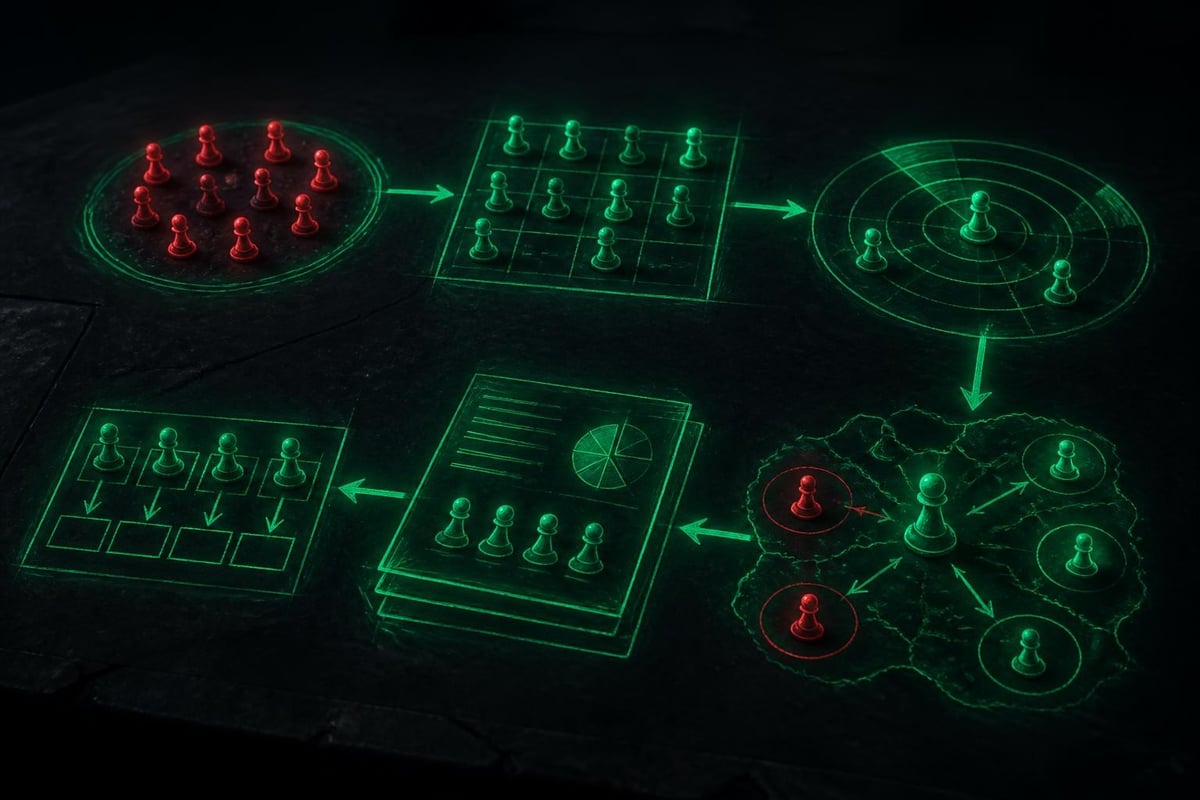
The work splits into three phases: discovery (who are they?), analysis (what are they doing and why?), and application (what do we do about it?). Most teams stop after discovery. They build a list, maybe a comparison table, then wonder why nothing changes. Analysis without a framework yields opinions. Application without grounding yields thrashing.
Discovery: Building the Competitive Set
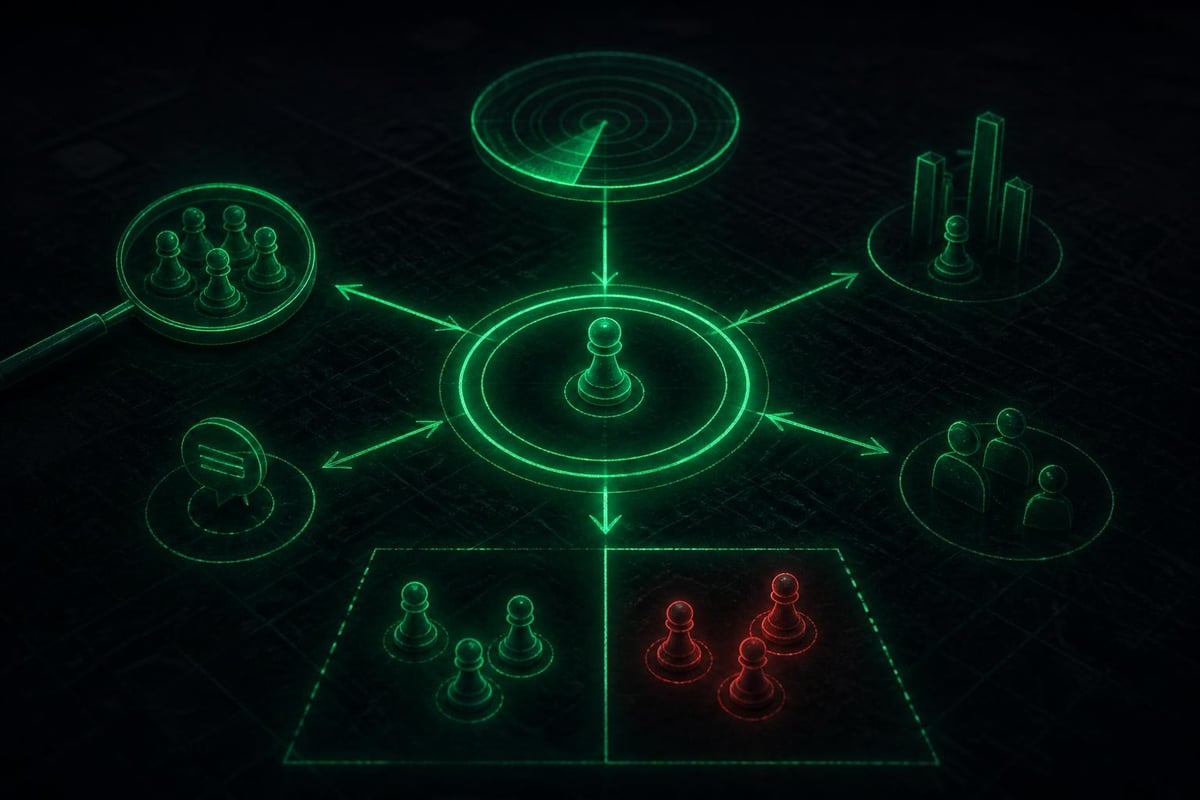
Discovery means identifying every player that matters – direct substitutes, indirect alternatives, emerging threats you haven't noticed yet. The obvious rivals are easy. The dangerous ones are the startups solving your customer's problem from a completely different angle, or the adjacent-market giant testing your category as a side project.
Start with these sources:
- Search behavior: What do prospects type when they don't know your name yet? Those results are your real competition.
- Review sites and communities: G2, Capterra, Reddit, niche forums. Who gets mentioned in the same breath as you?
- Funding databases: Crunchbase, PitchBook. Who just raised to attack your space?
- Job postings: Competitors hiring for roles you recognize signal strategic moves (e.g., enterprise sales team = upmarket push).
- Customer conversations: Ask "what else did you evaluate?" in every sales call and cancellation interview.
The goal is a living roster, not a static list. Competitive landscapes shift. New entrants appear. Incumbents pivot. If your list hasn't changed in six months, your research is dead. BrandScout’s Competitor Discovery & Tracking solves this by surfacing competitors – including rising threats you'd miss manually – and keeping the roster current as new intelligence arrives.
Analysis: Turning Observations Into Understanding
Raw intelligence is worthless until you structure it. You need frameworks that force clarity. Not because frameworks are magic, but because they make you answer hard questions you'd otherwise skip.
Porter's Five Forces: The Structural Reality Check
Porter’s Five Forces maps the structural forces shaping profitability in your market: rivalry intensity, threat of new entrants, threat of substitutes, supplier power, and buyer power. It's not about competitors alone – it's about whether your market structure allows anyone to win sustainably.
| Force | Key Questions | Why It Matters |
|---|---|---|
| Rivalry Intensity | How many credible competitors? How differentiated are offerings? Price pressure? | Determines whether you can hold margin or face commoditization |
| Threat of New Entrants | What stops a funded startup from launching in 90 days? | Reveals whether your position is defensible |
| Threat of Substitutes | What different approaches solve the same job? | Exposes the real competitive set beyond direct rivals |
| Supplier Power | How concentrated are critical inputs? Can suppliers dictate terms? | Affects cost structure and strategic flexibility |
| Buyer Power | How concentrated are customers? Can they dictate terms? | Shapes pricing power and retention dynamics |
Run this quarterly. If rivalry is intensifying while buyer power is rising and substitutes are proliferating, your strategic options narrow fast. You're heading toward a fight you can't win on features alone.
SWOT: Relative Position, Not Wishful Thinking
SWOT (Strengths, Weaknesses, Opportunities, Threats) is misused more than any framework in business. It's not a team-building exercise where everyone lists "great culture" as a strength. It's a relative-position audit: what can we do that rivals can't, and what vulnerabilities do we have that they could exploit?
Strengths and weaknesses are internal and relative. "Strong engineering team" isn't a strength if your competitor has a stronger one. "Slow enterprise sales cycle" isn't a weakness if competitors face the same structural issue – it's a market reality.
Opportunities and threats are external. An opportunity is a market gap you can exploit given your specific capabilities. A threat is a competitor move or market shift that could damage your position if unaddressed. Learn how to turn SWOT awareness into strategic advantage by grounding it in real competitive data, not assumptions.
PESTEL: Reading the Winds Before You Move
PESTEL analysis examines Political, Economic, Social, Technological, Environmental, and Legal forces shaping your competitive environment. It's the macro layer – the forces no individual competitor controls but everyone must navigate.
Why this matters for competitor market research: rivals react to the same external pressures, but with different constraints and capabilities. A regulatory shift that costs you 5% margin might kill a smaller competitor entirely. A technological breakthrough that commoditizes your core feature might open a new attack vector for an adjacent player.
Watch for:
- Regulatory changes: New compliance requirements, data privacy laws, industry-specific rules
- Economic shifts: Interest rates (affects customer buying and competitor fundraising), labor costs, currency fluctuations
- Technology disruption: AI capabilities, infrastructure costs dropping, new platforms emerging
- Social trends: Remote work, generational preferences, trust in institutions
The competitors who spot these shifts early gain asymmetric advantage. The ones who miss them face existential risk.
Sourcing Intelligence Ethically and Legally
Competitor market research operates within strict ethical and legal boundaries. You're gathering public information and analyzing observable behavior – not stealing secrets or colluding on pricing. The SCIP Code of Ethics establishes clear standards: respect all applicable laws, accurately disclose your identity and purpose, respect confidential information, and avoid conflicts of interest.
Legitimate sources include:
- Public filings (10-Ks, earnings calls for public companies)
- Published content (blogs, whitepapers, press releases, job postings)
- Product trials and demos (under your real identity)
- Customer reviews and third-party analyst reports
- Conference presentations and industry events
Off-limits practices:
- Misrepresenting your identity to access information
- Violating NDAs or confidentiality agreements
- Bribing employees for internal data
- Hacking, social engineering, or unauthorized access
- Engaging in anticompetitive information exchange (coordinating on pricing, territories, or bids)
You don't need to operate in gray areas. The competitive intelligence you need is already public – it's just scattered and unstructured. MIT Sloan research on competitive insight shows that organizations with systematic collection and analysis processes outperform those relying on ad-hoc research, even when using the same public sources.
Sizing the Battlefield: Market Quantification
Understanding competitor moves requires context about market size and growth. Are you fighting over a growing pie or redistributing fixed demand? The World Bank’s technical guidance on market sizing outlines two complementary approaches:
Top-down sizing starts with broad market data (industry reports, government statistics) and narrows to your addressable segment. Example: total enterprise software spend → cloud-based tools → project management category → teams of 10-50 people.
Bottom-up sizing builds from unit economics and customer counts upward. Example: 50,000 companies in target segment × 30% addressable given use case × $5,000 average contract value = $75M serviceable addressable market.
Use both. Top-down reveals growth trends and macro constraints. Bottom-up reveals whether your unit economics actually work at scale. When competitors raise funding or launch aggressive expansion, you need to know: is there room for everyone, or is this a zero-sum fight?
From Analysis to Action: Strategic Doctrine
Analysis paralysis kills more strategies than bad data. You can map every competitor move, run every framework, build perfect dashboards – and still lose because you never decided what to do. Competitor market research must end in strategic choices.
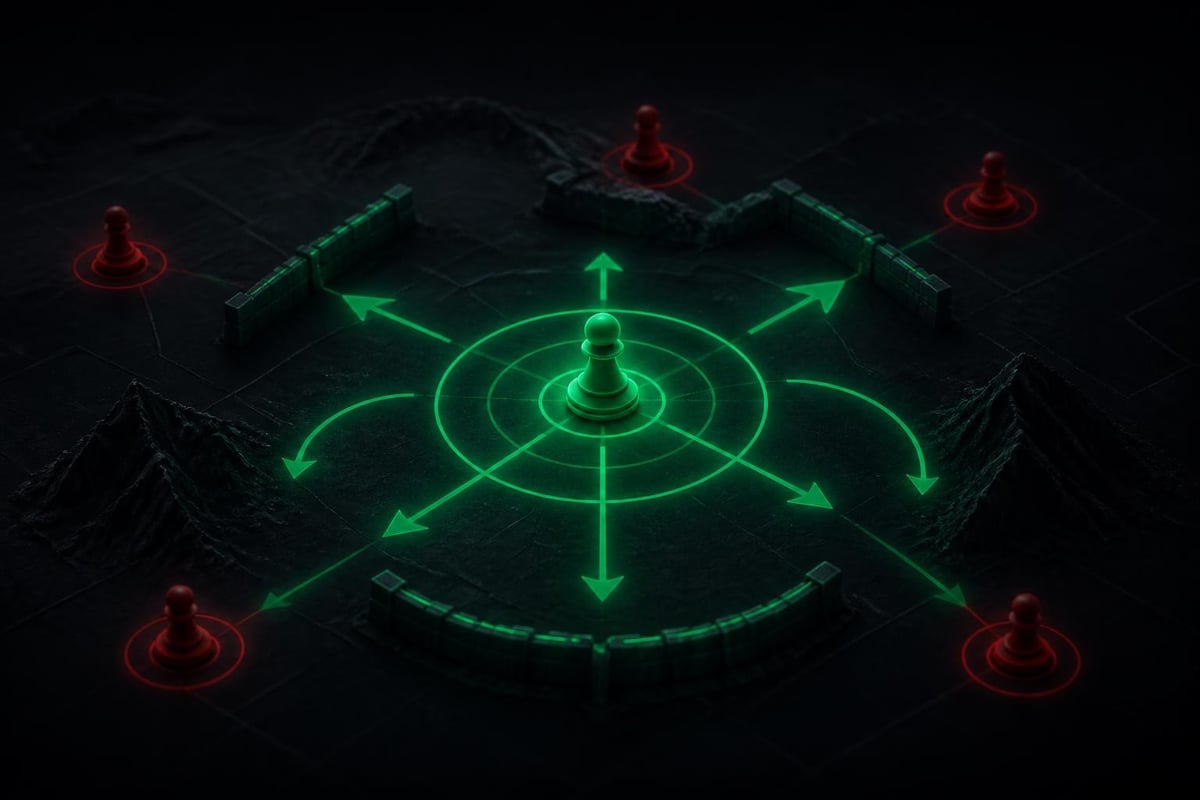
The 14 strategic doctrines – 8 defensive, 6 offensive – provide the decision framework. These aren't platitudes or consulting jargon. They're specific strategic postures with different resource requirements, risk profiles, and applicability conditions. You choose based on your competitive position and the specific threat or opportunity you face.
Defensive Doctrines: Protecting Position
When you hold valuable ground (market share, customer relationships, distribution advantage), these doctrines protect it:
- Position Defense: Reinforce core strengths where you're already dominant
- Flanking Defense: Protect vulnerable segments before competitors exploit them
- Preemptive Defense: Move first to control emerging territory
- Counteroffensive Defense: Strike back at a competitor's stronghold when attacked
- Mobile Defense: Shift to adjacent markets when current position erodes
- Strategic Withdrawal: Abandon indefensible positions to concentrate resources
- Contraction Defense: Narrow focus to most defensible segments
- Territory Expansion: Grow the entire category to raise all boats
Offensive Doctrines: Taking Ground
When you're challenging incumbents or exploiting competitor weaknesses:
- Frontal Attack: Direct assault on competitor strength (resource-intensive, high-risk)
- Flanking Attack: Target segments or geographies competitors underserve
- Encirclement: Attack from multiple angles simultaneously
- Bypass Attack: Invent new category or business model that makes their advantage irrelevant
- Guerrilla Warfare: Asymmetric tactics, fast iteration, avoid direct confrontation
- Strategic Alliance: Partner to access capabilities or markets you can't build alone
Understanding the rules of competition through frameworks like Porter’s Five Forces clarifies which doctrines are even viable given your structural position. A guerrilla strategy doesn't work if the market demands enterprise sales cycles and brand recognition. A frontal attack fails if you lack the resources to sustain it.
Organizing Intelligence for Decisions, Not Archives
The deliverable of competitor market research isn't a report. It's a decision. Everything you collect should answer: what do we do Monday morning?
Structure your intelligence output around:
Competitive profiles (one per major rival):
- Current position and recent moves
- Strategic intent (what they're trying to accomplish)
- Vulnerabilities (where they're exposed)
- Likely next moves (based on hiring, funding, messaging shifts)
Opportunity/Threat assessments:
- Specific competitive gaps you can exploit
- Emerging threats with probability and potential impact
- Recommended strategic responses with resource requirements
Battlecards for frontline teams:
- Head-to-head positioning vs. each major competitor
- How to handle specific objections and competitive traps
- When to engage directly vs. redirect the conversation
The cadence matters. Strategic reviews quarterly. Competitive profiles updated monthly. Battlecards refreshed as competitors launch features or shift messaging. Recent Harvard Business Review research on market intelligence emphasizes continuous monitoring over static reports – competitive advantage decays faster than ever in 2026.
Common Failures in Competitor Market Research
Most competitor market research efforts fail predictably:
| Failure Mode | What It Looks Like | Why It Happens | The Fix |
|---|---|---|---|
| Analysis paralysis | Endless research, no decisions | Fear of being wrong, lack of decision framework | Set decision deadlines, use doctrine framework to force choices |
| Competitor obsession | Reactive roadmap driven entirely by rival moves | Mistaking tactics for strategy | Return to customer problems and structural position |
| Static snapshots | Research done once, filed away | Treating intelligence as project not process | Build continuous monitoring and quarterly reviews |
| Feature myopia | Comparison tables of product specs | Confusing features with strategic position | Analyze business models, go-to-market, and economics |
| Echo chamber | Same public sources everyone reads | Lazy sourcing, reliance on obvious channels | Diversify signals: customer feedback, hiring, partnerships |
The most dangerous failure is treating competitor market research as information gathering instead of strategic preparation. Knowing what competitors are doing doesn't help if you can't or won't change your own strategy in response.
Who Owns Competitive Intelligence?
Competitor market research fails when it's nobody's job or everyone's job. The work requires sustained attention, analytical rigor, and cross-functional synthesis – not something you squeeze into a junior marketer's "other duties."
Effective ownership models:
Centralized competitive intelligence function (companies with 200+ employees): Dedicated analyst or small team reporting to strategy, product, or marketing leadership. Maintains competitive database, runs quarterly analyses, distributes intelligence to stakeholders.
Distributed collection, centralized analysis (companies with 50-200 employees): Frontline teams (sales, customer success, product) contribute signals. One senior person synthesizes and analyzes quarterly. Best of both: fresh signals without analysis fragmentation.
Founder/executive-led (companies under 50 employees): Founder or head of product/marketing owns it directly. At this scale, competitive position is existential – delegation is premature.
Regardless of model, the owner needs analytical capability (can run frameworks, spot patterns), strategic authority (decisions get made, not just documented), and organizational credibility (people actually use the intelligence).
The Continuous Discipline of Strategic Awareness
Competitor market research isn't a project you complete. It's a discipline you maintain. Markets shift. Competitors adapt. New entrants appear. The intelligence that informed your strategy six months ago is already stale.
Build these habits:
- Weekly signal collection: Set alerts for competitor news, funding, product launches, hiring
- Monthly profile updates: Refresh competitor profiles with recent moves and revised assessments
- Quarterly strategic reviews: Re-run frameworks, reassess doctrines, adjust strategy
- Annual deep dives: Comprehensive analysis including market sizing, scenario planning, war-gaming
The rhythm matters more than the intensity. Consistent light collection beats sporadic deep research. You're building pattern recognition – the ability to spot strategic shifts before they're obvious.
The competitors who will beat you in 2027 are making moves right now in 2026. They're hiring for capabilities you'll face in 18 months. They're testing messages that will define the category narrative. They're building partnerships that will close off distribution channels. The signals are there. The question is whether you're structured to see them and disciplined enough to act.
Competitor market research only creates advantage when it drives decisions, not when it generates reports. The path from scattered signals to strategic clarity requires systematic discovery, rigorous frameworks, and the discipline to choose a doctrine and commit resources. If you're ready to transform competitive intelligence from a quarterly exercise into continuous strategic advantage, Brandscout maps your competitive landscape, runs proven analysis frameworks, and generates tactical recommendations grounded in your real market position – turning awareness into action.