Market Plans: Build Strategy That Survives Contact
Most market plans die in the first thirty days. Not because the goals were wrong or the team was lazy, but because the plan was built on guesswork instead of intelligence. A market plan is not a wish list. It's not a slide deck you present once and forget. It's a decision framework that tells you where to fight, how to win, and what to ignore. If your plan doesn't account for what competitors are doing right now, it's already obsolete.
The difference between a plan that executes and one that collects dust is simple: does it reflect the actual battlefield or an imagined one? Market plans that work are grounded in real competitive intelligence, structured around clear strategic choices, and flexible enough to adapt when conditions change. Everything else is theater.
What Market Plans Actually Do
A market plan is a resource allocation decision wrapped in a timeline. It answers four questions: where are we competing, against whom, with what advantage, and over what period? Everything else in the document supports those answers.
The American Marketing Association defines a marketing plan as a roadmap for introducing and delivering your product or service to potential customers. That's accurate but incomplete. Market plans don't just introduce. They position, defend, and advance. They're built to handle interference, not operate in a vacuum.
The Core Components
Every functional market plan contains:
- Situational analysis: What's happening in your market right now – trends, competitive movements, customer behavior shifts
- Strategic framework: The logic that connects your position to your chosen moves (defensive fortification, offensive expansion, guerrilla disruption)
- Tactical choices: Channel priorities, messaging angles, partnership decisions, feature launches
- Resource map: Budget, team allocation, timeline dependencies
- Success metrics: Leading indicators that tell you if the plan is working before revenue proves it
The situational analysis is where most plans fail. If you don't know who's entering your space, what they're funding, or how customers are reacting to their moves, your strategy is just a bet.

Why Intelligence Comes Before Planning
You can't plan around threats you haven't identified. Market plans built on last quarter's assumptions are dead weight. Competitive landscapes shift: new entrants raise capital, incumbents pivot pricing, distribution partners choose sides. If your plan doesn't reflect current conditions, you're executing blind.
Forrester’s research on people-led planning emphasizes iterative, outcome-focused planning. That iteration requires input. Fresh intelligence. Real signals about what competitors are launching, where they're expanding, and how they're positioning against you.
BrandScout was built to solve this gap. Most teams collect competitive data in scattered tabs, Slack threads, and half-remembered conversations. Competitive intelligence needs structure. When you can map your competitive landscape, track movements in real time, and run proven strategic frameworks against actual competitor data, your market plans shift from guesswork to decision-making.
The Intelligence-to-Strategy Workflow
- Discovery: Identify every player in your space, including rising threats you'd miss manually
- Analysis: Run structured frameworks (SWOT, Porter's Five Forces, PESTEL) on real competitive data
- Strategy selection: Choose offense or defense doctrines based on position and capability
- Tactical translation: Convert strategic choices into channel priorities, messaging, and launch sequences
- Execution planning: Build the 90-day plan with milestones, owners, and leading metrics
This isn't linear. Intelligence updates continuously. New competitors appear. Customer preferences shift. Your plan should absorb those signals and adjust tactics without abandoning the core strategy.
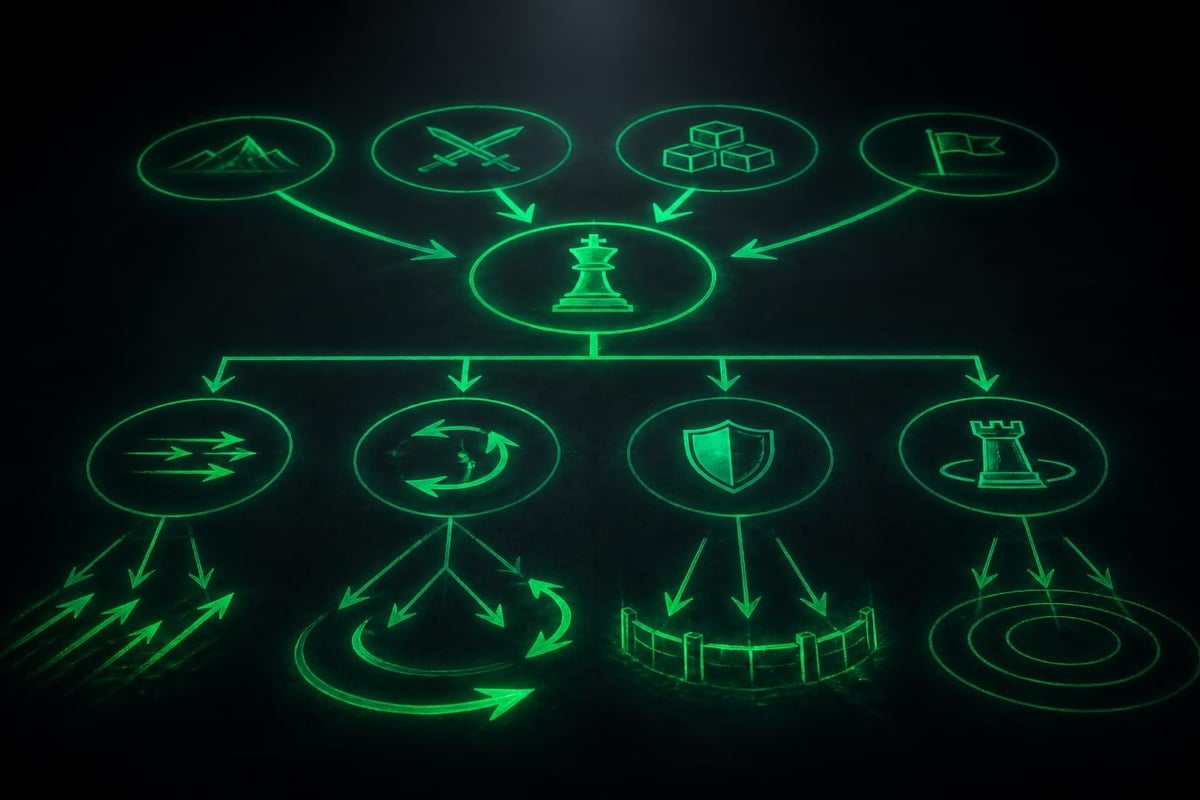
Strategy Selection: Offense vs. Defense
Market plans require a posture. Are you defending market share or taking it? The answer determines everything: budget allocation, messaging tone, partnership strategy, product priorities.
Defensive strategies make sense when you hold position and face pressure. You're fortifying, not because you're weak, but because the cost of losing ground is higher than the reward of new territory. Offensive strategies suit challengers and leaders expanding into adjacent markets.
Jorge A. Vasconcellos e Sá identified fourteen competitive strategies: eight defensive, six offensive. These aren't abstract models. They're decision frameworks tested across industries and validated by outcomes.
Defensive Strategies in Market Plans
| Strategy | When to Use | Tactical Expression |
|---|---|---|
| Position Defense | Leader under attack from multiple angles | Double down on brand, increase share of voice, lock in long-term contracts |
| Flank Defense | Vulnerable segment or geography threatened | Launch targeted sub-brand, regional partnerships, localized campaigns |
| Preemptive Defense | Competitor preparing major move | Announce product roadmap early, lock key distribution, flood category with content |
| Counteroffensive Defense | Direct attack on your core | Strike competitor's weak flank, poach key accounts, aggressive win-back offers |
| Mobile Defense | Market shifting, position eroding | Diversify revenue streams, enter adjacent categories, redefine value proposition |
| Contraction Defense | Overextended resources, multiple fronts | Exit low-margin segments, consolidate to defensible core, rebuild profitability |
| Strategic Withdrawal | Unwinnable position, better battles exist | Shut down losing product lines, reallocate to growth areas, pivot messaging |
| Guerrilla Defense | Smaller player vs. dominant incumbent | Niche focus, community-driven growth, agility over budget |
Your business strategy guide should map these doctrines to specific competitive scenarios you face. The choice depends on your market position, resource base, and competitor capabilities.
Offensive Strategies in Market Plans
Offensive strategies assume you can take ground and hold it. They require confidence in your differentiation and the resources to sustain pressure.
- Frontal Attack: Direct assault on competitor's core strength (requires clear superiority in product, pricing, or distribution)
- Flanking Attack: Target underserved segment or geography competitor ignores
- Encirclement: Surround competitor with superior offerings across multiple dimensions (features, price tiers, integrations)
- Bypass Attack: Redefine the category, making competitor's position irrelevant (technology shift, business model innovation)
- Guerrilla Attack: Unpredictable, localized strikes that force competitor to overspend on defense (content blitzes, partnership surprises, viral stunts)
- Differentiated Circle Attack: Win by being fundamentally different in a way that matters to a specific segment
The doctrine you choose shapes your entire market plan. A flanking strategy dictates different channel priorities than a frontal attack. Understanding how differentiated attacks work helps you recognize when uniqueness beats scale.
Building the Tactical Layer
Strategy without tactics is philosophy. Market plans must translate doctrine into executable work. That means assigning channels, setting budgets, defining messages, and scheduling launches.
Channel Prioritization
Not every channel deserves equal investment. Your strategic posture determines where to concentrate resources.
Defensive postures favor:
- Owned channels (email, community, product-led content) where you control the conversation
- Long-form thought leadership that reinforces category authority
- Customer retention and expansion programs
- Strategic partnerships that lock in distribution or integrations
Offensive postures favor:
- Paid acquisition in competitor keywords and audiences
- High-frequency launches that dominate news cycles
- Aggressive content production targeting competitor weaknesses
- Outbound sales targeting competitor customer bases
Deloitte’s 2025 marketing investment trends show marketers shifting budget toward first-party data activation and AI-powered personalization. Your market plan should account for these industry-wide shifts while staying true to your strategic choice.
Messaging Architecture
Your messaging must reflect your strategy. A flanking attack requires different language than a position defense.
Flanking messages emphasize what incumbents ignore: "We serve [overlooked segment] because [major players] don't care about [specific need]." Position defense messages reinforce leadership: "The proven choice for [category]" or "Trusted by [credible customer base]."
Avoid generic benefit claims. Your competitive intelligence should reveal specific weaknesses in competitor positioning. Exploit those gaps directly.
Resource Allocation and Timeline Structure
Market plans fail when budget and reality diverge. You cannot defend on all fronts with limited resources. You cannot execute six offensive campaigns simultaneously without diluting impact.
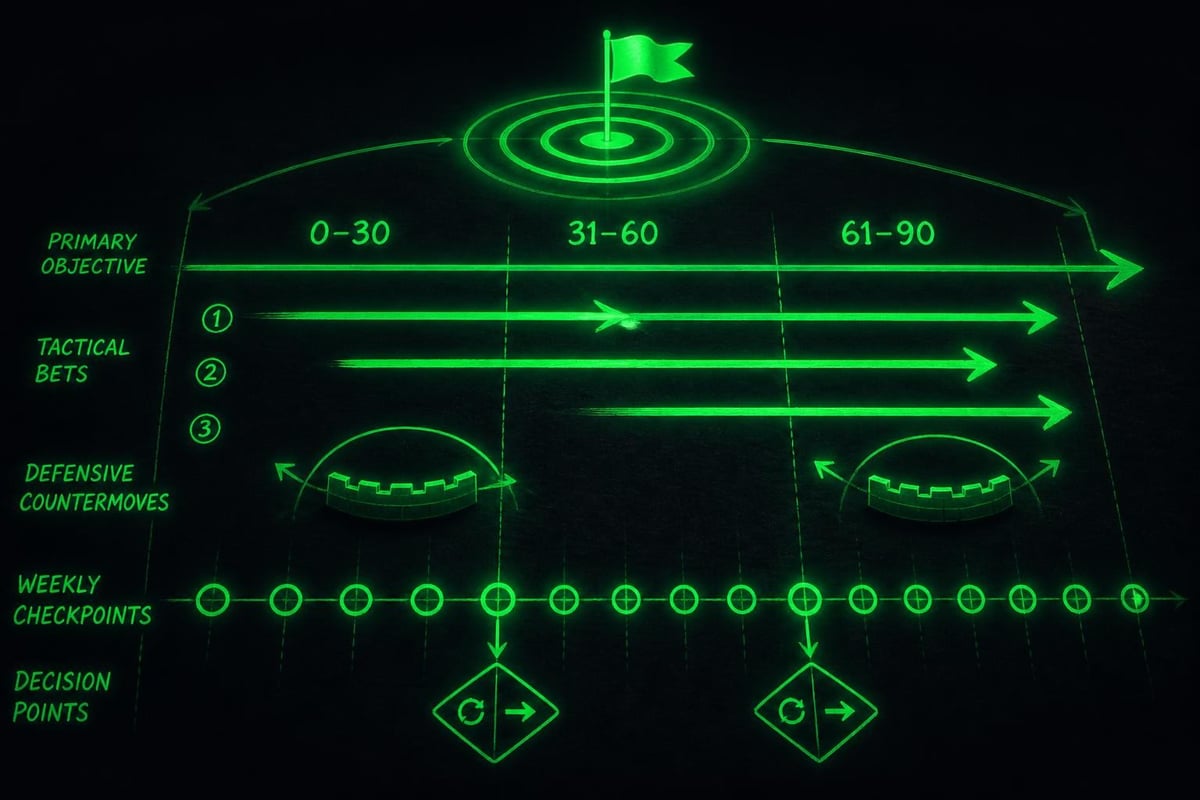
The 90-Day Planning Cycle
Annual plans are fiction. Quarterly plans are testable. Ninety days is enough time to execute, measure, and adjust without committing to obsolete assumptions.
Your 90-day market plan should include:
- Primary objective: One strategic goal (e.g., defend 15% market share in enterprise segment, capture 5% share in mid-market)
- Three tactical bets: Channel experiments, partnership launches, or product releases
- Two defensive moves: Countermeasures against known competitor actions
- Weekly checkpoints: Leading indicators reviewed every seven days
- Kill criteria: Conditions under which you abandon a tactic and reallocate
The U.S. Small Business Administration provides templates that help structure budget and resource decisions in practical terms. Use them, but don't treat them as gospel. Your competitive situation may require unconventional allocations.
Budget Distribution Models
| Strategic Posture | Brand/Awareness | Demand Gen | Customer Retention | Competitive Response |
|---|---|---|---|---|
| Position Defense | 20% | 30% | 40% | 10% |
| Flanking Attack | 15% | 50% | 25% | 10% |
| Guerrilla | 10% | 35% | 30% | 25% |
| Frontal Attack | 25% | 55% | 10% | 10% |
These are starting points, not rules. Your pricing strategy and unit economics determine how aggressively you can fund acquisition versus retention.
Adapting When Conditions Change
Market plans are not contracts. They're hypotheses. The moment a competitor raises funding, launches a category-redefining feature, or partners with your key distribution channel, your plan must adapt.
Triggering Events That Demand Reassessment
- Competitor funding announcements: New capital changes their risk tolerance and speed
- Product launches that shift customer expectations: You're now behind the new baseline
- Major customer churn or win: Signal that positioning or product-market fit has changed
- Regulatory or economic shifts: Macro forces that rewrite cost structures or access
When these events occur, don't panic. Don't abandon strategy. Reassess your intelligence, confirm whether your core doctrine still fits, and adjust tactics. Harvard Business Review’s piece on marketing’s future explores how modern marketers must balance long-term positioning with rapid tactical iteration.
The teams that win aren't the ones with perfect plans. They're the ones who update their intelligence weekly, test new moves quickly, and kill losing bets without ego.
Measuring What Matters
Market plans need metrics that predict outcomes, not just record them. Revenue is a lagging indicator. By the time it moves, the battle is already won or lost.
Leading Indicators by Strategic Posture
Defensive plans track:
- Customer retention rate (weekly cohorts)
- Net Revenue Retention (NRR)
- Share of voice in key channels
- Competitive win/loss rates in deals
- Feature parity gaps vs. top competitors
Offensive plans track:
- New logo acquisition rate
- Competitive displacement rate (customers switching from named competitors)
- Time to first value for new customers
- Virality coefficient or organic growth rate
- Market penetration in target segment
The MIT Sloan case on crafting a marketing plan demonstrates how product-market fit metrics inform go-to-market strategy in practice. Study it. The logic transfers across industries.
Common Failures and How to Avoid Them
Market plans fail predictably. Here's what kills them:
The Wish List Trap
Plans that list every possible tactic without prioritization. You can't do everything. Choose three bets per quarter and fund them properly. Kill the rest.
The Static Plan Problem
Plans written in January and never updated. Competitive intelligence should flow into your plan continuously. If you're not revising tactics monthly, you're flying blind.
The Metrics Vanity Show
Tracking impressions, clicks, and engagement without connecting them to strategic outcomes. Measure what predicts customer acquisition, retention, and competitive displacement. Ignore the rest.
The Ivory Tower Syndrome
Plans built by executives without input from sales, customer success, or product teams who see competitor moves daily. Your best intelligence comes from the front line. Use it.
The Framework Addiction
Over-reliance on analysis frameworks without tactical translation. SWOT analysis doesn't execute itself. Neither does Porter's Five Forces. Run the frameworks, then make decisions and assign work.
Building Plans That Execute
The best market plans are boring documents. They specify who does what, by when, with what resources, against which competitor moves. They don't inspire. They direct.
If your market plan doesn't answer these questions clearly, rewrite it:
- Which competitors are we prioritizing this quarter and why?
- What is our primary strategic posture (offensive or defensive) and which doctrine applies?
- What three tactical bets will we fund fully, and what are we explicitly not doing?
- What leading indicators will we review weekly to confirm the plan is working?
- Under what conditions do we pivot or abandon this approach?
Your plan should fit on two pages. Everything else is appendix. Situational analysis, framework outputs, detailed channel plans – those belong in supporting documents. The plan itself is pure decision and assignment.
The competitive intelligence database playbook walks through how high-growth companies structure ongoing intelligence collection so market plans stay current. Build the system once. Let it feed every planning cycle.
The Continuous Intelligence Loop
Market plans aren't annual projects. They're living documents fed by continuous competitive intelligence. When you map your competitive landscape properly, track competitor moves as they happen, and run strategic frameworks against real data, planning shifts from guesswork to pattern recognition.
You start seeing moves before competitors make them. You recognize when a competitor's hiring spree signals a product launch. You notice when their messaging shifts toward your core segment. You adapt your plan before they execute, not after.
This is the advantage intelligence-backed market plans deliver: you stop reacting and start dictating tempo. Your competitors respond to you, not the other way around.
Market plans only work when they're grounded in competitive reality and structured around clear strategic choices. If you're building plans on scattered intelligence and outdated assumptions, you're already behind. Brandscout gives you the competitive intelligence infrastructure and strategic frameworks to build market plans that survive contact with the market. Map your landscape, run the analysis, and execute with confidence.