Data Decisions: When Competitive Intelligence Counts
Most executives drown in data they barely trust. Dashboards multiply, reports stack up, yet the essential call – which competitor to confront, which market gap to exploit – hangs in paralysis. Data decisions separate winning organizations from those buried under information. The difference isn't access to more data. It's the system that converts signals into a decision you can execute Monday morning. In 2026, market intelligence platforms either solve this translation problem or they become part of the noise.
Why Most Data Decisions Fail Before They Start
Organizations collect obsessively and decide poorly. The root cause isn't bad data quality or insufficient volume. It's the gap between measurement and meaning.
You track twenty competitors. You monitor pricing changes, feature releases, funding announcements, customer reviews. The signals arrive daily. Now what? Most teams stop at visibility. They've built a watch system without a doctrine for what action each signal should trigger. So data piles up, and decisions default to whoever argues loudest in the room.
The Three Failure Modes
Measurement theater – tracking metrics because they're trackable, not because they drive action. Competitor website traffic, social follower counts, press mention volume. Interesting. Irrelevant to the decision you're avoiding: should we match their pricing or defend on differentiation?
Analysis paralysis – running every framework in the toolkit, producing reports no one implements. SWOT becomes a quarterly ritual. Porter's Five Forces lives in a slide deck. Where data-driven decision-making can go wrong tracks this pattern across industries: organizations mistake analytical activity for strategic progress.
Institutional bias – using data selectively to confirm what leadership already believes. Competitive intelligence becomes evidence collection for predetermined conclusions. The signals that contradict the current plan get filtered out before they reach decision-makers.
What Makes a Data Decision Actually Defensible
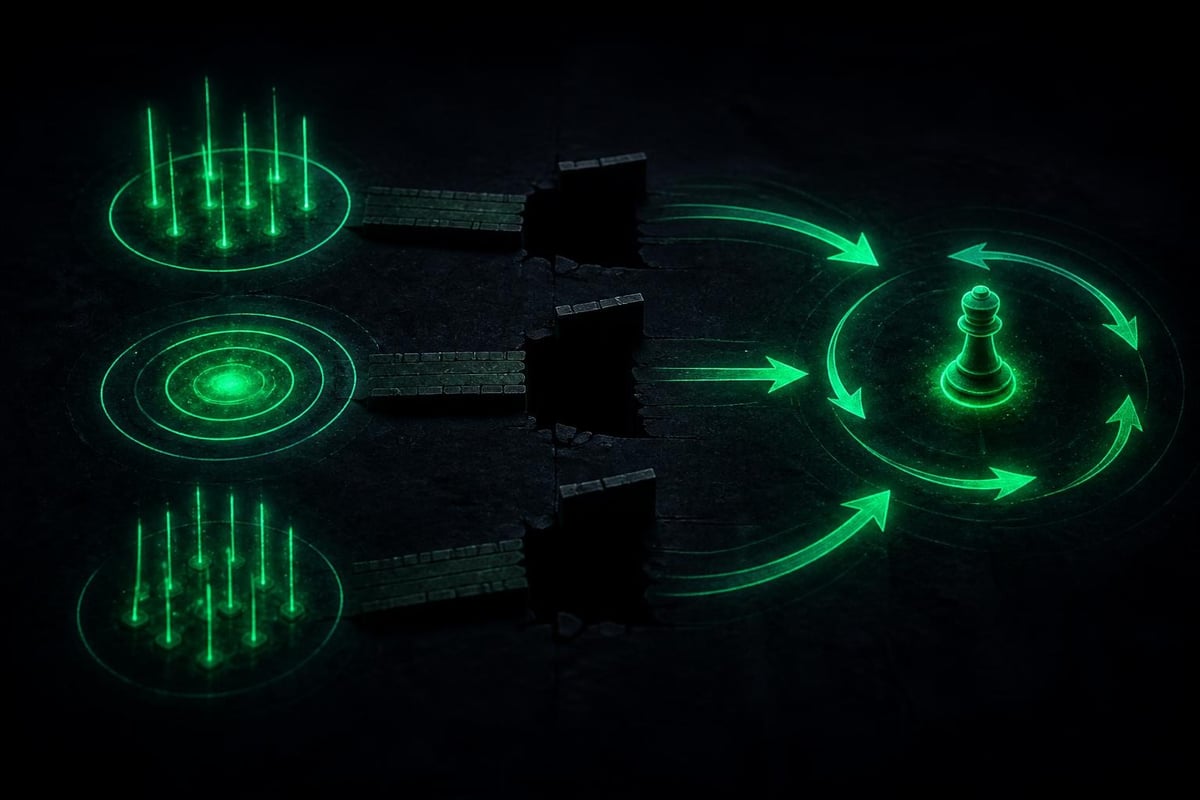
A defensible data decision has three attributes: it's falsifiable, traceable, and doctrine-grounded.
Falsifiable means you've defined conditions under which you'd choose differently. "We're entering this segment because competitor X is under-investing there" only works if you'd abandon entry when X pivots investment. If you're entering regardless, don't pretend data drove it.
Traceable means someone reviewing your decision six months later can reconstruct your logic from the intelligence you had. Which competitor signals mattered? Which you discarded and why? This isn't cover-your-ass documentation. It's the feedback loop that makes your next data decision smarter.
Doctrine-grounded means the decision maps to a strategic principle you can name. Defensive doctrines – position defense, mobile defense, strategic withdrawal, counter-offense – give structure to competitive responses. Offensive doctrines – frontal attack, flanking, encirclement, bypass – organize market entry moves. When a competitor launches adjacent to your core, doctrine tells you whether to extend your defensive line or concentrate force and let the periphery go.
The Structured Intelligence Standard
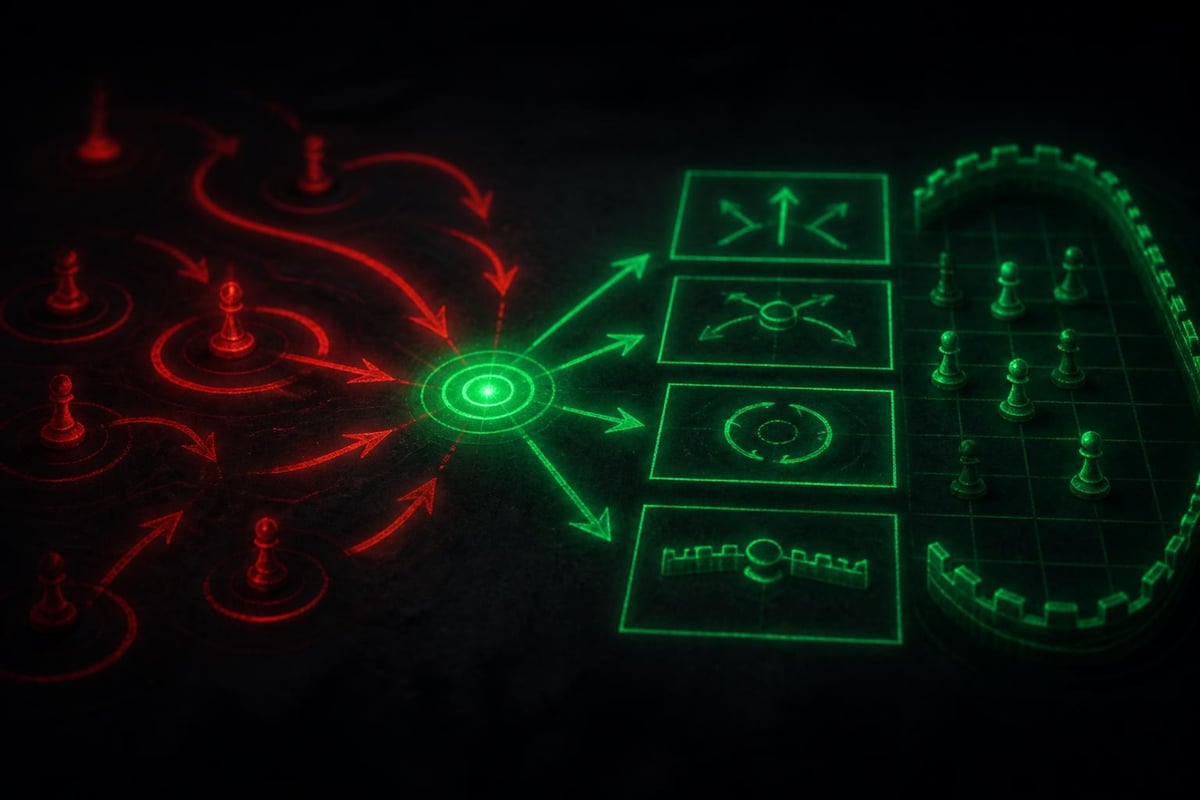
Intelligence only becomes actionable when it's structured around decisions you actually face. Raw signals – a competitor raises Series B, another deprecates a feature, a third hires a VP from your industry – mean nothing in isolation.
| Signal Type | Strategic Question | Decision Enabled |
|---|---|---|
| Funding event | Are they preparing offensive expansion or solving burn? | Resource allocation timing |
| Feature deprecation | Retreat from segment or pivot to premium? | Competitive positioning |
| Executive hire | Capability build or symbolic acquisition? | Threat timeline assessment |
This isn't a call to ignore qualitative judgment. It's recognizing that judgment improves when applied to structured input rather than scattered impressions. Competitive intelligence as a discipline exists to create that structure.
From Signals to Strategy: The Translation Layer
The hardest part of data decisions isn't collection. It's translation – converting what you observe into what you should do.
Most platforms stop at dashboards. They surface changes, highlight anomalies, track trends. Then they hand you the strategic question: so what? The translation burden falls entirely on you. For a single-brand founder or growth lead, that's a weekly tax on cognitive bandwidth. For agencies and multi-brand teams, it's repetitive work that scales badly.
Frameworks as Translation Infrastructure
Strategic frameworks – PESTEL, Porter's Five Forces, SWOT, Ansoff – exist to automate part of this translation. They're not theoretical exercises. They're structured prompts that force you to convert observations into implications.
- PESTEL asks which macro forces (political, economic, social, technological, environmental, legal) turn competitor moves into threats or opportunities for you
- Porter's Five Forces translates industry signals into competitive intensity and profit potential
- SWOT organizes internal capabilities and external conditions into a decision matrix
- Ansoff converts market and product signals into growth direction choices
The value isn't running these once in a strategy off-site. It's applying them systematically every time significant intelligence arrives, so your data decisions benefit from cumulative pattern recognition rather than starting fresh each quarter.
BrandScout's Competitive Analysis & Strategy runs these frameworks automatically against your live competitive data, then uses HORIZON AI to generate specific attack and defense strategies with a 90-day execution plan. It solves the "I have competitor intelligence but don't know what to do with it" problem by ending in a play, not a report.
When Organizational Design Undermines Data Decisions
You can have perfect intelligence and still make bad calls if the organization isn't built to use it. Organizational factors that enable or impede data-informed decisions include analytical culture, centralization versus decentralization, and the gap between insight generation and decision authority.
The Centralization Trade-Off
Centralized competitive intelligence – one team gathering signals for the whole organization – creates consistency but delays local response. A regional sales lead spots a competitor discount pattern in their territory. By the time it's validated centrally and approved for countermeasure, the window's closed.
Decentralized intelligence – every function tracking competitors independently – accelerates response but fragments understanding. Marketing sees one competitor set, sales another, product a third. No one has the complete picture.
The effective middle ground: centralized infrastructure, decentralized interpretation. One system captures all signals. Multiple teams apply doctrine to their domain. Regional sales uses the same competitive data as product, but each translates it through their lens: pricing response versus feature roadmap adjustment.
Culture Eats Dashboards
A dashboard showing competitor moves means nothing if leadership punishes bearers of bad news. If the organizational norm is "we're winning, don't surface threats," your competitive intelligence becomes a parade of false positives and missed warnings.
Data decisions require a culture that rewards early warning over comfortable confirmation. The intelligence team's job isn't to make leadership feel good about their position. It's to surface the move that threatens that position while there's still time to respond. Organizations that shoot that messenger end up making data decisions based on stale assumptions and wishful projections.
The Equity and Governance Dimension
Data decisions carry embedded assumptions about whose perspective matters and whose gets filtered out. Frameworks for data equity push organizations to examine whether their intelligence gathering privileges certain signals and silences others.
In competitive intelligence, this shows up in which competitors you track and which you ignore. Focusing only on funded startups and public companies means you miss bootstrapped challengers and regional specialists. Monitoring only English-language signals means you're blind to competitors building in other markets until they're at your door.
Data Stewardship Standards
NIST’s Research Data Framework addresses governance and lifecycle management for data used in decisions. While built for research contexts, the principles apply: data decisions are only as trustworthy as the provenance, handling, and validation processes behind them.
For competitive intelligence, this means:
- Source documentation – where did each signal originate, when was it captured, how was it verified?
- Update cadence – how often is each data point refreshed, and what's the lag between real-world change and your awareness?
- Conflict resolution – when sources disagree (two estimates of competitor revenue, for example), what's your tiebreaker?
This isn't bureaucratic overhead. It's the foundation that lets you make a data decision today and defend it tomorrow when the outcome becomes clear.
Building Your Data Decision System
The system that turns intelligence into action has five components. Most organizations have three, wonder why decisions still feel arbitrary.
Component Breakdown
| Component | What It Does | Common Gap |
|---|---|---|
| Collection | Gathers competitor and market signals | Scattered across tools, incomplete |
| Structure | Organizes signals into comparable categories | Manual tagging, inconsistent taxonomy |
| Analysis | Applies frameworks to generate implications | One-off reports, no cumulative learning |
| Doctrine | Maps implications to strategic options | Missing entirely or ad hoc |
| Execution | Converts option into plan with owners and timeline | Stops at recommendation, no follow-through |
Most platforms solve collection, maybe structure. BrandScout connects all five – discovery through execution – because a data decision isn't complete until someone owns the next ninety days.
The Update Loop
Your competitive landscape changes faster than your quarterly planning cycle. A functional data decision system updates continuously, flags threshold changes, and prompts reconsideration when assumptions break.
Set tripwires: "If competitor A enters market segment B, we revisit our resource allocation within two weeks." When the signal arrives, the decision process triggers automatically. You're not scrambling to interpret what it means; you've already defined the decision tree.
This is how effective battlecards work in sales. The competitive response isn't improvised in the moment. It's pre-loaded based on structured intelligence, activated when the scenario appears.
Deciding Under Uncertainty Versus Deciding Without Information
Data decisions never have perfect information. The question is whether you're deciding under uncertainty – you've gathered available signals, assessed reliability, and defined your confidence level – or ignorance – you're guessing because you haven't built the intelligence system.
Uncertainty you can quantify. "We estimate competitor X has twelve-month runway based on last funding round and burn rate signals, confidence medium." That's a data decision. You might be wrong, but you've structured your reasoning and can update it.
Ignorance looks like: "We think they're probably fine financially?" No data decision happened. You're moving on vibes.
Confidence Calibration
Track your data decisions and outcomes. Did the competitor you predicted would retreat actually withdraw? Did the market gap you entered based on intelligence analysis turn out undefended? Over time, you'll see which signal types and analytical approaches yield reliable decisions versus noise.
Most organizations never close this loop. They make a competitive call, move on, and never score whether their intelligence held up. That's how you repeat the same interpretive errors for years. Calibrate your confidence by tracking your hit rate, and your data decisions compound in accuracy rather than cycling through the same blind spots.
What Good Looks Like in Practice
A well-executed data decision leaves a clean trail: the signal that prompted review, the analysis conducted, the doctrine applied, the option selected, the plan built, the owner assigned. Six months later, anyone should be able to reconstruct your logic and evaluate whether the intelligence matched reality.
Bad data decisions are untraceable. "We decided to enter this segment" – based on what signals? Analyzed how? Why this approach versus alternatives? The answers are in someone's head, lost when they leave, unavailable for institutional learning.
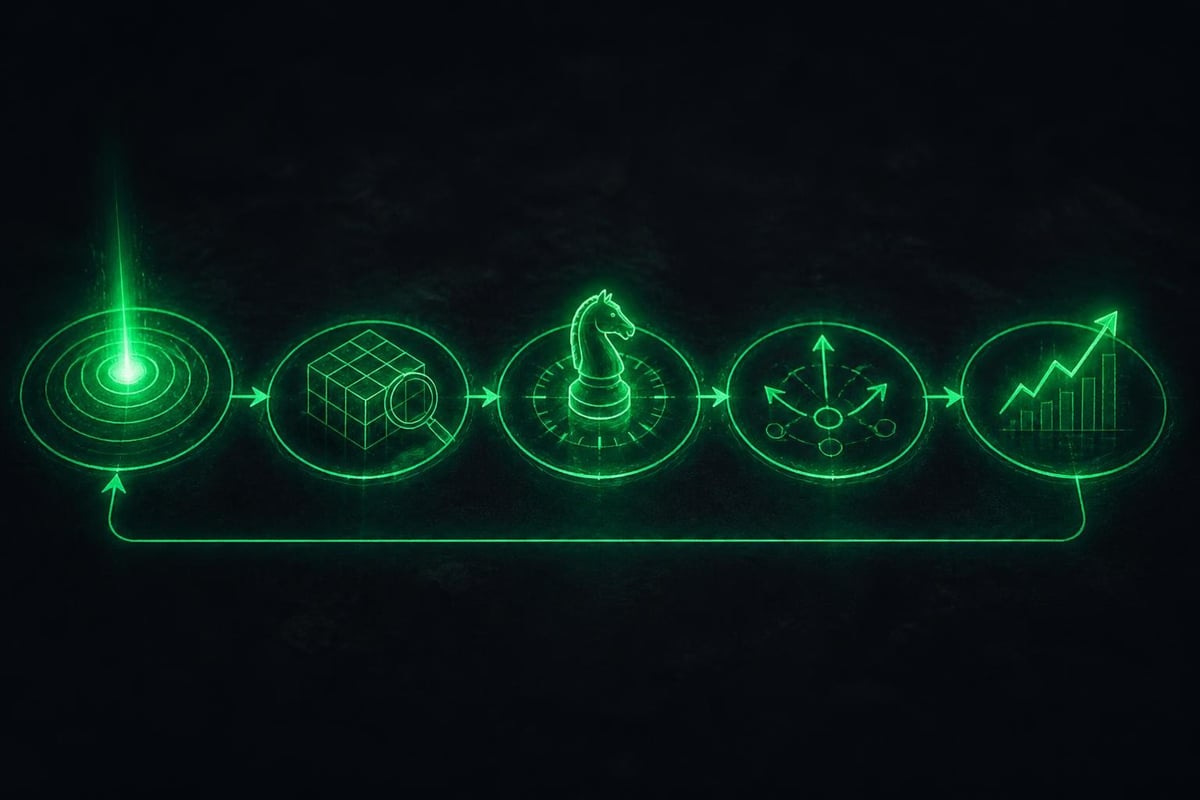
The competitive intelligence advantage isn't secret data. It's the system that makes reliable data decisions repeatable. Build structure around signal interpretation. Ground choices in doctrine. Document your reasoning. Track outcomes. Each cycle makes the next data decision faster and more defensible. That's how market intelligence becomes a capability, not a cost center hoping to justify headcount.
Data decisions convert competitive signals into strategic action – but only when you've built the infrastructure that connects observation to execution. Most organizations stop at dashboards and wonder why clarity never arrives. Brandscout closes that gap by running proven frameworks against live competitive intelligence, generating doctrine-grounded strategies with execution plans your team can implement immediately. Turn market signals into decisions you can defend.