Salesforce Marketing Intelligence: What You Need to Know
Salesforce Marketing Intelligence entered the market in 2024 as a data unification and analytics tool designed to solve a persistent problem: marketers drowning in disconnected campaign data spread across platforms, unable to see clear ROI or move fast on optimization decisions. The promise is simple: pull everything into one view, automate the analysis, and let AI surface what matters. The reality is more conditional. It works when your marketing operation already runs on Salesforce infrastructure, when your team has the capacity to configure connectors correctly, and when you're willing to pay enterprise pricing for what is fundamentally a consolidation play. This isn't magic. It's middleware with intelligence baked in.
What Salesforce Marketing Intelligence Actually Does
Salesforce marketing intelligence is a data aggregation and analytics platform built inside the Salesforce Marketing Cloud ecosystem. It connects to advertising platforms, social channels, web analytics, CRM systems, and email tools, then pulls that data into centralized dashboards where performance metrics can be tracked, compared, and analyzed without jumping between tools.
The core function is data normalization. Different platforms report metrics differently: Facebook calls it "impressions," LinkedIn calls it "views," Google Ads uses "served." Marketing Intelligence translates these into a common language so you can compare channel performance on equal terms. This is not trivial work. Most marketing teams waste hours each week manually reconciling spreadsheets to answer basic questions like "which channel delivers the lowest cost per acquisition?"
Salesforce’s official introduction to Marketing Intelligence emphasizes automation as the value driver. The platform can ingest data automatically on schedules you set, eliminating manual exports and imports. It also includes pre-built dashboards for common use cases: campaign performance, audience engagement, conversion tracking, budget allocation.

How the AI Component Works
Agentforce, Salesforce's AI layer, powers the intelligence side of the platform. According to Salesforce Ben’s analysis, Agentforce analyzes historical campaign data to identify patterns, anomalies, and optimization opportunities.
Here's what that means in practice:
- Anomaly detection: If a campaign's cost-per-click suddenly spikes, Agentforce flags it and suggests possible causes based on data patterns.
- Trend forecasting: The AI projects future performance based on historical trajectories, helping you estimate whether current spend levels will hit quarterly targets.
- Recommendation generation: When performance dips, Agentforce suggests tactical adjustments like budget reallocation, creative rotation, or audience refinement.
The recommendations are narrow and tactical, not strategic. Agentforce won't tell you to abandon a channel or reposition your brand. It will tell you to increase bid caps on high-converting keywords or shift budget from underperforming ad sets to proven ones. This is optimization intelligence, not strategic positioning intelligence.
What You Need to Run It
Marketing Intelligence isn't plug-and-play. You need:
- Salesforce Marketing Cloud subscription: Marketing Intelligence is sold as an add-on, not a standalone product. If you're not already in the Salesforce ecosystem, you're buying the entire stack.
- Clean data infrastructure: Connectors only work if your platforms are configured correctly. Broken tracking pixels, mismatched UTM parameters, or incomplete CRM records will corrupt your dashboards.
- Technical resources: Setting up connectors, configuring dashboards, and maintaining data pipelines requires either a dedicated admin or external consultants. KPMG’s Salesforce practice offers implementation services specifically because most teams can't do this alone.
| Requirement | What It Means | Risk If Missing |
|---|---|---|
| Salesforce Marketing Cloud | Existing subscription to core platform | Need to buy entire ecosystem |
| Data governance | Standardized naming, UTM discipline, tracking consistency | Dashboards show garbage data |
| Admin capacity | Dedicated person to manage connectors and troubleshoot | Tool sits unused, ROI never realized |
The pricing structure is tiered by data volume and connector count. Expect enterprise-level costs, not SaaS startup pricing.
Where Marketing Intelligence Wins
Marketing Intelligence solves specific pain points exceptionally well when conditions are right.
Multi-Channel Attribution Clarity
If you're running paid search, paid social, email, display, and content marketing simultaneously, attribution becomes a nightmare. Which touchpoint deserves credit for a conversion? Marketing Intelligence uses multi-touch attribution models to assign weighted credit across the customer journey.
Example scenario: A prospect sees a LinkedIn ad, clicks through to read a blog post, receives three nurture emails, then converts via a Google search ad. Without unified tracking, Google gets 100% credit. With Marketing Intelligence's attribution modeling, each channel receives proportional credit based on its role in the journey.
This clarity directly improves marketing decisions by showing which channels actually drive pipeline, not just last-click conversions.
Budget Reallocation Speed
When a channel underperforms, most teams take weeks to reallocate budget. They wait for monthly reports, schedule review meetings, debate internally, then execute changes. Marketing Intelligence compresses this cycle.
Real-time dashboards show performance against benchmarks. When a campaign falls below efficiency thresholds, Agentforce flags it immediately. Marketers can shift budget the same day instead of waiting for end-of-month reviews.
Speed matters in competitive markets. If your competitor is optimizing weekly and you're optimizing monthly, they gain incremental advantage repeatedly. Over a year, that compounds into significant share loss.
Unified Reporting for Stakeholder Communication
CMOs and VPs of Marketing spend absurd amounts of time building executive reports. Marketing Intelligence automates this by maintaining always-current dashboards that answer standard executive questions: What's our CAC by channel? What's our pipeline velocity? How much revenue came from marketing this quarter?
You can grant stakeholders direct dashboard access or schedule automated report exports. Either way, the "data gathering" phase of reporting disappears.

Where Marketing Intelligence Fails
No tool is universal. Marketing Intelligence has clear limitations.
It Doesn't Tell You What to Do Strategically
Salesforce marketing intelligence optimizes execution. It does not build strategy. It will tell you which Facebook ad set performs best. It will not tell you whether Facebook is the right channel for your market, whether your positioning is defensible against competitors, or whether you're attacking the right customer segment.
This is a critical gap. Most marketing failures aren't execution problems. They're strategy problems. You're targeting the wrong audience, your message doesn't differentiate, your product doesn't solve a urgent enough problem, or you're fighting in a saturated category where you have no positional advantage. No amount of dashboard intelligence fixes strategic misdirection.
Platforms like BrandScout exist specifically to fill this gap by running proven strategic frameworks (SWOT, Porter's Five Forces, Ansoff Matrix) on competitive data to generate attack and defense strategies before you execute campaigns. Marketing Intelligence assumes your strategy is sound and optimizes execution. If that assumption is wrong, you're optimizing your way toward failure faster.
It's Only as Good as Your Data Discipline
Garbage in, garbage out. If your team doesn't use consistent UTM parameters, if your CRM data is incomplete, if your tracking pixels are broken, Marketing Intelligence will surface confident insights based on bad data.
According to Salesforce’s release notes, the platform includes data validation features, but these only catch obvious errors. Subtle inconsistencies (like one team using "demo_request" and another using "demo-request" in UTM campaigns) won't trigger alerts but will fragment your reporting.
It Locks You Into Salesforce's Ecosystem
Once you build dashboards, train your team, and integrate your workflows around Marketing Intelligence, switching costs become prohibitive. This is intentional. Salesforce's business model relies on ecosystem lock-in. The deeper you go, the harder it becomes to leave.
This isn't inherently bad if Salesforce's roadmap aligns with your needs. But if the platform stagnates, if pricing increases sharply, or if better alternatives emerge, you're trapped. Always consider exit costs before committing to enterprise platforms.
Competitive Context: Where Salesforce Sits in the Market
Salesforce marketing intelligence competes directly with Google Analytics 360, Adobe Analytics, and HubSpot Marketing Analytics. Each has different strengths.
| Platform | Best For | Weakness |
|---|---|---|
| Salesforce Marketing Intelligence | Salesforce ecosystem users needing cross-platform unification | Expensive, requires existing Salesforce investment |
| Google Analytics 360 | Teams heavily invested in Google Ads and Google Cloud | Limited non-Google integrations |
| Adobe Analytics | Enterprise teams with complex customer journeys and massive data volumes | Steepest learning curve, highest implementation cost |
| HubSpot Marketing Analytics | Small to mid-size teams wanting simplicity and speed | Limited depth for sophisticated attribution modeling |
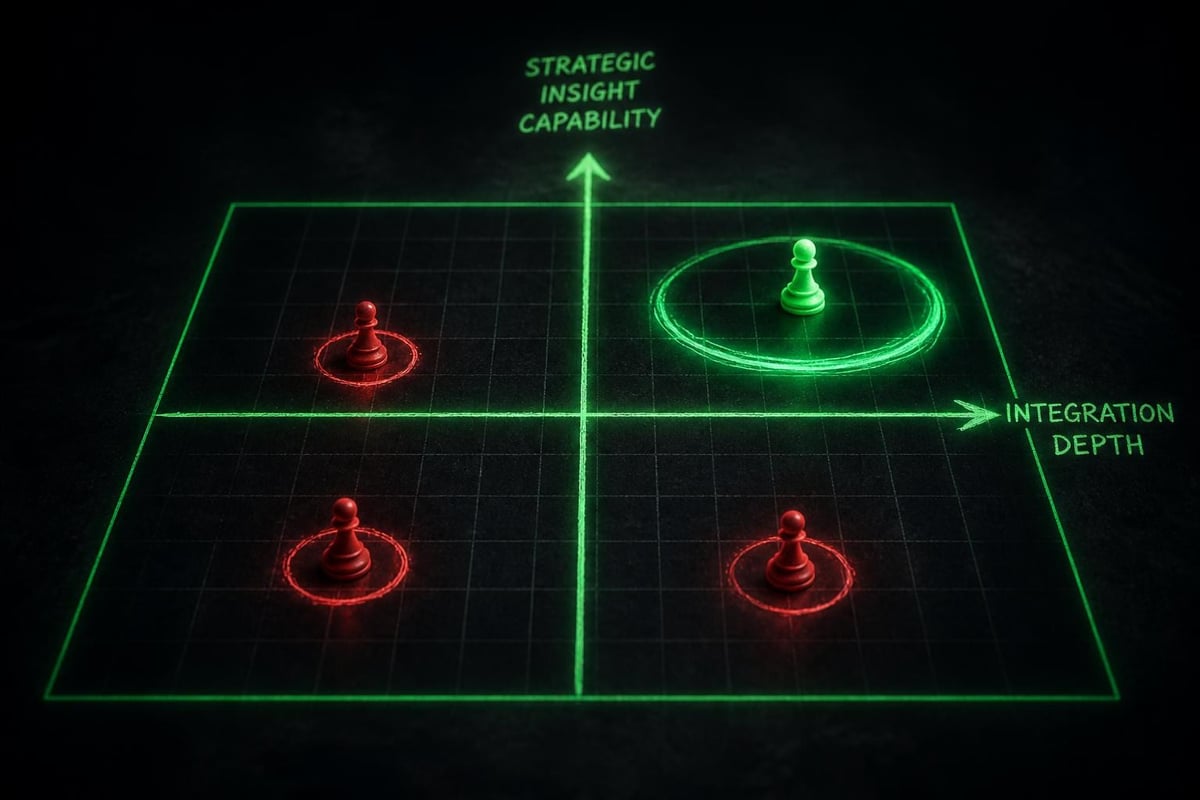
None of these platforms provide strategic analysis. They all optimize execution of existing strategies. If your competitors are using competitive intelligence to identify positioning gaps and market entry opportunities while you're only optimizing ad spend, you're fighting the wrong battle.
The IDC whitepaper on Salesforce Marketing Intelligence positions it as a "fully integrated marketing experience," but integration is a feature, not a strategy. Integration makes execution smoother. It doesn't tell you what to execute.
Who Should Use Marketing Intelligence (and Who Shouldn't)
Good Fit Scenarios
You should seriously consider Salesforce marketing intelligence if:
- You're already on Salesforce Marketing Cloud: The integration is seamless, and you avoid duplicate platform costs.
- You run campaigns across 5+ channels simultaneously: The consolidation value justifies the cost and complexity.
- You have dedicated marketing ops resources: Someone needs to own data governance, connector management, and dashboard maintenance.
- Your executive team demands real-time reporting: Automated dashboards eliminate manual report building cycles.
Bad Fit Scenarios
You should avoid or delay Marketing Intelligence if:
- You're not on Salesforce: Buying the entire ecosystem just to get analytics is backwards. Use native platform tools first.
- Your campaigns are simple (1-2 channels): Native analytics from Facebook or Google Ads are sufficient and free.
- You lack data discipline: Fix your tracking and UTM strategy first. Otherwise you're building dashboards on quicksand.
- Your strategy is unclear: If you don't know who you're targeting or why you'll win, optimization tools make you fail faster.
The AI Evolution and What It Means
Salesforce's integration of Agentforce into Marketing Intelligence reflects a broader industry shift toward AI-driven decision automation. The question isn't whether AI will play a larger role in marketing analytics (it will), but whether the AI serves the right master.
AI optimizes for the objective function you give it. If you tell it to minimize cost-per-acquisition, it will. If market conditions change or your strategic positioning becomes obsolete, the AI won't notice. It will keep optimizing CPA while your competitors steal share with better positioning.
According to ITPro’s coverage of Agentforce 360, Salesforce is enabling partners to build custom AI agents for specific use cases. This opens the door for more sophisticated strategic analysis tools built on top of Salesforce infrastructure.
Meanwhile, researchers are exploring causal AI frameworks that could theoretically identify not just correlations but causal relationships in marketing data. The Salesforce CausalAI Library represents early work in this direction, though practical marketing applications remain limited.
The risk: teams that blindly trust AI recommendations without understanding the underlying strategy will optimize themselves into predictable patterns that competitors can exploit. AI makes you faster at executing your current strategy. It rarely tells you when that strategy is wrong.
What You Actually Need to Decide
Before adopting salesforce marketing intelligence, answer these questions honestly:
- Is your strategy sound? Do you know your competitive positioning, your differentiation, your defensibility? If not, fix that first.
- Do you have data discipline? Are your UTM parameters consistent, your tracking pixels functional, your CRM data clean?
- Are you already on Salesforce? If not, the switching costs and ecosystem lock-in may outweigh the benefits.
- Do you have admin capacity? Who will configure connectors, troubleshoot data issues, and maintain dashboards?
- Will you act on insights? Dashboards are worthless if your team doesn't have the authority or speed to reallocate budget based on performance data.
If you answered "no" to any of these, pause. Fix the gap before buying the tool.
The Integration Reality
Marketing Intelligence requires connectors for each data source. Salesforce provides pre-built connectors for major platforms (Facebook Ads, Google Ads, LinkedIn, Twitter, Instagram, TikTok), but you'll need custom development for less common tools.
Setup timeline: Expect 4-8 weeks for basic implementation, longer if you have complex data sources or custom reporting requirements. You'll need to:
- Audit existing data sources and tracking mechanisms
- Configure API connections for each platform
- Map fields between platforms to normalize metrics
- Build or customize dashboards for your specific KPIs
- Train your team on dashboard navigation and interpretation
- Establish governance processes for data quality monitoring
Most companies underestimate this. They budget for the software subscription but not the implementation labor or ongoing maintenance.
The Honest Trade-Off
Salesforce marketing intelligence gives you faster execution optimization at the cost of strategic flexibility and significant upfront investment. It assumes your strategy is correct and accelerates your ability to refine tactics within that strategy.
If your strategy is sound, this acceleration compounds into real advantage. You iterate faster, waste less budget, and outpace competitors who rely on monthly reporting cycles.
If your strategy is flawed, acceleration compounds the damage. You optimize your way deeper into a losing position faster than competitors make the same mistake.
This is why strategic analysis must come first. Tools like Marketing Intelligence optimize execution. They don't question direction. You need both, in the right order: strategy first, execution optimization second.
Marketing intelligence platforms optimize the execution of your current strategy, but they don't tell you if that strategy positions you to win. If you're fighting in a crowded market without clarity on how you differentiate or which competitors threaten your position, faster dashboards won't save you. BrandScout helps businesses map their competitive landscape, run proven strategic frameworks automatically, and generate attack and defense strategies grounded in real market intelligence so you know not just how to optimize campaigns, but which battles to fight in the first place.